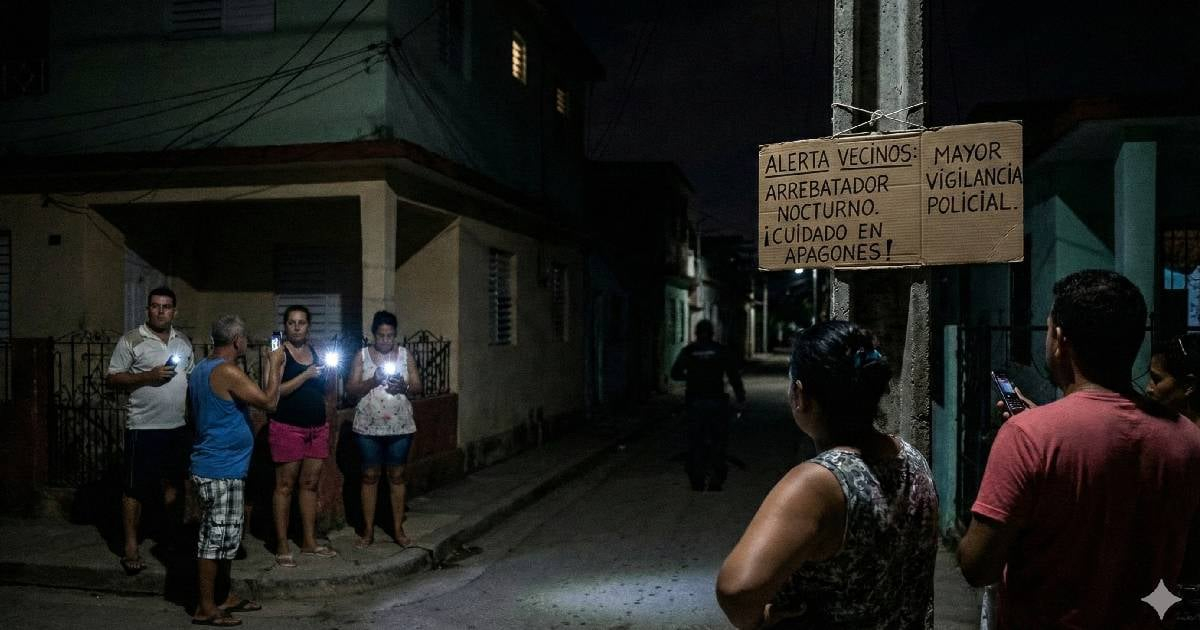
In Cuba, the gap in power generation remains alarmingly close to 2,000 megawatts (MW), showing an increase compared to previous days. This situation unfolds amidst a deteriorating scenario characterized by internal turmoil and regional instability, notably influenced by the current circumstances in Venezuela, a primary energy partner of the Cuban regime.
The official forecast by the Unión Eléctrica (UNE) for the peak hours on January 6, 2026, anticipates an available capacity of 1,533 MW against a maximum projected demand of 3,300 MW. This discrepancy would result in a deficit of 1,767 MW and potentially affect up to 1,797 MW during peak consumption periods.
During the evening peak, there is an expectation for partial restoration of several units, including 65 MW from unit 1 of the Santa Cruz CTE, unit 5 of the Nuevitas CTE, unit 1 of the Felton CTE with 125 MW (still in startup phase), and 48 MW from Regla's Patana engines. However, these additions fall short of meeting the national demand.
Enduring Disruptions and Worsening Service
The Informative Note on the State of the National Electric System (SEN) reveals that service disruptions began at 5:16 a.m. the previous day, with no recovery achieved throughout the early hours. The most significant impact occurred at 6:20 p.m., reaching 1,863 MW, surpassing planned levels due to the unexpected shutdown of unit 5 at the Nuevitas CTE and higher than anticipated demand.
As of 6:30 a.m. on Tuesday, SEN's availability was a mere 1,240 MW, against a demand of 2,192 MW, leading to a 965 MW shortfall, with a midday forecast predicting 1,100 MW of impact.
Breakdowns, Maintenance Issues, and Fuel Shortages
The UNE report confirms that the primary reasons for the deficit continue to be multiple breakdowns in thermoelectric plants, prolonged maintenance activities, and fuel shortages, a structural issue showing no signs of short-term resolution.
Breakdowns include:
- CTE Mariel (unit 5)
- CTE Nuevitas (unit 5)
- CTE Santa Cruz (unit 1)
- CTE Felton (units 1 and 2)
Currently undergoing maintenance:
- CTE Santa Cruz (unit 2)
- CTE Carlos Manuel de Céspedes in Cienfuegos (unit 4)
Furthermore, 441 MW are offline due to thermal generation limitations, and 1,159 MW are affected by fuel issues, including: 97 distributed generation plants (860 MW), 48 MW in Regla's Patana, 106 MW in the Moa Fuel Center, and 145 MW unavailable due to lubricant shortages.
A Grim Outlook
Despite government claims highlighting the contribution of 34 photovoltaic solar parks, which generated 2,884 MWh with a peak of 560 MW, this output remains inadequate to offset the thermal system collapse and fuel scarcity.
With extended blackouts, persistent deficits, and increasing external vulnerabilities, Cuba's energy landscape appears increasingly bleak, as authorities have yet to propose structural solutions that could foresee a tangible improvement in the electric service in the near future.
Understanding Cuba's Energy Deficit
What are the main factors contributing to Cuba's energy deficit?
Cuba's energy deficit is primarily caused by breakdowns in thermoelectric plants, extended maintenance periods, and significant fuel shortages.
How does the situation in Venezuela affect Cuba's energy crisis?
Venezuela, as a key energy ally, influences Cuba's energy crisis since instability in Venezuela can disrupt energy supplies to Cuba, exacerbating the deficit.
Are renewable energy sources helping to alleviate the energy crisis in Cuba?
While renewable sources, like photovoltaic solar parks, contribute to the energy mix, their output is insufficient to significantly mitigate the ongoing energy crisis in Cuba.