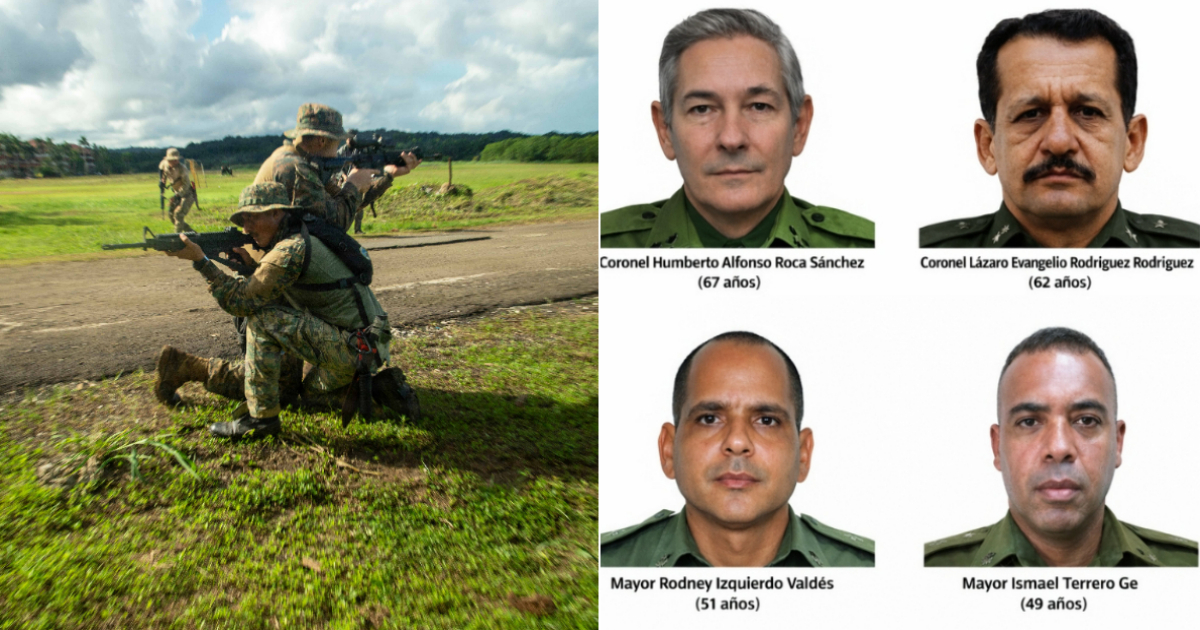
The release of an official list featuring the names and images of 32 Cuban soldiers killed in Venezuela during the capture of Nicolás Maduro has ignited a storm of reactions on social media. The list, distributed by the Havana regime through state media and circulated by CiberCuba Noticias, has provoked widespread outrage, sarcasm, and sorrow among users.
Within just hours, the post garnered over 30,000 views and hundreds of comments, becoming a hot topic of debate since the Cuban regime first acknowledged its military presence in Venezuela.
A significant portion of the feedback highlighted the regime's hypocrisy, which for years had vehemently denied its military involvement in Venezuela. "They denied it all along, and now they publish their photos in uniform," one user remarked, while another sarcastically noted, "According to Bruno Rodríguez, there were no Cuban troops in Venezuela; now there are 32 dead. How do they explain that?"
Critics also condemned the mission's mercenary nature: "The Cuban government doesn't send soldiers on principle; they sell them. They died defending Maduro, not Cuba," a commentator stated, describing the event as "human trafficking in uniform."
Divisive Reactions
Many responses were openly hostile. "Thirty-two spies less," one user wrote, while another added, "God is just; the same ones who beat the people on 11J died." Several compared the operation to a vendetta: "They were sent to die; they knew too much."
Nonetheless, some called for empathy. "They were human beings, Cubans with families; in times like these, we must show compassion," a woman from Havana urged. Others mourned the loss of young lives sent to "die for a country that wasn't theirs."
Voices of Criticism and Disillusionment
The most shared comment came from historian Jorge L. León, who deemed it "indecent" to label the fallen as heroes: "They didn't die for the homeland or sovereignty; they died defending a foreign dictator. That's not heroism; it's mercenary work forced by hunger," he wrote.
There was also space for mockery and disillusionment. "I thought they were young, but they look like they came from a nursing home," one user joked. Another summed up the prevailing sentiment: "The lie blew up in their face. For years they talked about doctors; today they show colonels."
The official announcement, far from unifying the nation, reignited the divide between those who support "internationalist solidarity" and those who see these events as proof that Havana exploits its citizens' lives as bargaining chips.
While the regime attempts to glorify these deaths, the outrage on social media tells a different story: that of a people who no longer believe in the symbols of an exhausted revolutionary epic.
As one commentator expressed, "They died as victims of a system that impoverished, deceived, and sacrificed them. And that's something the government will never admit."
Understanding the Impact of Cuban Military Presence in Venezuela
Why did the Cuban regime deny military presence in Venezuela?
The regime likely denied military presence to maintain an image of non-intervention and to avoid international criticism while supporting Nicolás Maduro's government.
How has social media reacted to the list of fallen soldiers?
Social media has erupted with anger, sarcasm, and sorrow, highlighting the perceived hypocrisy and condemning the mission as mercenary.
What are the implications of the Cuban regime's official statement?
The official statement has sparked renewed controversy, revealing deep societal divisions over Cuba's involvement in Venezuela.