The Cuban regime has released the identities of 32 Cuban nationals who lost their lives on January 3 during a U.S. attack in Venezuela, part of the military operation that concluded with Nicolás Maduro's capture.
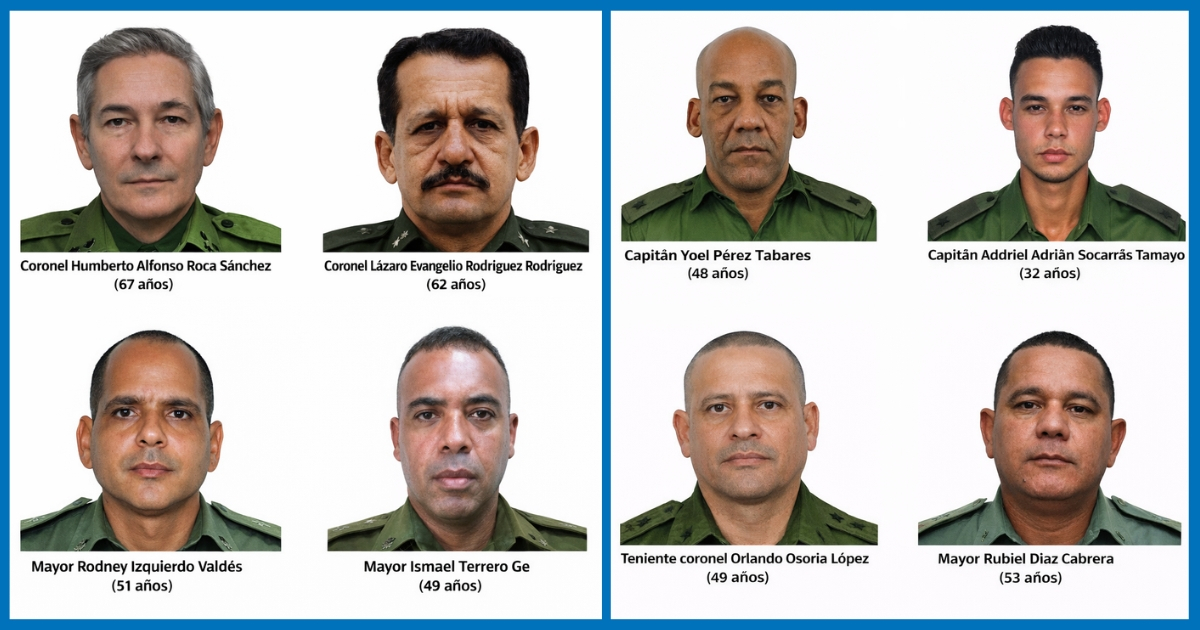
On Monday, pro-government journalist Lázaro Manuel Alonso shared on social media the photographs and names of the Cuban soldiers who were serving as personal security for the dictator, an ally of Havana.
According to the post, the troops—members of the Revolutionary Armed Forces (FAR) and the Ministry of the Interior (MININT)—were on missions at the request of their Venezuelan counterparts, thus officially confirming the Cuban military's presence in the South American nation, a fact Havana had denied for years.
The list features senior officers, captains, lieutenants, and soldiers aged between 26 and 67. Among them are Colonels Humberto Alfonso Roca Sánchez and Lázaro Evangelio Rodríguez Rodríguez, as well as Majors Ismael Terrero Ge, Rodney Izquierdo Valdés, and Rubiel Díaz Cabrera.
The names were published alongside their official portraits, marking Cuba's first public acknowledgment of the scale of casualties suffered during the operation. According to the Ministry of the Interior, the Cubans "fell in direct combat or as a result of bombings" and were hailed as "heroes who proudly upheld the spirit of solidarity of millions of compatriots."
Official List of Deceased Combatants During Maduro's Capture
MININT Combatants
- Colonel Humberto Alfonso Roca Sánchez (67 years old)
- Colonel Lázaro Evangelio Rodríguez Rodríguez (62 years old)
- Major Rodney Izquierdo Valdés (51 years old)
- Major Ismael Terrero Ge (47 years old)
- Captain Yoel Pérez Tabares (48 years old)
- Captain Adriell Adrián Socarrás Tamayo (32 years old)
- Lieutenant Colonel Orlando Osoria López (49 years old)
- Major Rubiel Díaz Cabrera (53 years old)
- Major Hernán González Perera (43 years old)
- Captain Bismar Mora Aponte (50 years old)
- First Lieutenant Yorlenis Revé Cuza (38 years old)
- First Lieutenant Alejandro Rodríguez Royo (35 years old)
- First Lieutenant Erdwin Rosabal Ávalos (35 years old)
- First Lieutenant Daniel Torralba Díaz (34 years old)
- Lieutenant Yasmani Domínguez Cardero (32 years old)
- Lieutenant Fernando Antonio Báez Hidalgo (26 years old)
- First Lieutenant Yandrys González Vega (45 years old)
- First Lieutenant Yordanys Marlonis Núñez (43 years old)
- First Lieutenant Yunior Estévez Samón (32 years old)
- Lieutenant Yoandys Rojas Pérez (46 years old)
- First Sub-officer Giorki Verdecia García (30 years old)
Revolutionary Armed Forces Combatants
- Captain Adrián Pérez Beades (34 years old)
- Senior Sub-officer Suriel Godales Alarcón (42 years old)
- Retired Soldier Adelkis Ayala Almenares (45 years old)
- Retired Soldier Alexander Noda Gutiérrez (48 years old)
- Retired Soldier Ervis Martínez Herrera (52 years old)
- Retired Soldier Juan Carlos Guerrero Cisneros (55 years old)
- Retired Soldier Juan David Vargas Vaillant (54 years old)
- Retired Soldier Rafael Enrique Moreno Font (35 years old)
- Retired Soldier Luis Alberto Hidalgo Canals (57 years old)
- Retired Soldier Luis Manuel Jardines Castro (59 years old)
- Retired Soldier Sandy Amita López (37 years old)
This announcement follows a national mourning decree by Miguel Díaz-Canel, which declared two days of mourning for the fallen and suspended all festive activities across the country.
The official disclosure starkly contrasts with Cuba's long-held narrative, which denied any military presence in Venezuela and claimed their cooperation was limited to sending doctors and civilian advisors.
This public acknowledgment of the deceased—referred to as "combatants of the FAR and MININT on international missions"—signals a significant shift in Havana's rhetoric and raises questions about the true nature of these "missions" amid the tense climate between Caracas and Washington.
Key Questions About Cuban Military Presence in Venezuela
Why did the Cuban regime deny military presence in Venezuela for years?
The Cuban government likely denied military presence to maintain a narrative focused on humanitarian aid and diplomatic relations, avoiding international scrutiny and criticism.
What does the public acknowledgment of Cuban casualties signify?
The acknowledgment marks a shift in Cuba's public stance, possibly indicating a change in policy or strategy, and highlights the regime's commitment to its ally, despite potential international backlash.