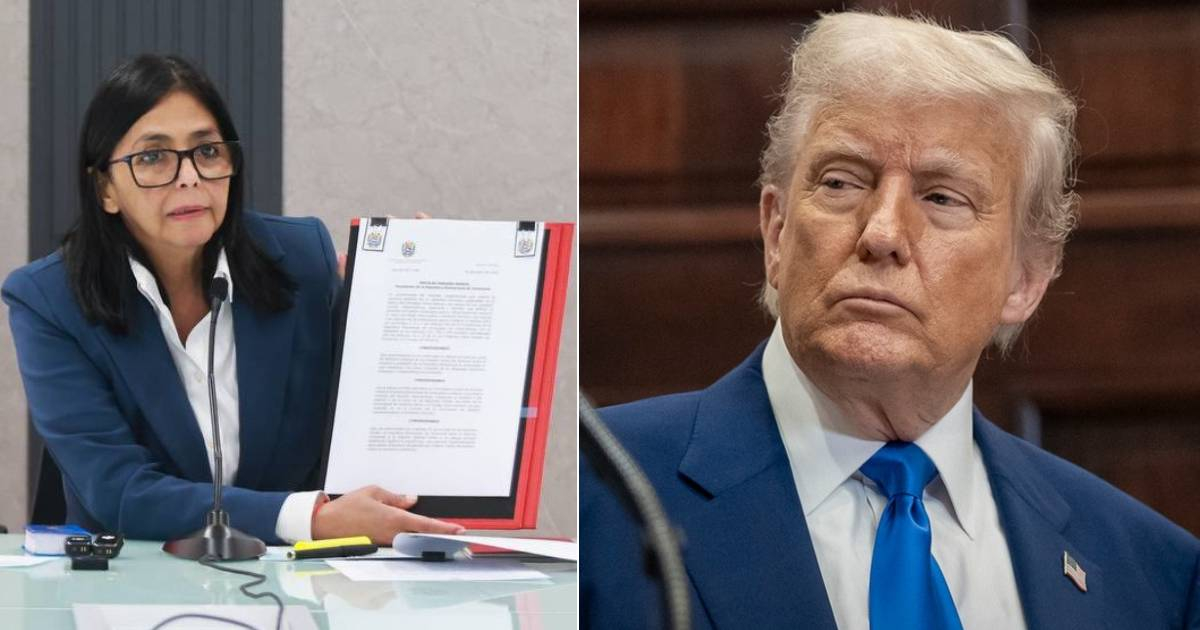
In a recent statement, Donald Trump characterized Delcy Rodríguez as maintaining active communication with Washington, with her continued authority in Venezuela hinging on her cooperation with the United States amidst ongoing political and military pressure on the nation.
During an interview with NBC News, the former U.S. president highlighted Rodríguez's collaboration with his administration following the capture of Nicolás Maduro, who was apprehended in Caracas and transferred to New York to face charges related to narcoterrorism.
Rodríguez, a prominent figure in the Chavista regime, was sworn in as acting president on Monday, a process heavily influenced by direct U.S. intervention.
While Trump refrained from acknowledging Rodríguez as a legitimate political interlocutor, he emphasized the absence of any prior coordination with Venezuelan factions before Maduro's ousting.
Trump clarified there was no advance communication with Rodríguez's team, though he admitted that "many people wanted to reach a deal," leaving open the possibility of future negotiations.
As reported by Politico, the Trump administration has outlined specific demands for Rodríguez to avoid Maduro's fate. These include curbing drug trafficking to the U.S., expelling Iranian, Cuban, and other agents viewed as hostile by Washington, and halting oil sales to American adversaries.
Officials quoted by the media outlet noted that Washington also expects Rodríguez to eventually facilitate elections and step down, although no timeline has been set.
During his NBC interview, Trump left the status of the sanctions on Rodríguez unresolved, stating that his administration would assess whether to maintain or lift them in the coming days.
This stance places the new Venezuelan leader under a form of political oversight, dependent on her willingness to continue cooperating with Washington.
Trump went further, warning that the U.S. is prepared for military action should Rodríguez cease cooperation. Although he expressed doubt about the necessity, he acknowledged that a second intervention had been considered by his administration, amplifying the direct pressure on Caracas's new leadership.
Trump also declined to confirm any personal conversations with Rodríguez but noted that Secretary of State Marco Rubio maintains a "very strong" relationship with her, communicating in Spanish, thereby confirming the existence of active diplomatic channels, though controlled from Washington.
Trump's remarks portray Delcy Rodríguez as a temporary figure, tolerated as long as she serves U.S. interests, lacking genuine political backing. Her leadership, according to Trump, remains tied to monitored cooperation and the looming threat of further intervention in Venezuela.
Key Questions on Delcy Rodríguez and U.S. Relations
What are the U.S. demands for Delcy Rodríguez to avoid Maduro's fate?
The U.S. demands include stopping drug trafficking to the United States, expelling Iranian, Cuban, and other hostile agents, and ceasing oil sales to American adversaries.
Is there a timeline for Delcy Rodríguez to facilitate elections and step down?
No specific timeline has been set for Rodríguez to facilitate elections and step down.
Has Trump spoken directly with Delcy Rodríguez?
Trump did not confirm any direct conversations with Rodríguez, but noted that Secretary of State Marco Rubio has a strong relationship with her.