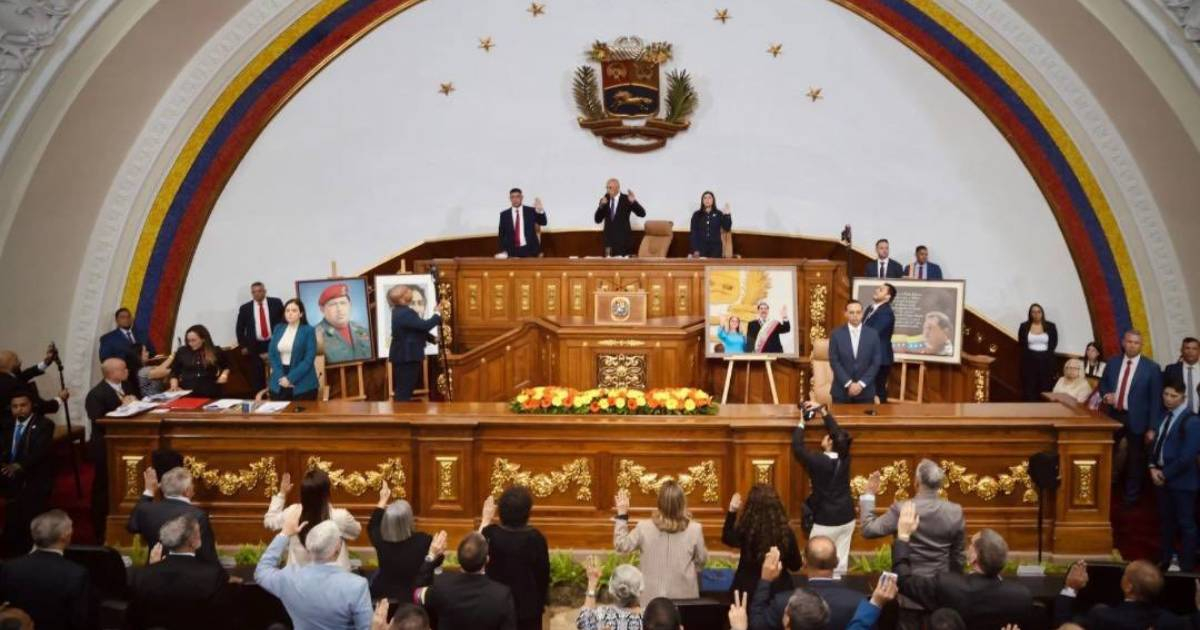
As Delcy Rodríguez was inaugurated on Monday as Venezuela's interim president in front of a chavismo-controlled National Assembly, a starkly different scene unfolded in the streets and corridors of the Legislative Palace. At least fourteen journalists and media workers were detained by state security forces in Caracas, casting a shadow over the day's events.
The National Union of Press Workers (SNTP) confirmed the detentions, noting that eleven of those arrested were affiliated with international media and agencies, while one worked for a national outlet. Although four were released a few hours later, at least ten individuals remain in custody, with several cases described by the union as enforced disappearances.
These arrests occurred during the coverage of the new session of the National Assembly, coinciding with Rodríguez stepping into power following Nicolás Maduro's capture in the United States.
According to the SNTP, journalists were banned from live broadcasting, recording videos, or taking photographs, marking the beginning of a control and persecution operation.
Within the Legislative Palace itself, agents from the General Directorate of Military Counterintelligence (DGCIM) apprehended at least three journalists. They were taken to the National Guard's command center located at the site, where their cell phones underwent thorough inspections.
Officers demanded access codes and examined photos, contacts, private conversations, voice notes, Instagram accounts, emails, and even cloud-stored files.
The case of journalist Daniel Álvarez, a reporter for Televen, highlighted the severity of these actions. According to SNTP, Álvarez lost control of his phone while officials left the room where he was held before his release.
The media union argues that these practices not only breach privacy and professional confidentiality but also reinforce a pattern of criminalizing journalism in Venezuela.
The day, which was supposed to herald a new political era following Maduro's arrest, instead turned into a show of force against the press. While speeches inside the chamber focused on peace, dignity, and sovereignty, outside, reports of censorship, intimidation, and repression were rampant.
In a statement released on the same day, the SNTP warned that discussions of democratic transition are moot as long as political persecution, censorship, and arbitrary detentions continue.
The union reminded the public that at least 23 journalists and media workers are currently imprisoned, and over 60 media outlets remain blocked online.
For many Venezuelans, both within the country and abroad, the image is clear: a presidential oath aired by official media, with reporters detained for attempting to report the truth. It underscores the notion that, even amid unprecedented political upheavals, controlling information remains a top priority for those in power in Caracas.
Key Concerns About Press Freedom in Venezuela
Why were journalists detained in Caracas during Delcy Rodríguez's presidency assumption?
Journalists were detained to prevent them from broadcasting, recording, or photographing the events, reflecting a broader effort to control and suppress media coverage.
How did the SNTP describe the situation of detained journalists?
The SNTP described the situation as a pattern of criminalizing journalism, with some cases being labeled as enforced disappearances, highlighting severe breaches of privacy and professional confidentiality.