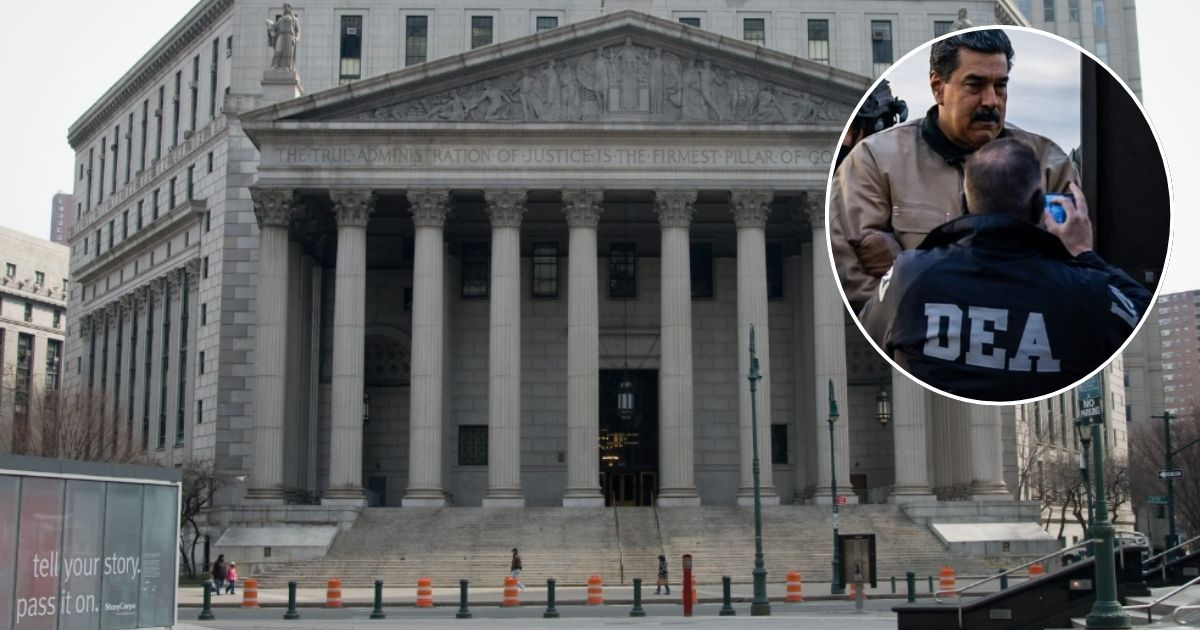
This past Monday, Nicolás Maduro appeared in a federal court in New York, using his first hearing to paint himself as a victim, declare himself the "president of Venezuela," and condemn what he called a "kidnapping" by the United States.
The scene, as depicted by several journalists present, revealed a mix of political defiance, human tension, and a meticulously crafted narrative for the judicial stage.
According to CNN reporter Laura Coates, Maduro appeared "assertive" and "confident," his voice steady and his words deliberate. Speaking in Spanish with an interpreter's aid, he described himself as "innocent" and "a decent man," while asserting that he was taken from his home in Caracas and treated like a "prisoner of war."
Coates noted that the Chavista dictator frequently took notes and tapped the table with his fingertips, projecting an image of control and resolve.
The use of an interpreter, as explained by CNN senior legal analyst Elie Honig, might have allowed Maduro to extend his responses beyond the judge's questions. Honig pointed out that since he wasn't speaking English directly, the judge had to wait for the full translation before intervening, complicating efforts to curb a speech that was more political than procedural.
In this setting, Maduro not only addressed formal inquiries but also reiterated his themes of innocence, legitimacy, and persecution.
Additional insights were offered by journalist Carla Angola TV from the courtroom. She reported that Maduro carried a notebook to jot down the judge's remarks and even requested to take those notes to his cell, a request that was denied.
During the hearing, the judge asked the prosecution to disclose evidence while the defense emphasized questioning the legality of the detention rather than seeking bail.
The defense attorney argued that both Maduro and his wife, Cilia Flores, sustained physical injuries and medical issues following their capture, including bruises and possible rib fractures.
The defense strategy aims to portray the capture as a breach of Venezuelan sovereignty and seek immunity by claiming the detention took place in a "sovereign state."
An extensive analysis published by El País corroborated that Maduro and Flores pleaded not guilty to four federal charges related to narcoterrorism levied by U.S. authorities.
Under guard and clad in prison attire, both appeared before Judge Alvin Hellerstein, who scheduled the next hearing for March 17.
Outside the courthouse, tensions ran high as well. While Chavismo supporters demanded Maduro's release, exiled Venezuelans voiced their outrage. A CNN producer witnessed a man in the courtroom shouting in Spanish that Maduro would "pay for what he did to Venezuela." Maduro replied by pointing skyward, asserting he was "a man of God" and the country's president.
Key Insights on Nicolás Maduro's Court Appearance
What was Nicolás Maduro's demeanor in the courtroom?
Maduro appeared assertive and confident, speaking with a steady voice and deliberate words, as observed by CNN's Laura Coates.
How did the use of an interpreter affect the proceedings?
The use of an interpreter allowed Maduro to extend his responses, as the judge had to wait for the complete translation, complicating efforts to limit his speech.
What is the defense's strategy regarding Maduro's detention?
The defense aims to challenge the legality of Maduro's capture, portraying it as a violation of Venezuelan sovereignty and seeking immunity.