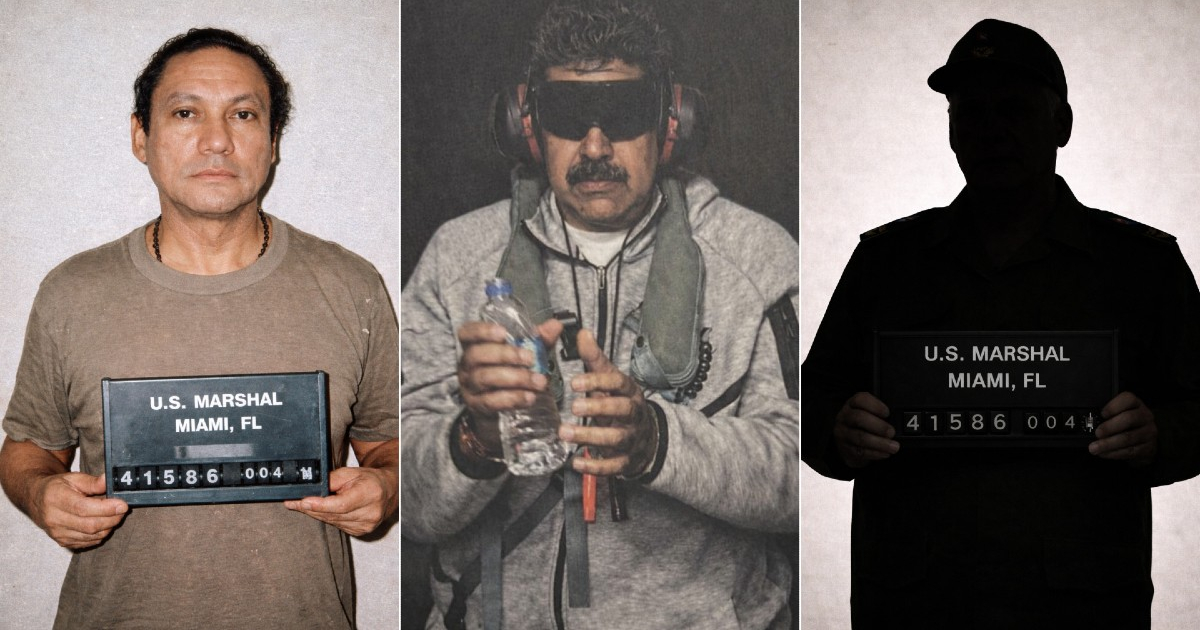
Dictatorships often operate under a dangerous delusion: mistaking longevity for immunity. They believe that time is their shield, that their uniforms grant them invulnerability, and that fear can replace legitimacy. Yet, history repeatedly demonstrates otherwise: impunity is fragile, and military power doesn't always hold up when the moment of reckoning arrives.
Manuel Noriega ruled under the belief that he had full control. With armed forces, intelligence services, and an effective repressive apparatus, he seemed untouchable. Nonetheless, when the balance shifted, all that power vanished. The military couldn't protect him. Sovereignty offered no defense. Ultimately, he found himself out of the country, facing a foreign court.
Nicolás Maduro has walked a similar path. For years, he appeared unassailable, supported by generals, military parades, and slogans. However, military power in dictatorships is often vertical and dependent, efficient at suppressing civilians but ineffective against firm external decisions. When the decisive blow comes, the chain of command collapses, and the leader realizes he wielded less authority than he believed.
The so-called "great military power" of Venezuela didn't fire a single missile or launch a single plane. Not because they weren't available, but because the real power wasn't there when it was needed. The muscle flexed over the years proved to be mere theatrics—suitable for parades and internal repression, but useless against a resolute external decision.
The saying isn't just a phrase; it's a warning. Those who ignore advice neither grow old nor end well. For other dictatorships that still see themselves as eternal, the lesson is simple and urgent: listen in time, withdraw, or negotiate while there is still room to do so. Because there is always a moment when a dignified exit is possible. Beyond that threshold, decisions are no longer made at home.
History presents two paths. One leads to a negotiated transition, imperfect yet self-determined. The other ends far from home, handcuffed and standing before a judge in the United States.
Choosing is not a sign of weakness. It's the last act of true power.
Understanding the Fragility of Dictatorial Power
What is the common misconception dictators have about power?
Dictators often mistakenly believe that the duration of their rule equates to immunity and that fear and military might can replace legitimate authority.
How did Noriega's belief in his control lead to his downfall?
Noriega thought his control over the military and intelligence services made him invincible, but when the geopolitical context changed, his supposed power evaporated, leaving him vulnerable to foreign legal action.
Why did Venezuela's military fail to act when needed under Maduro's rule?
Despite having military resources, Venezuela's military did not respond because the real power was not there when external threats demanded action, revealing the facade of their might.