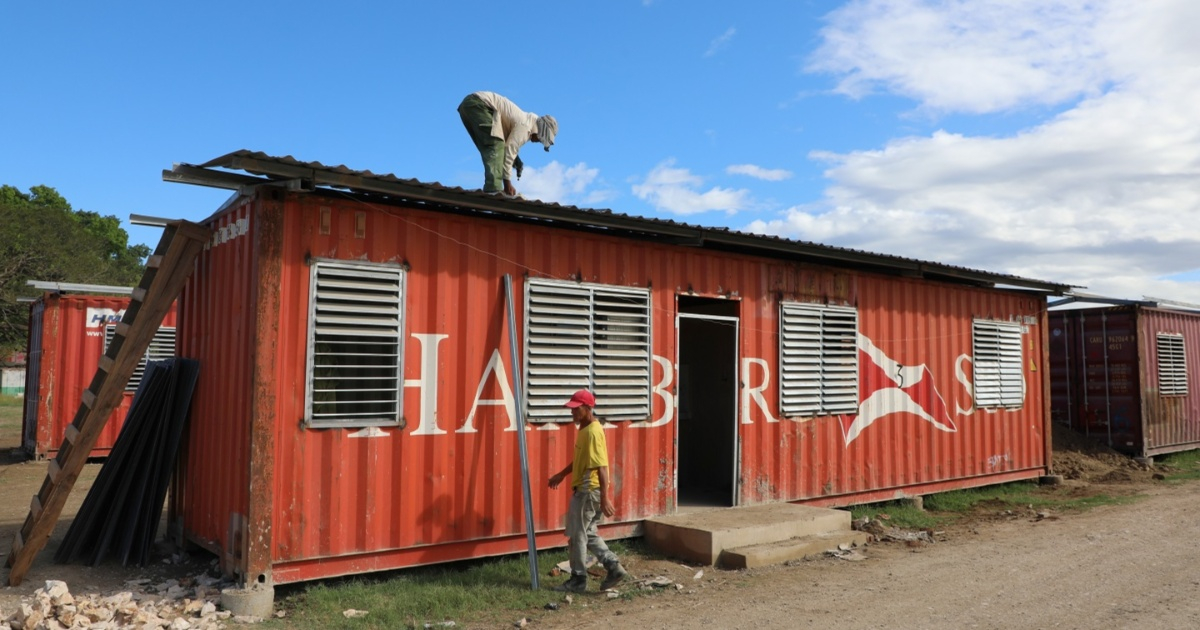
In Guantánamo, families displaced by natural disasters are being provided with homes made from shipping containers. However, these are not being given as donations; instead, recipients must purchase them at a price exceeding the bank valuation of traditional homes.
According to the state-run newspaper Venceremos, the cost of the container must be borne by the recipient "according to the approved budget," while the government covers the expenses for urbanization and other associated costs.
The project projects an expenditure of approximately 900,000 Cuban pesos (CUP) per unit, although the "final cost" is still being fine-tuned. The payment process will be determined "later" in collaboration with the banking system in a "mutual negotiation and understanding," following the usual procedures of the housing program.
The official report clarifies that these are not donations; they are "state-owned homes with public funding."
Although the beneficiary must assume the cost of the container as per the budget, the specifics of the financing method—including the number of installments and conditions—remain undefined publicly and will be established later with the banking system.
As per the released information, this initiative aims to provide a solution for families who have suffered total property loss and is part of the state's housing investment plan. It utilizes repurposed containers originally used to import solar panels for photovoltaic parks, which are then converted into residential units.
Currently, the province is constructing 70 container homes across three municipalities:
- San Antonio del Sur: 15 homes in the Buenavista settlement
- Guantánamo: 20 homes in the Cabaña Mariana community
- Imías: 35 homes near the "Airport" area
All these homes are earmarked for families who suffered total losses due to hurricanes Oscar and Melissa, as well as heavy rains in September.
The 900,000 Peso Cost and Public Debate
An internet user, Yulieta Hernández Díaz, highlighted the 900,000 CUP estimate as a reference point and compared it to the average monthly salary of 6,685.3 CUP. Her analysis illustrates the time required to pay off the home under various scenarios (allocating 100%, 50%, 30%, or 20% of one's salary).
She noted that if a person dedicated 100% of their salary to paying for the home, it would take 135 months (11 years and two months) to complete the payment. If only 50% of the salary were used, it would extend to 22.5 years, and with 30%, it would take 37.5 years.
"This isn't just an individual problem; it's a structural symptom of an economy where the costs of essential goods are completely disconnected from real incomes," she wrote.
She emphasized that the cost of container homes is higher than the bank's valuation for conventional masonry houses, which, according to the official resolution, averages around 225,000 CUP.
Design and Features of the Container Homes
The container home model is based on a 12-meter-long container, offering a usable area of approximately 29 square meters, designed to accommodate families of up to four people. The layout includes two bedrooms, an interior bathroom, a kitchen with a countertop, a living-dining area, natural ventilation, and water and electrical installations.
For insulation against heat, the design incorporates internal insulation (wooden frames and melamine panels) and a separate roof creating an air chamber. Additionally, the homes feature eight windows for ventilation.
The homes are elevated and integrated into settlements with urbanization, drainage, access, and basic services. As stated in the official explanation, "the project is not limited to the house."
Furniture is not mandatory; each family has the option to acquire it. In cases of social vulnerability, the state may cover this cost as part of its assistance, according to the report.
Understanding the Container Housing Initiative in Guantánamo
Why are container homes more expensive than traditional houses in Guantánamo?
Container homes are priced higher than traditional houses due to the costs associated with repurposing shipping containers for residential use and covering urbanization expenses. The pricing reflects the state's investment in this housing solution.
How are families expected to finance these container homes?
The financing method for container homes will be determined through negotiations with the banking system, although specific terms and conditions are yet to be publicly detailed.
What features do these container homes include?
The container homes offer two bedrooms, a bathroom, a kitchen, a living-dining area, and are equipped with natural ventilation and necessary installations. They are designed for families of up to four people.