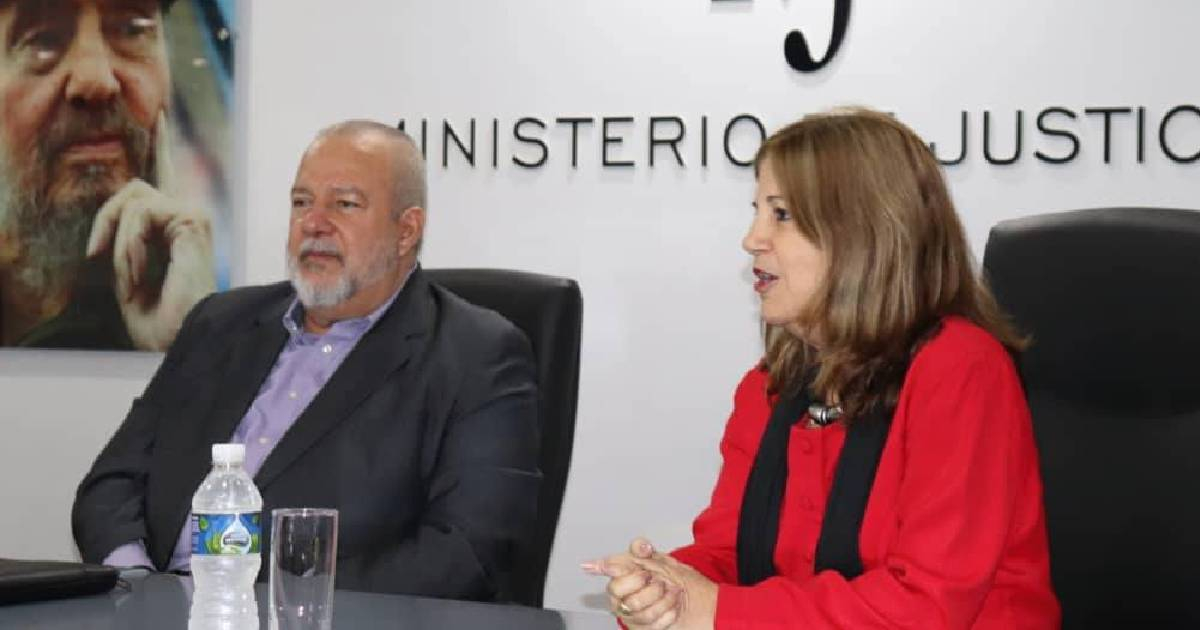
This Tuesday marked the official appointment of Rosabel Gamón Verde as Cuba's new Minister of Justice. The ceremony, held at the Ministry of Justice headquarters in Havana, was led by Prime Minister Manuel Marrero Cruz.
The event, shared by the institution on its official Facebook page, was characterized as a "handover and reception of the position," which the official statement described as showcasing "solidity, transparency, and continuity."
Among the attendees were high-ranking regime officials, including the new president of the People's Supreme Court, Óscar Manuel Silvera Martínez, who recently held the position of Minister of Justice himself.
The Ministry of Justice emphasized a sense of institutional continuity in its announcement, stating, "We build on past achievements to set new work horizons. Our bond with the People's Supreme Court is reinforced, and we will advance with a unified goal: to serve Cuba and its people."
The appointment of Gamón Verde comes just two weeks after Miguel Díaz-Canel declared a series of changes within the country's judicial and political leadership. These changes included the departure of veteran magistrate Rubén Remigio Ferro from the presidency of the People's Supreme Court and the transfer of Silvera Martínez to that position.
This leadership reshuffle is part of a broader wave of resignations and reassignments within the state apparatus, occurring amid a severe economic crisis, widespread power outages, and growing public discontent.
Analysts assert that these changes are not indicative of genuine renewal but rather reflect the regime's need to restructure its control mechanisms.
Recent departures include Ulises Guilarte de Nacimiento, former secretary of the Cuban Workers' Central (CTC), and Ricardo Rodríguez González, former president of the University Student Federation (FEU), whose resignation has been interpreted as a sign of generational fractures within the regime's organizations.
The appointment of Rosabel Gamón Verde—who previously served as the first vice minister of the department—reinforces the "continuity" narrative promoted by Díaz-Canel. However, it comes at a time when the institutional credibility of Cuba's judicial system is profoundly compromised.
In recent years, the Ministry of Justice and the courts have been criticized for their role in judicial repression against protesters, activists, and dissidents, particularly following the July 11, 2021, protests.
International organizations and human rights groups have consistently condemned the lack of judicial independence in Cuba, pointing out its direct subordination to the Communist Party.
Insights on Cuba's Judicial Changes
What prompted the appointment of a new Minister of Justice in Cuba?
The appointment is part of a series of leadership changes announced by Miguel Díaz-Canel, aimed at restructuring the country's judicial and political landscape amidst a deepening crisis.
How have international bodies reacted to Cuba's judicial system?
International organizations and human rights groups have criticized the Cuban judicial system for its lack of independence and its role in repressing dissent, highlighting its direct control by the Communist Party.
Who are some of the key figures affected by the recent leadership changes in Cuba?
Key figures include Rubén Remigio Ferro, who was replaced as president of the People's Supreme Court, and Óscar Manuel Silvera Martínez, who transitioned from Minister of Justice to this role.