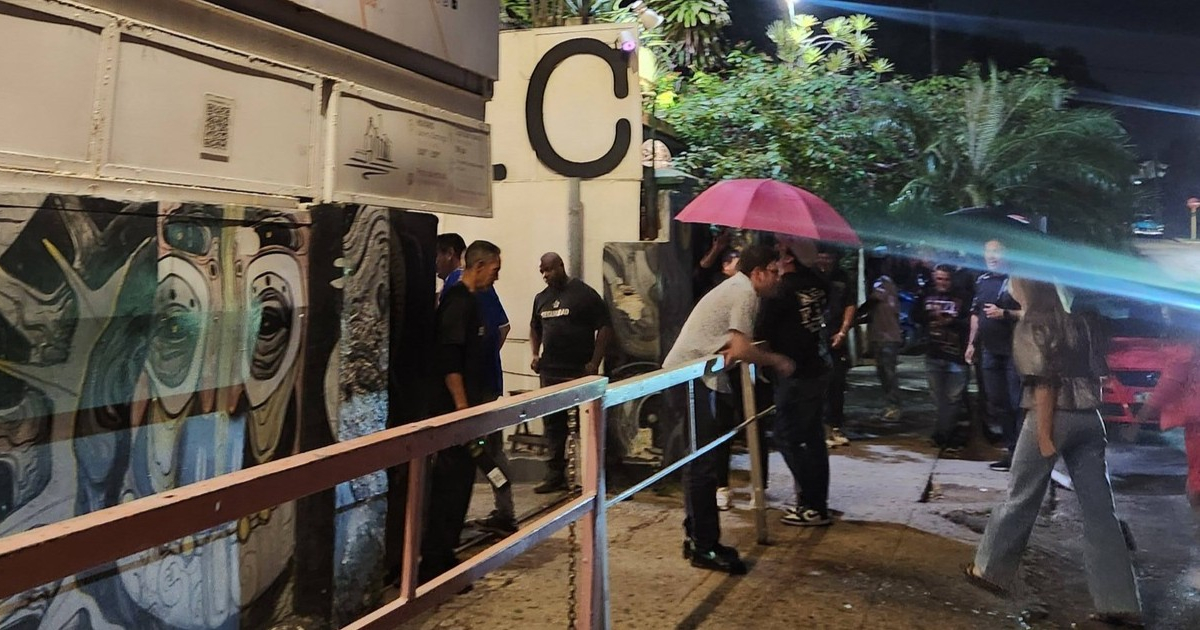
A social media post has sparked intense discussions over alleged racial and national discrimination at one of Havana's most iconic cultural venues, the Cuban Art Factory (FAC).
Alejandro Bridon Mesa shared his experience from the night of December 26th, around 10:00 pm, when he and two friends were denied entry without explanation, under the guise of the so-called "right of admission."
According to his Facebook post, the group chose to visit the venue to celebrate a friend's birthday. They selected the FAC for its reputation as an inclusive, diverse, and open space. However, their encounter, he claims, unveiled the deep-rooted inequalities in Cuban society.
Bridon Mesa described how they waited in line like everyone else. He observed that those ahead of them, who appeared to be foreigners or white, were granted access without any issues.
When it was their turn, a staff member—described as a black man—separated them from the queue and informed them they couldn't enter, citing "right of admission." No further justification was provided.
Faced with the lack of explanation, Bridon Mesa sought reasons for the decision and attempted to clarify that they were there for a birthday celebration, asking for at least a rationale. His inquiries went unanswered.
During this interaction, he noted that another black woman was initially barred entry but was allowed in after clarifying she wasn't Cuban, reinforcing the notion of differential treatment based on race and nationality.
For Bridon Mesa, the most painful aspect wasn't just being denied entry but the manner in which it happened, as if they didn't even deserve an explanation. "It was as if our presence was uncomfortable, unwanted, invisible," he expressed.
He believes this silence acts as a form of humiliation and denial of dignity, reflecting a system that normalizes exclusion. Bridon stated, "The so-called 'right of admission' is meant to protect security and order in public or private spaces. However, in practice, it turns into an arbitrary mechanism that legitimizes discrimination. Without an explanation, the suspicion remains that we were turned away for being black or Cuban."
"What happened that night illustrates how even in spaces that promote culture and openness, colonial and racist logic persists. Foreigners are favored, whites are favored, and black Cubans are marginalized," he added.
Bridon Mesa emphasized that the actions of the black staff member were more than just an individual gesture; they were indicative of a system that teaches Cubans to reject each other, even when they share the same race. "It's the violence of exclusion masked as administrative policy," he remarked.
His post concluded with a plea to resist normalizing such practices and to regulate the "right of admission" transparently, ensuring it doesn't become an excuse for discrimination. He called for culture to serve as a domain that dignifies, embraces, and includes, rather than a realm of privilege for some and exclusion for others.
"What we experienced that night at the Cuban Art Factory is a reminder of the significant societal changes still needed. Opening physical doors isn't enough if the doors of respect and dignity remain closed," he concluded.
Key Questions on Discrimination at Cuban Art Factory
What is the "right of admission" and how is it applied?
The "right of admission" is a policy intended to maintain security and order in public or private spaces. However, it can be misused as an arbitrary tool for discrimination, as alleged in this incident at the Cuban Art Factory.
How did the incident at the Cuban Art Factory highlight societal issues in Cuba?
The incident underscored deep-seated racial and national inequalities in Cuba, showing how even cultural venues with reputations for openness can perpetuate colonial and racist biases by prioritizing foreigners and white individuals over black Cubans.