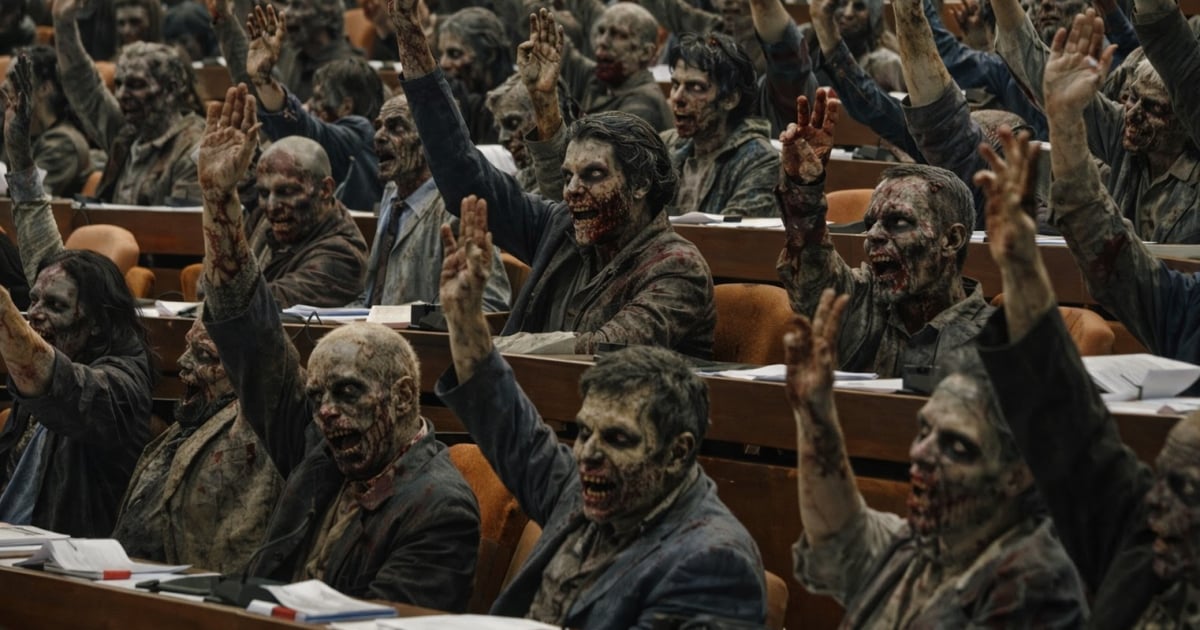
In Cuba, the sight of unanimous decisions has lost its shock value long ago. What would truly be astonishing is a dissenting vote. Every parliamentary session unfolds like a rehearsed ritual: hands raised in unison, blank faces, and an obedience that requires no explanation. There is no real debate, only reflexes at play. Thus, describing it as a "puppet parliament" is not poetic exaggeration but an accurate portrayal of the current state of Cuban politics.
The so-called National Assembly of People's Power resembles an institutional set rather than a legislative body. Its gatherings aren't about solving power outages, hunger, or mass migration; they merely aim to justify why these issues persist. Lawmakers raise their hands with the automatic response of those trained not to think, question, or dissent. In this theatrical setting, each vote is a predictable act.
The concept of a zombie in films—a soulless body driven by an external force—mirrors this Parliament's operations. They walk, sit, obey...yet are empty inside. This is evident in a legislature that approves 100% of laws, 100% of failing budgets, and 100% of policies that exacerbate national decline. The institutional machinery keeps moving, though critical thinking became obsolete decades ago.
While the real Cuba crumbles—with endless blackouts, long queues, and an exodus that empties the streets—the Parliament continues to vote "yes" to everything: yes to hollow rhetoric, yes to repeated lies, yes to the continuation of a worn-out model. It does so with a ritualistic solemnity, as if absolute obedience were an act of patriotic faith. They do not represent the people struggling to survive; they symbolize a system that uses them as mere props.
Unanimity, in truth, does not signify agreement. It is symptomatic of fear, political barrenness, and institutional death. Cuba lacks a living Parliament; instead, it has an assembly of the living dead who clap, smile, and obey while the country bleeds out.
Yet, even in zombie films, unexpected twists occur. Sometimes, one remembers who they were, feels something, reacts differently. If there remains even a shred of humanity in those seats, perhaps one day we will witness a hand that doesn't rise, a voice of dissent, a vote against the tide. Maybe then, for the first time in a long while, the Cuban Parliament will begin to come back to life.
Understanding Cuba's Political Landscape
What is the significance of the unanimous votes in Cuba's Parliament?
The unanimous votes in Cuba's Parliament are not indicative of genuine consensus but rather reflect a culture of fear, political sterility, and institutional death. They highlight the lack of debate and critical thinking, showcasing a system that prioritizes obedience over genuine legislative processes.
How does the Cuban Parliament's operation impact the country's issues?
The Cuban Parliament's operations, characterized by automatic approvals and lack of dissent, fail to address critical issues such as power outages, hunger, and migration. Instead, they perpetuate these problems by maintaining policies that deepen the nation's decline.
Is there hope for change within Cuba's parliamentary system?
While the current state seems bleak, there's hope that a change could emerge if even a small amount of independent thought and dissent arises within the Parliament. This could potentially lead to a more dynamic and responsive legislative body.