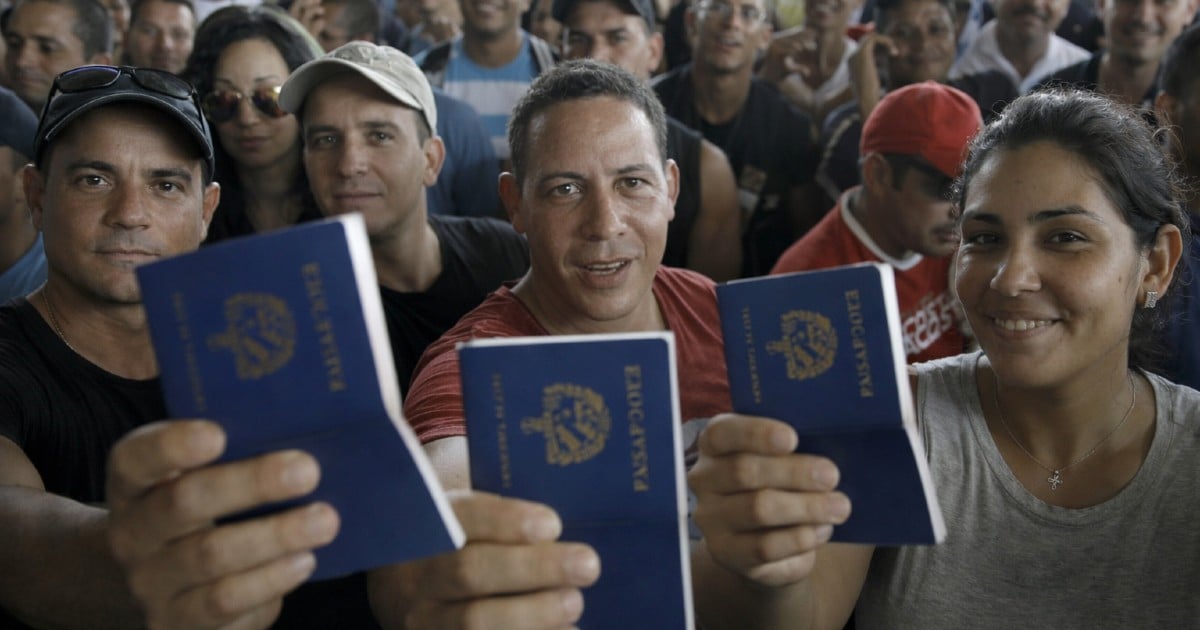
By 2025, Cuba witnessed an unprecedented demographic exodus, reshaping its population landscape. Over a million individuals have fled the island since 2021, dwindling the population from 11.3 million to an estimated 8.6 to 8.8 million, reminiscent of the mid-1980s figures. This mass departure not only reshapes the Cuban diaspora's migration map—shifting focus from the United States to countries like Brazil, Spain, and several Latin American nations—but also triggers a structural demographic crisis marked by accelerated aging, declining birth rates, a female-dominated migration flow, and a net loss of productive-age labor force.
The Migration Context: Trends and Magnitudes from 2021 to 2025The ongoing Cuban migration crisis began after the July 11, 2021 protests (11J), when government repression, a sharp decline in living standards, the collapse of essential services such as electricity, healthcare, and food supply, and the closure of traditional escape routes converged to trigger a historically significant wave of migration. Between 2021 and mid-2024, over 860,000 Cubans reached the United States alone, primarily during 2022–2023, when land routes through Central America and sea crossings in the Florida Straits reached levels unseen since the 1994 Balseros crisis.
Cuba has lost approximately 2.7 million people since 2020, reducing its populace from 11.3 million to an estimated 8.6 million. However, the Cuban government persistently refuses to release official emigration figures, claiming individuals retain "resident" status until two years abroad, creating a statistical gap that forces researchers to reconstruct migration flows from host country data. In July 2024, the National Office of Statistics and Information (ONEI) officially acknowledged a 10.1% population drop since December 2020, with the population at 10,055,968 by the end of 2023, indicating a net loss of over a million people. By late 2024, ONEI reported a further decline to 9,748,007 inhabitants, 307,961 fewer than in 2023, with a decrease rate of -30.6 per thousand inhabitants.
U.S. Migration Patterns: From Dominant Destination to Regulatory BottleneckFor decades, the United States served as the primary destination for Cuban emigrants, supported by specific policies like the Cuban Adjustment Act (1966), the lottery visa program, and recently the humanitarian parole CHNV (Cuba, Haiti, Nicaragua, Venezuela) and CBP One appointment system at the southern border. The 2021–2023 cycle mirrored this pattern: more than 220,000 Cubans arrived in fiscal year 2022, and the 2023 numbers remained high, totaling over 860,000 arrivals over four fiscal years.
However, fiscal year 2024 marked a turning point. The United States received 217,615 Cubans through all channels (land border, CBP One at entry ports, humanitarian parole, flights), a still significant number but a slowdown from previous peaks. For fiscal year 2025 (October 2024–September 2025), data from the Customs and Border Protection (CBP) showed a dramatic drop: total apprehensions at the southern border for all countries were just 237,538, the lowest since 1970, with 76% of that flow occurring in the first four months (October 2024–January 2025), under the Biden administration.
From February 2025, with Donald Trump's return to the presidency, immigration controls tightened significantly: the CBP One system for scheduling entry port appointments was canceled, deportations intensified, and a zero-tolerance rhetoric against irregular migration was reinforced. In March 2025, reports indicated only 132 Cubans illegally crossed the southern border, a minimal figure reflecting the deterrent effect of the new policies. Meanwhile, deportation flights increased: between January and November 2025, Cuba received 1,535 repatriated Cuban migrants on 52 flights from the United States and other regional countries, with at least 1,370 from the U.S.
Brazil: An Emerging Gateway for Cuban MigrantsBrazil has emerged as a symbol of the changing migration map for Cubans in 2024–2025. In 2024, Brazil became the country with the highest number of Cuban asylum applications worldwide, with 19,100–19,700 files between January and November, surpassing Mexico for the first time and nearing levels comparable to historical flows to the United States. This qualitative leap is due to several factors: the progressive closure of northern routes, established corridors from Guyana and Suriname to the Brazilian state of Roraima, the perception of relatively accessible refuge policies, and the formation of migration networks providing information, shelter, and jobs to newcomers.
In 2025, the flow to Brazil accelerated dramatically. According to the Observatory of Migrations (Obmigra), between January and October 2025, 34,909 Cuban asylum applications were recorded, nearly doubling the entire 2024 figure. In the year's first quarter, Cuban applications (9,467) surpassed Venezuelan ones (5,794) for the first time, marking a historic milestone given the Venezuelan crisis context and the massive displacement of over 8 million Venezuelans across Latin America.
The Impact of Cuban Migration: Demographic Challenges AheadThe Cuban exodus from 2021 to 2025 coincides with an advanced demographic transition that Cuba has been experiencing since the 1970s. With a total fertility rate below replacement level since 1978, high life expectancy (76 years for men, 80 for women), and a population structure dominated by the 15 to 64 age group (71.1%), Cuba already exhibited "aged country" characteristics before the current crisis.
In 2024, 25.7% of the Cuban population was 60 or older, making Cuba the most aged country in Latin America and the Caribbean. This is the only age group growing in absolute terms, while all other segments (children, adolescents, working-age adults) shrink year after year. The median age in Cuba is 42.2 years, the highest in the Americas.
The combination of massive youth emigration and declining birth rates creates a "perfect demographic storm." In 2024, Cuba recorded 71,374 births versus 130,645 deaths, nearly doubling deaths over births. The natural growth rate has been negative since 2020, and the external migration balance rate stood at -25.4 per thousand inhabitants in 2024, meaning around 25 people per 1,000 inhabitants left the country that year.
This scenario presents multiple structural challenges:
- Labor force collapse: The departure of hundreds of thousands of productive-age individuals reduces the tax base, domestic consumption, and the state's ability to finance public services. Moreover, those remaining in Cuba must bear additional eldercare burdens, pushing many women out of the formal labor market.
- Pressure on pension and healthcare systems: With an aged population representing over a quarter of the total, Cuba's social security system faces unsustainable dependency, with fewer active workers per retiree.
- Distortion of fertility indicators: The emigration of women of childbearing age artificially inflates the total fertility rate and, above all, the relative weight of adolescent fertility, creating statistical distortions that mask the population's true reproductive level.
- Rural depopulation and aging: Internal migration from rural areas to Havana and other cities, combined with the international emigration of young people from all regions, leaves the Cuban countryside severely depopulated and aged, jeopardizing agricultural production and food security.
The Cuban migration of 2025 is not a temporary phenomenon but the manifestation of a multidimensional systemic crisis that combines economic collapse, political repression, deterioration of basic services, demographic aging, and a lack of prospects for short- and medium-term improvement. Cuba loses between 250,000 and 350,000 inhabitants annually due to the combined effect of negative migration balance and negative natural balance (more deaths than births), projecting a population between 6 and 8 million by 2050–2100 in the most conservative scenarios.
The geographical redistribution of migration flows—with Brazil, Spain, Mexico, and Uruguay emerging as alternative poles to the United States—reflects both migrants' adaptation to a more restrictive geopolitical environment and the formation of new transnational networks connecting the island with multiple diaspora nodes. However, this diversification does not mitigate the demographic impact on Cuba: the country is being depleted of youth, women of childbearing age, skilled labor, and reproductive capacity, creating an unprecedented "demographic storm" scenario in Latin America.
For host countries, the challenge is to manage increasing flows of asylum seekers and irregular migrants in a region already marked by multiple migration crises (Venezuela, Haiti, Central America), with limited resources and institutional frameworks requiring adaptation and strengthening.
For Cuba, the exodus represents a population hemorrhage that undermines any development strategy and raises structural questions about the viability of the current economic and political model.
Key Questions About Cuban Migration in 2025
Why has there been a significant increase in Cuban migration since 2021?
The increase in Cuban migration since 2021 is largely due to the convergence of several factors, including government repression following the July 11, 2021 protests, a sharp decline in living standards, the collapse of essential services, and the closure of traditional escape routes. These elements combined to trigger a historically significant wave of migration.
What are the demographic impacts of the Cuban exodus?
The Cuban exodus has significant demographic impacts, including accelerated aging, declining birth rates, a loss of productive-age labor force, and a shift in gender balance with more women emigrating than men. This results in a "demographic storm" with fewer births, more deaths, and a shrinking workforce.
How has the United States' role as a destination for Cuban migrants changed?
While the United States has historically been the primary destination for Cuban migrants, recent shifts in immigration policy and increased migration controls have reduced its role. The United States remains a significant symbolic and economic attraction, but more Cubans are now seeking routes to countries like Brazil, Spain, and Mexico.