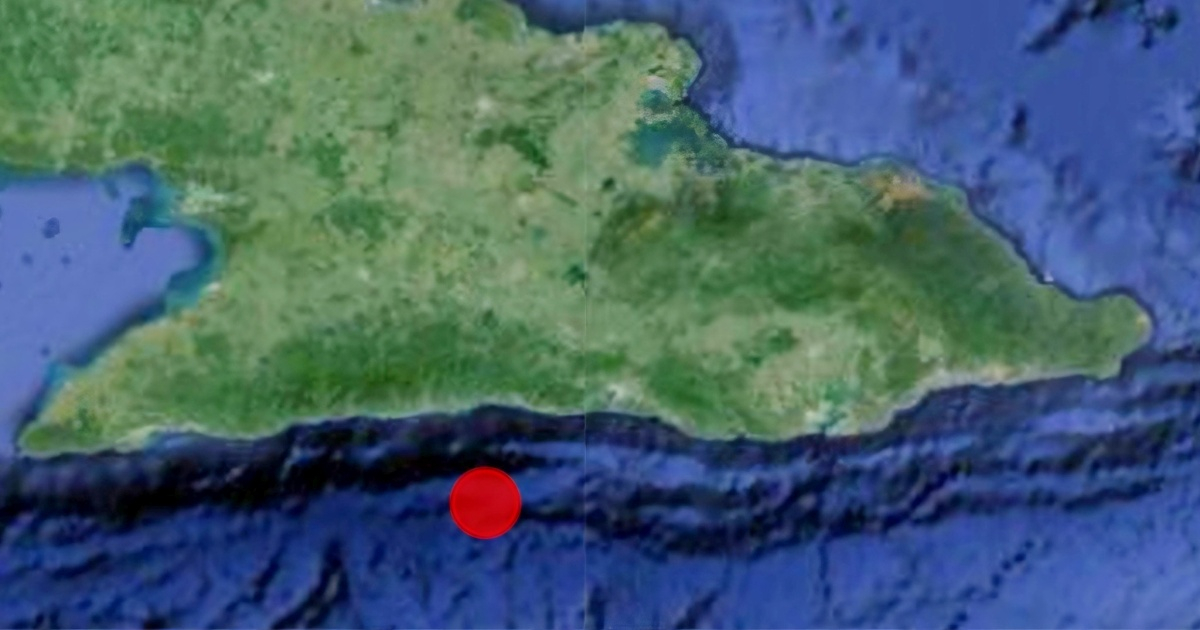
The National Center for Seismological Research (CENAIS) has reported an earthquake in eastern Cuba, which was noticeably felt by residents in at least two provinces: Santiago de Cuba and Granma.
The seismic event took place at 9:41 p.m. local time, registering a magnitude of 2.9 on the Richter scale. It was identified by the network of stations belonging to the Cuban National Seismological Service.
Confirmation of the quake came through Information Bulletin No. 14, issued by the Central Station of the National Seismological Service, based in Santiago de Cuba.
According to the official report, the quake's epicenter was located 5 kilometers deep, positioned 17 km southwest of Santiago de Cuba city, along the coast of the Guamá municipality.
It was precisely plotted at the coordinates 19.70 degrees north latitude and -76.26W longitude.
The news was first shared on social media by Enrique Diego Arango Arias, the head of the Seismological Service and a specialist at CENAIS, who noted: “Preliminary data of a noticeable earthquake recorded at 9:41 pm today, December 29, with an epicenter south of Guamá municipality, Santiago de Cuba province. It is reported as perceptible in various localities within the provinces of Santiago de Cuba and Granma. The Central Station's information note will follow shortly.”
Initially, Arango Arias estimated the earthquake's magnitude at 3.2 with a shallow depth of 0.7 kilometers. However, the official bulletin later revised these figures to 2.9 degrees and 5 kilometers deep.
The CENAIS official statement highlighted that citizen reports of the quake's perceptibility were received from multiple areas within Granma and Santiago de Cuba provinces.
No material damage or casualties were associated with this occurrence.
A Historically Seismic Region
Eastern Cuba is situated on one of the most active seismic zones in the Caribbean archipelago, influenced by the interaction of the Caribbean and North American tectonic plates.
Despite the minor magnitude of this tremor, its shallow depth and proximity to populated areas contributed to its perceptibility among some residents.
The shallow depth of just 5 km and the epicenter's closeness to the coast explain why, even though the event wasn't strong, it was felt by the population.
Earthquakes like these typically cause brief sensations of movement or vibration, which may go unnoticed by many but can alarm those in higher floors or lightweight structures.
Over Three Months Without Noticeable Events
Since September 17, no perceptible earthquakes had been reported in Cuba. On that day, two quakes with magnitudes of 2.9 and 3.2 on the Richter scale were felt in Pilón municipality, Granma province.
The first seismic event occurred at 6:34 p.m. local time, at a depth of 7.4 kilometers, located at 19.88 degrees north latitude and -77.40 degrees west longitude, 7 kilometers west of Pilón.
The second tremor was detected by the seismic station network at 6:40 p.m., with a magnitude of 3.2, 10 km deep, and at coordinates 19.82 degrees north latitude and -77.33 degrees west longitude, 10 kilometers south of the same eastern locality.
Reports of perceptibility were received from Pilón and Niquero localities in Granma province.
More Than 3,000 Quakes in Cuba During Early 2025
Throughout the first half of 2025, a total of 3,623 earthquakes were recorded in the region, with 3,273 of them occurring within Cuba's geographical area, as per data released in July by the National Seismological System.
Despite the high number of seismic events in the year's first half, only 10 were perceptible by the population, with nine being related to the plate boundary zone in southern eastern Cuba.
The day with the highest seismic activity was January 27, when 60 events were recorded within a 24-hour period.
The most active zone was Pilón–Chivirico, with 1,849 quakes, mostly aftershocks from the earthquake on November 10, 2024, while the most energetic area was Santiago–Baconao.
Understanding Seismic Activity in Cuba
What causes earthquakes in eastern Cuba?
Earthquakes in eastern Cuba are primarily caused by the interaction of the Caribbean and North American tectonic plates, making it a seismically active region.
How often do noticeable earthquakes occur in Cuba?
Noticeable earthquakes in Cuba are relatively rare, with only a few perceptible events reported each year, despite numerous minor quakes occurring regularly.
What was the depth of the recent earthquake in Santiago de Cuba?
The recent earthquake in Santiago de Cuba had a depth of 5 kilometers.