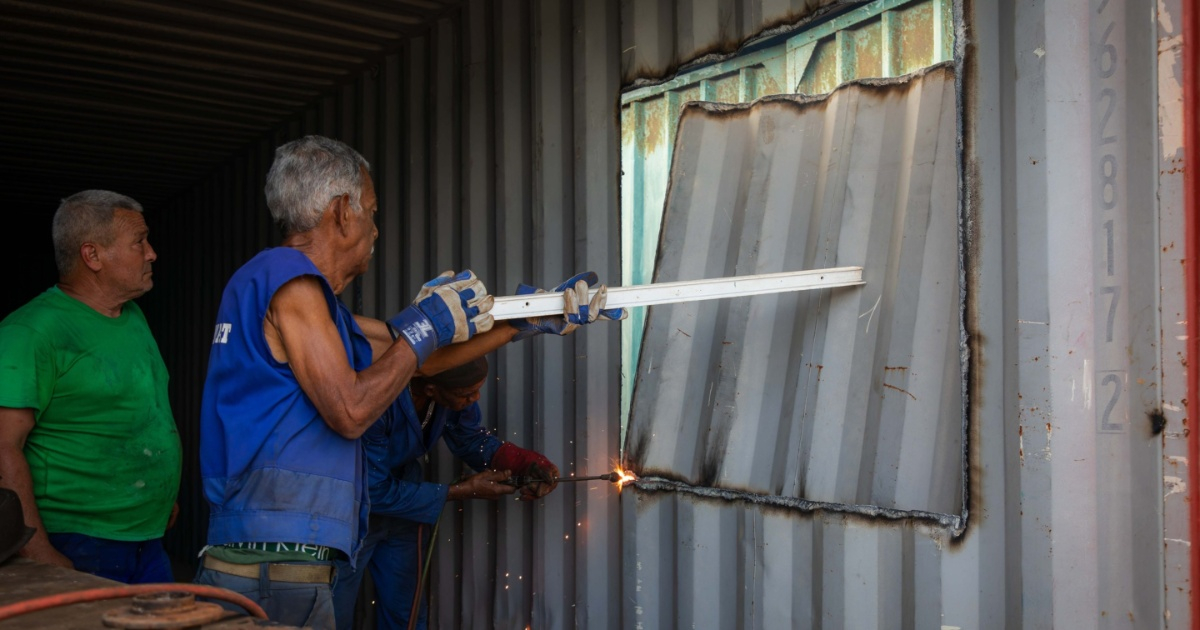
The Cuban state-run media has labeled as an "innovation" a new initiative aimed at constructing homes using repurposed shipping containers.
This project is being touted as a solution to the country's housing deficit, which is exacerbated by shortages of cement and fuel that have stalled the national housing plan. Moreover, it seeks to address the damage caused by cyclones like Melissa.
According to a report by Granma, in Villa Clara, the Electromechanical Company of the Ministry of Construction is progressing with a project to build 20 homes using containers, with 90% of the necessary resources already secured. The provincial government is set to manage the distribution.
Justo Rodríguez Gattorno, director of the company, mentioned to ACN that construction pace depends on material availability. He highlighted the project as a demonstration of the team’s "versatility."
Specialist Aracelys Machado Hurtado emphasized that the conversion process demands "precision engineering and welding" to ensure "habitability, safety, and comfort." The containers are transformed into fully equipped residential spaces.
In the same report, a Santa Clara resident, María de los Ángeles Pérez, expressed that any "new and well-executed" solution is welcome if it speeds up the process for families awaiting housing.
Political Oversight in Matanzas
Coverage by Girón also highlights that in Matanzas, the president of the National Assembly, Esteban Lazo Hernández, along with provincial Party and Government officials, inspected the progress of these so-called "container homes."
Lazo acknowledged housing as one of the most pressing issues, attributing delays to the lack of cement, fuel shortages that halted production, and cyclone damage. The report notes that Melissa alone affected over 100,000 homes.
Idhovaldo Díaz Martínez, a government coordinator, announced the inauguration of the first three container homes in a "transforming" neighborhood of the Pueblo Nuevo council, coinciding with the celebration of the Revolution's Triumph.
The report states each unit will measure 27 m², with expectations to deliver seven such homes to needy families in Matanzas by mid-January.
The official narrative presents this project as part of an "innovation" strategy, incorporating recycled and prefabricated materials while focusing on structural safety standards.
However, the article lacks details on costs per home, exact execution timelines, expected lifespan, beneficiary selection criteria, or specific technical conditions.
Experts consulted by state media indicated these containers will feature a covering that shields them from the elements and acts as thermal insulation. Despite this, they are expected to remain quite warm during summer.
FAQs on Container Homes in Cuba
What are the primary materials used for constructing container homes in Cuba?
The primary materials include repurposed shipping containers, with additional engineering and welding to ensure safety and comfort. The strategy also incorporates recycled and prefabricated materials.
How does the Cuban government plan to address the housing deficit with container homes?
The plan involves constructing homes using shipping containers to tackle the housing shortage, focusing on areas affected by cyclones and material shortages, and aims to expedite housing solutions for waiting families.
What challenges are associated with living in container homes in Cuba?
Challenges include maintaining comfortable temperatures during summer despite thermal insulation, availability of materials affecting construction pace, and lack of detailed information on costs and execution timelines.