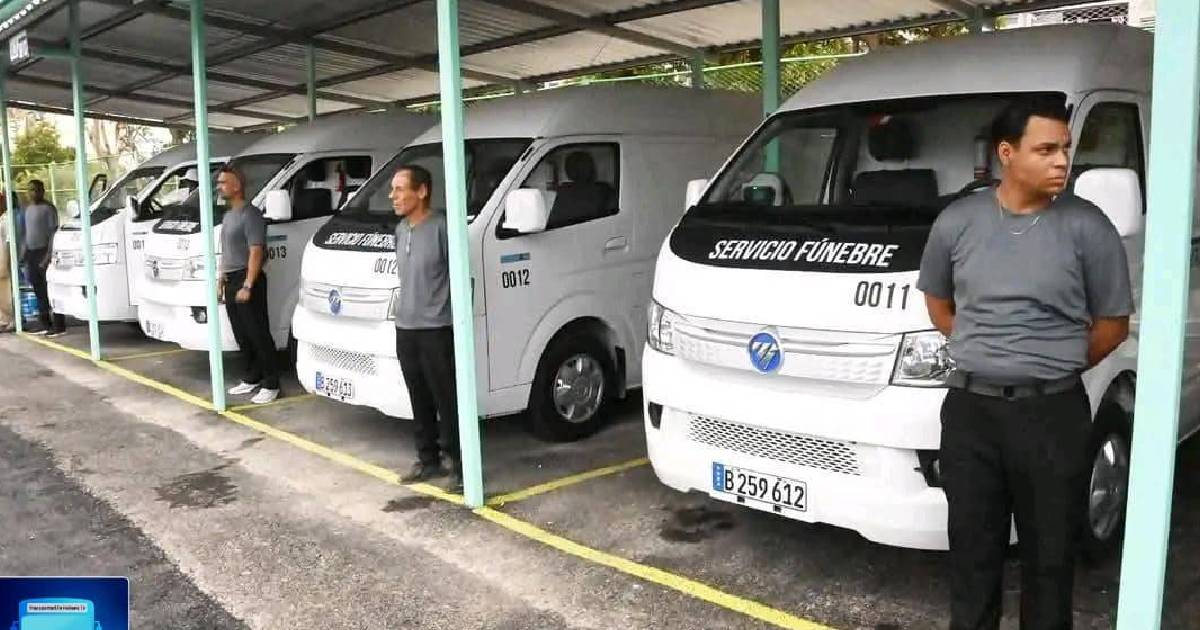
The state-owned midsized enterprise, Servi Axess, part of the AXESS Commercial Company under the Ministry of Transport's OSDE/GEA, is set to manage 15 newly acquired electric vehicles for Havana's funeral services.
These vehicles come equipped with technical features allowing for charging through conventional methods or via solar panels at the parking base, as reported by the Facebook group Transportación Habana TH.
Oscar Carvajal Serrano, head of the Ministry of Transport's Automotive Business Group, stated that these vehicles were specifically purchased and modified for funeral tasks, dedicated solely to the capital.
This initiative was unveiled to the public on December 24th during a visit by the ruler Miguel Díaz-Canel to transportation facilities, where officials described the project's purported functionality and social impact.
State-aligned social media described Servi Axess as an exemplar of "green innovation" and "social sensitivity."
Public Outcry and Skepticism
The endeavor sparked a wave of critical feedback online, with numerous users challenging the state-owned midsized enterprise model and questioning the project's underlying motives.
To many, ventures like these are not indicative of economic liberalization but rather a mechanism for control. "These are maneuvers to maintain dominance and enrich a select group of family members and allies," wrote one user.
Others pointed out that the systemic crisis is beneficial to the regime. "The dictatorship thrives on constant crises: power outages, water shortages, food scarcity, only to later claim they are the solution," commented another, who also highlighted remittances as a primary source of enrichment for the ruling elite.
Criticism also targeted the "state-owned" nature of the enterprise. One citizen argued it is a form of concealed privatization, as the businesses "remain under their control under the guise of new-type state entities," lacking genuine competition or the guarantees typical of a rule of law.
Several users contrasted the announcement with conditions in other provinces. A resident from Santa Clara noted that families must provide materials to build coffins and pay bribes to expedite burials due to the absence of hearses, fuel, and staff, leaving bodies unburied for days.
For some, the midsized enterprise model embodies an unresolved ideological contradiction. "It's capitalism hiding behind socialism and revolution," one commenter remarked.
Another questioned who the actual beneficiaries of the new company would be: "They have everything planned out and will continue to create needs just to establish their midsized enterprises."
The public's reactions indicate deep skepticism toward a measure presented as a partial remedy to a failing service but perceived as an economic restructuring aimed more at preserving privileges and control rather than addressing the underlying funeral crisis in the country.
In June, it was reported that an electric hearse was delivered to the municipality of Placetas in Villa Clara.
This announcement comes amid a backdrop of ongoing collapse in Cuba's funeral services, plagued by a lack of maintenance for hearses, fuel shortages, insufficient materials for coffin production, and poor management.
Recent months have seen severe incidents, such as coffins falling from vehicles on public roads and bodies left untransferred for hours, sparking outrage and highlighting the erosion of dignity even after death.
Frequently Asked Questions about Funeral Services in Cuba
What is Servi Axess?
Servi Axess is a state-owned midsized enterprise that manages funeral vehicles in Havana, part of the AXESS Commercial Company under the Ministry of Transport.
Why were electric vehicles chosen for Havana's funeral services?
Electric vehicles were selected for their ability to be charged through conventional methods or using solar panels, aligning with a trend towards green innovation.
What has been the public reaction to the new funeral vehicle project?
The public reaction has been largely skeptical, with many questioning the motives behind the project and its effectiveness in addressing the funeral service crisis.