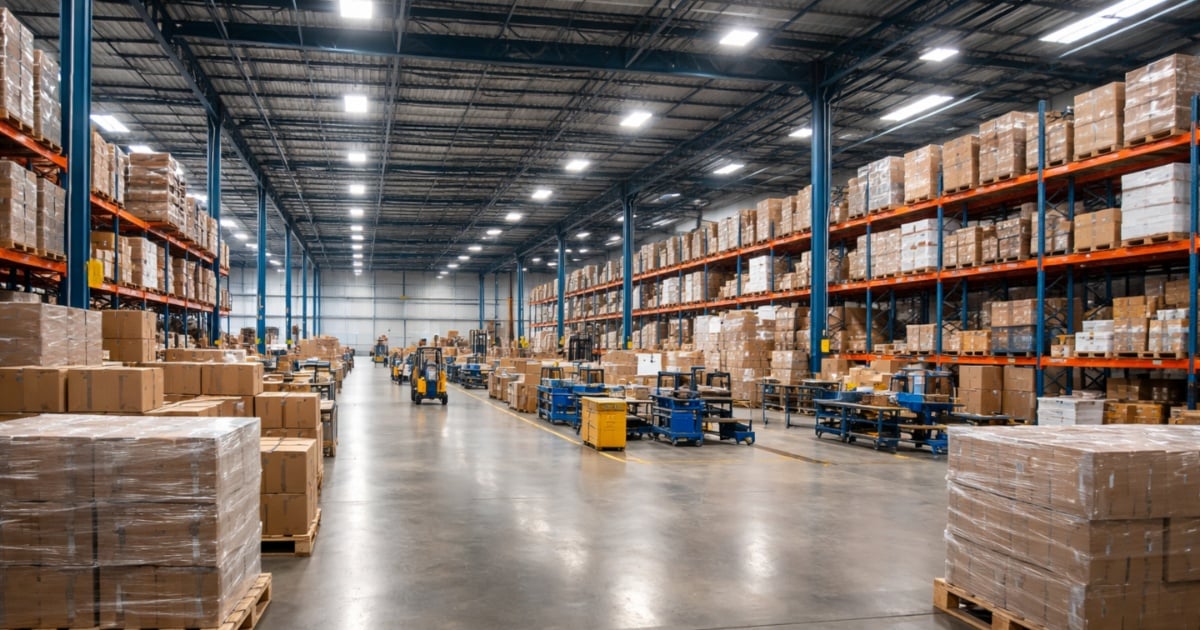
The administration under President Donald Trump is reportedly seeking contractors to overhaul the U.S. immigration detention system, planning to transform industrial warehouses into massive centers capable of holding over 80,000 immigrants at a time, according to a draft proposal reviewed by The Washington Post.
Instead of moving detainees across the country to find available space, as is currently done, ICE aims to create a "deliberate feed system" to expedite deportations, the document reveals.
This proposal outlines that newly detained individuals would first be processed for a few weeks before being transferred to one of seven large warehouses, each designed to accommodate between 5,000 and 10,000 individuals, where they would be "prepared" for removal.
The draft also references 16 smaller facilities, each with a capacity for 1,500 detainees.
According to the document, the large warehouses would be strategically located near major logistical hubs in Virginia, Texas, Louisiana, Arizona, Georgia, and Missouri.
Proposed facilities include a capacity of up to 10,000 detainees in Stafford, Virginia, another with 9,500 near Dallas, Texas, and a facility for 9,000 in Hammond, Louisiana.
It's important to note that this document is not final. ICE intends to share it with private detention companies to gauge interest and make necessary adjustments before formally requesting bids.
Tricia McLaughlin, a spokesperson for the Department of Homeland Security (DHS), declined to confirm the information or answer questions about the warehouse plan when contacted by The Washington Post.
The proposal suggests that the new facilities aim to "maximize efficiency," "minimize costs," reduce processing times, and accelerate deportation processes, while promoting "safety, dignity, and respect" for those in ICE custody.
Meanwhile, Todd M. Lyons, ICE's acting director, defended treating the system "like a business" and likened the goal to Amazon's logistics, saying: "Like Prime, but with human beings," according to the report.
Experts caution that warehouses are designed for storage and transport, not human habitation. They often have poor ventilation, imprecise temperature controls, and might lack adequate plumbing and sanitation infrastructure for thousands of people.
Immigration advocate Tania Wolf of the National Immigration Project criticized the plan as "dehumanizing," arguing that it treats people "like cattle."
Despite these criticisms, the draft plans for extensive renovations to include reception areas, housing units with showers and bathrooms, kitchens, dining areas, medical units, recreational spaces, legal libraries, and administrative offices. Some facilities would also have spaces for families in custody.
This initiative aligns with Trump's push to detain and deport millions of immigrants and expand the detention system, backed by $45 billion allocated by Congress for immigrant incarceration, according to the report.
The administration has also revived inactive prisons, repurposed parts of military bases, and promoted tent camps, such as the one at Fort Bliss, Texas, noted as ICE's largest facility at the time.
The document does not specify when construction would begin but indicates that facilities should start receiving detainees 30 to 60 days after construction commences.
Former officials and cited reports also highlight practical challenges, such as the lack of trained staff and previously identified issues by inspectors at new centers.
Key Questions About Trump's Immigration Detention Plan
What is the goal of transforming warehouses into detention centers?
The aim is to create a more efficient system for detaining and deporting immigrants, allowing for centralized processing and expedited removal of up to 80,000 individuals at a time.
Where will the new detention facilities be located?
The large warehouses are proposed to be near major logistics hubs in Virginia, Texas, Louisiana, Arizona, Georgia, and Missouri, with specific sites mentioned in Stafford, Virginia; Hutchins, Texas; and Hammond, Louisiana.
What are the criticisms of using warehouses for detention?
Critics argue that warehouses are not suited for human habitation due to poor ventilation, inadequate temperature control, and insufficient sanitation infrastructure. The plan is also seen as dehumanizing.