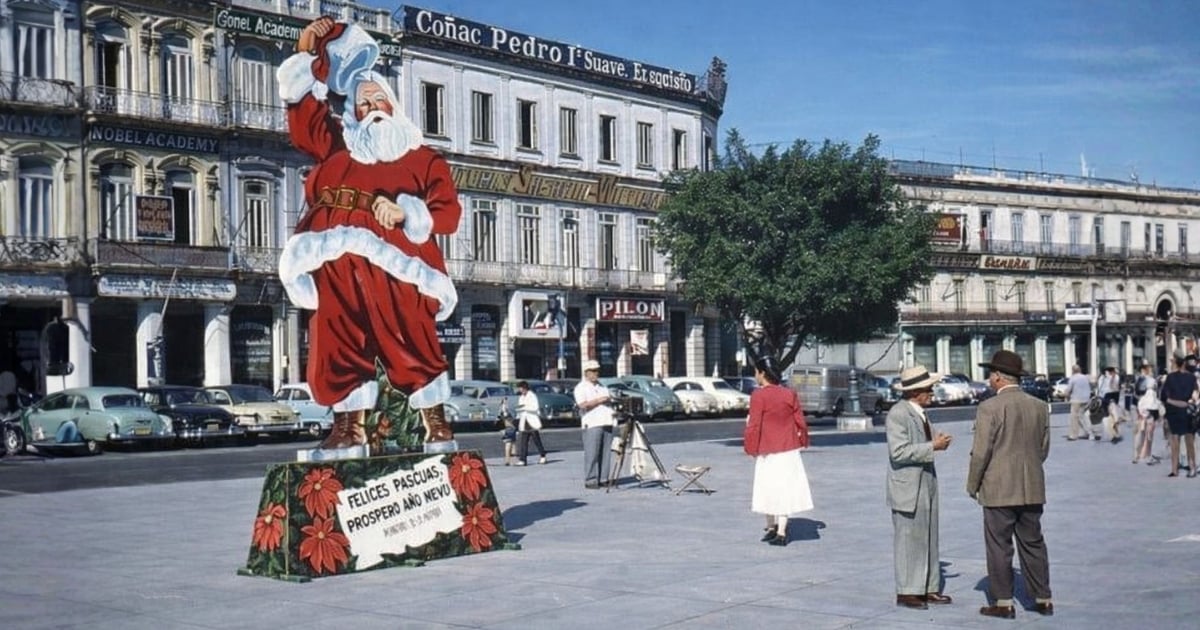
The memories of many Cubans, along with surviving photographs, paint a picture of a bygone era: Havana in December, bustling with festive storefronts, streets adorned with garlands, Christmas advertisements, and families eagerly preparing for the holiday season. Iconic stores like El Encanto were renowned for their extravagant Christmas displays, as historical accounts of this grand department store recall.
While no Christmas is flawless, the holiday prior to 1959 was public, visible, and free from restrictions. This starkly contrasts with what followed—a state that, prioritizing ideology and economic campaigns, pushed the celebration into the shadows, turning it into a subject of suspicion.
Havana in December: Festive Streets and Public Celebration
Before the revolution, December was enjoyed openly in Cuba. Shopping streets and department stores competed for attention with elaborate decorations: nativity scenes, Christmas trees, lights, and shopping promotions. In the memories of "Havana Christmases," names like El Encanto, Fin de Siglo, La Época, San Rafael, and Obispo evoke nostalgia for a city in celebration mode.
Significantly, Christmas was not a clandestine affair. Decorating, gathering, attending Mass, and exchanging holiday greetings were done without fear of repercussions.
Cuban Christmas Eve: Family Gatherings and Midnight Mass
Christmas Eve in Cuba traditionally centers around family gatherings. A tree topped with a star, a nativity scene at its base, and the tradition of attending Midnight Mass mark the spiritual beginning of Christmas.
Culinary traditions are well-known both on and off the island: roasted pork is the star dish of Christmas Eve, a tradition so deeply ingrained that it remains a staple among the Cuban diaspora.
However, historical memories of festive lights also bring to mind social disparities. Some neighborhoods celebrated modestly, while others displayed grand festivities. Even charitable homes were filled during these times.
Post-1959: Ideology Over Faith
Following the revolution, the relationship between the state and religion grew increasingly strained. The push for a "new man" and an officially atheist state suppressed religious expressions and forced faith into private life. This included the expulsion of priests, nationalization of religious schools, and restrictions on believers' political participation.
In this context, Christmas was more than just a date; it was a cultural and religious celebration. When a state deems religion as a hindrance, Christmas becomes a target.
1969: The Sugar Harvest and the Disappearance of Christmas
The most significant turning point came with the Ten Million Ton Sugar Harvest. In 1969, the government eliminated the Christmas holiday, citing the need to support the sugar harvest efforts. The holiday was officially removed, allegedly because it interfered with the 1970 sugar production.
The rationale was so extreme that reports describe the government attempting to "stretch the calendar" and postpone celebrations, including Christmas, to avoid interrupting the harvest. The practical outcome was severe: Christmas ceased to exist as a public celebration.
While there may not have been a formal prohibition, the cancellation was real. The official decision and the accompanying political climate effectively erased Christmas from public life for decades. Many Cubans continued to celebrate quietly, fearing accusations of "ideological weakness."
The Revival of Christmas in the 1990s
In the 1990s, the regime began to relax its stance. Constitutional reforms removed the state's atheist designation and allowed limited religious practices. The return of the Christmas holiday came through a symbolically powerful avenue: the Catholic Church and Pope John Paul II's visit.
On December 20, 1997, the Pope celebrated the restoration of Christmas as a civil holiday in Cuba, allowing people to participate in celebrations and reclaim a tradition deeply rooted in Cuban hearts. The holiday's return was solidified following the papal visit.
This development was not spontaneous but rather a result of moral pressure, political necessity, and image management.
Christmas 2025: Challenges Persist Amidst Restoration
Today, December 24, 2025, Christmas in Cuba is no longer viewed as a "counter-revolutionary act" as it was in past decades. However, the country faces a different type of blackout—literal power outages.
Thousands of families in Havana will endure power cuts during Christmas Eve, with rotating blackout schedules and predictions of several hours without electricity on the 24th and 25th. Without power, even the traditional meal is at risk. The price of pork surpasses 1,000 CUP per pound in some markets, making the most symbolic Christmas Eve dish a luxury for many.
This isn't nostalgia for consumption; it's a harsher reality: without material dignity, the celebration becomes an act of resistance. And the Cuban people have been resisting for far too long.
The True Christmas Lost
When it is said that "Cuba had a true Christmas before 1959," it refers not just to the lights on San Rafael or the displays at El Encanto. It speaks to something more fundamental:
- Celebrating without suspicion.
- Faith not being a stain.
- The family not needing to hide.
- The state not attempting to replace Christmas with slogans.
The Castro dictatorship—and its continuation—robbed Cubans of the right to enjoy traditions without fear. Christmas, with all its cultural significance, was one of the most intimate victims of that control.
Today, amidst blackouts and shortages, the question remains: what does it mean to celebrate when essentials are missing? Yet, the Cuban spirit persists: with a candle, some rice, a silent prayer, or a videoconference hug from exile.
That is Christmas too. But it should be celebrated with freedom and plenty, not under surveillance and scarcity.
Understanding the Impact of Cuba's Christmas Past and Present
How did Christmas celebrations change in Cuba after 1959?
After 1959, Christmas celebrations in Cuba were heavily restricted by the government, which discouraged public displays of religious faith and eventually removed Christmas as a public holiday to prioritize economic goals.
Why was Christmas considered suspicious in post-revolutionary Cuba?
In post-revolutionary Cuba, the government viewed religious celebrations, including Christmas, as incompatible with its atheist ideology and political goals, leading to suspicion and suppression of such festivities.
What role did Pope John Paul II play in the restoration of Christmas in Cuba?
Pope John Paul II's visit to Cuba in 1998 was pivotal in restoring Christmas as a public holiday, as it symbolized a shift in the government's stance and allowed Cubans to openly celebrate the tradition again.