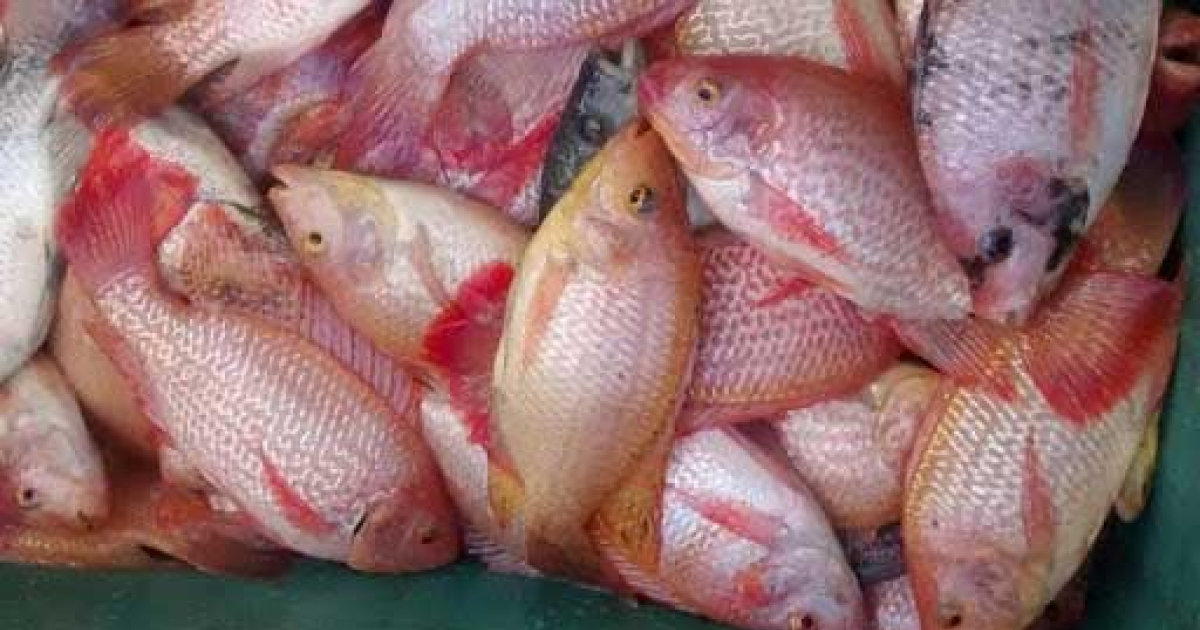
In the midst of a severe food crisis that is heavily affecting Cuban families, the government has announced the reintroduction of tilapia farming in the province of Granma. This measure is touted as part of their strategy to secure food supply but fails to address the core issue: the increasingly unaffordable prices that residents face.
According to the official Communist Party newspaper Granma, the Cali Sur Base Business Unit (UEB) in Granma has allocated 20 hectares for tilapia farming. This comes in response to the damage caused by Hurricane Melissa to other production sectors.
Manuel Yero, head of the production area, reported that three ponds have already been stocked—two of 0.5 hectares and one of a full hectare—with 131,000 fingerlings weighing between 7 and 30 grams each.
The aim, according to Yero, is for the fish to reach market size (450-500 grams) within approximately five months. At that time, the production will be directed entirely to sales points within the company and other local markets.
Although the installation was not severely impacted by the hurricane, the company admitted that shrimp farming was halted, leading them to employ fishing brigades and croquette production as temporary income solutions.
To ensure a steady supply of fingerlings, the UEB is exploring options in Bartolomé Masó and Havana, as the local center is temporarily out of operation.
Despite these productive announcements, the daily reality for Cuban families remains grim due to the extreme rise in food prices, which far exceed the purchasing power of wages and pensions. Products promoted by the state as "solutions" remain out of reach for a large portion of the population, even when available in markets.
As the government continues to "invent" agricultural programs and projects, the structural problem remains: the food is there, but it's unaffordable. In this context, the return of tilapia is unlikely to provide any real relief to Cuban households, where food insecurity has become a leading cause of poverty and declining quality of life.
Addressing Cuba's Food Crisis
What is the current food situation in Cuba?
Cuba is facing a severe food crisis, with prices of basic necessities skyrocketing beyond the reach of average citizens, despite government efforts to increase food production.
How is the Cuban government addressing food insecurity?
The Cuban government is attempting to tackle food insecurity by implementing agricultural programs like the reintroduction of tilapia farming. However, these measures often fail to address the underlying issue of high food prices.
Why are high food prices a problem in Cuba?
Despite the availability of food, exorbitant prices make it inaccessible for many Cubans, exacerbating issues of poverty and food insecurity.