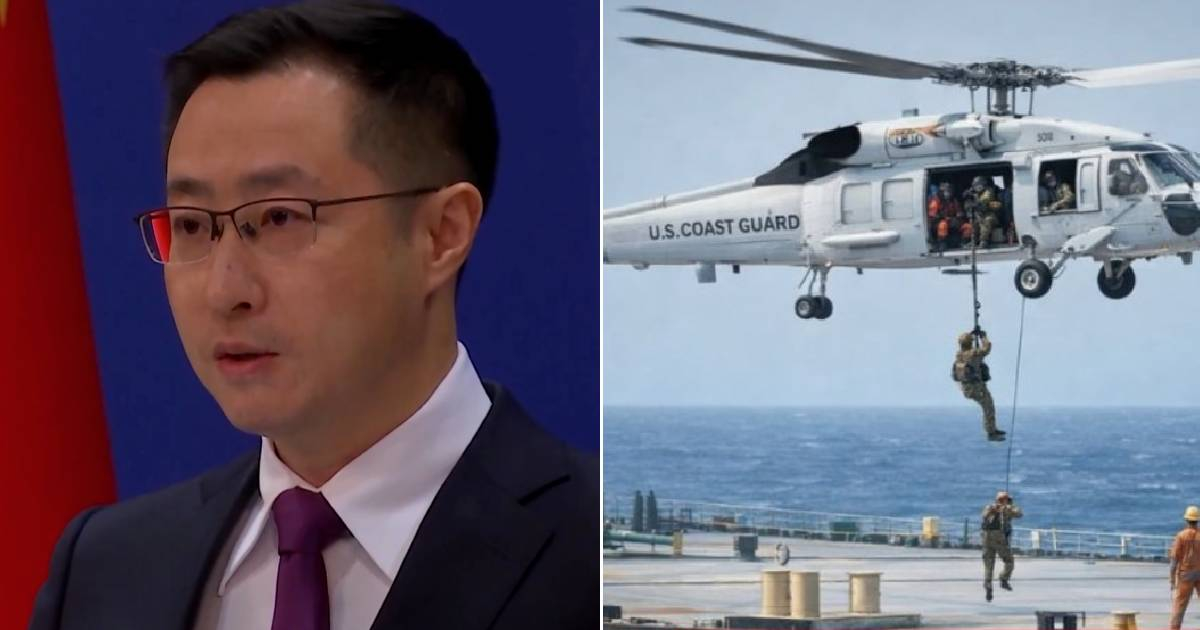
On Monday, the Chinese government accused the United States of a "serious breach of international law" after intercepting an oil tanker loaded with Venezuelan crude that was en route to China. This incident is part of escalating tensions tied to the heightened sanctions against Nicolás Maduro's regime.
During a regular press briefing, Lin Jian, spokesperson for China's Ministry of Foreign Affairs, stated that Venezuela is entitled to engage in commercial relations with other nations. He also reiterated Beijing's opposition to what he labeled as "unilateral and unlawful" sanctions, according to Reuters.
These remarks followed an event on Saturday when the U.S. Coast Guard intercepted a second tanker in international waters off the Venezuelan coast. This occurred shortly after President Donald Trump announced a "blockade" against all sanctioned vessels entering or leaving Venezuela.
International agencies reviewed documents revealing that the tanker, named Centuries but falsely registered as "Crag," was loaded in Venezuela with approximately 1.8 million barrels of Merey crude, intended for China.
The shipment was reportedly purchased by Satau Tijana Oil Trading, one of the several intermediary companies utilized by the state-owned PDVSA to sell Venezuelan oil to independent Chinese refineries, as per the documents.
A White House spokesperson claimed the ship was a "false-flagged vessel" transporting sanctioned oil and was part of Venezuela's so-called "ghost fleet," used to circumvent international restrictions.
Meanwhile, the Venezuelan government condemned the tanker's interception, describing it as a "severe act of international piracy," and joined the criticism against Washington for employing naval force in the Caribbean.
China, currently the largest purchaser of Venezuelan oil, which comprises about 4% of its total oil imports, views such interdictions as a sensitive issue in its relationship with Washington.
The seizure of the vessel is part of a broader U.S. strategy to constrain Maduro's regime's oil revenues. This policy has included maritime interdictions, cargo confiscations, and vessel detentions, increasing diplomatic and commercial tensions in the region.
Last Wednesday, China expressed its support for Venezuela and rejected what it called "unilateral bullying" amid increasing U.S. pressure on the South American nation.
This statement was made during a phone call between Chinese Foreign Minister Wang Yi and his Venezuelan counterpart Yvan Gil, as reported by a Chinese Foreign Ministry communiqué cited by Reuters.
In that conversation, Wang stated that China "supports countries in safeguarding their own sovereignty" and emphasized that China and Venezuela are strategic partners, characterized by "mutual trust and support."
According to the same source, the Chinese minister added that "the international community understands and supports Venezuela's position in defending its legitimate rights and interests," reinforcing Beijing's diplomatic backing of Caracas.
Questions on U.S-China-Venezuela Relations
Why did the U.S. intercept the Venezuelan oil tanker?
The U.S. intercepted the oil tanker as part of its enforcement of sanctions against the Venezuelan regime, aiming to limit its oil revenues.
How has China responded to the U.S. actions?
China condemned the U.S. actions, labeling them as a violation of international law and expressing support for Venezuela's right to conduct international trade.
What is the significance of China's oil imports from Venezuela?
Venezuelan oil accounts for approximately 4% of China’s total oil imports, making it a significant component of China's energy strategy.