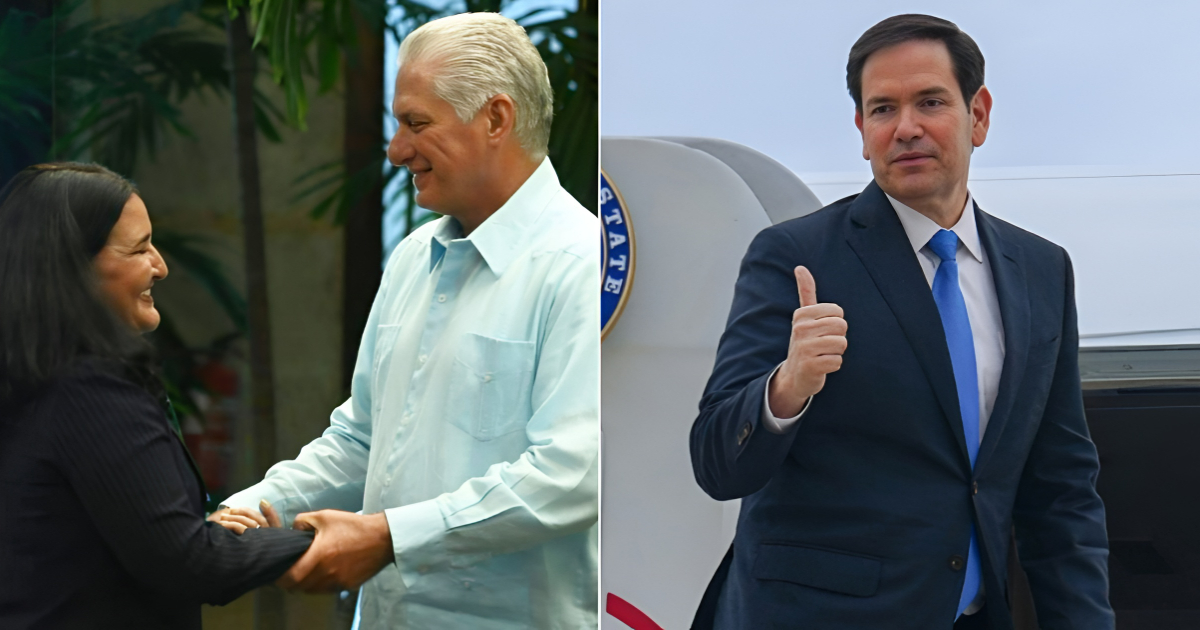
Johana Tablada de la Torre, the Deputy Director General for the United States at Cuba's Ministry of Foreign Affairs, has once again stirred controversy with a lengthy and scathing critique aimed at U.S. Secretary of State Marco Rubio. Her message, shared on social media, was filled with personal jabs, branding Rubio a "fascist," "bandit," and "executioner," and ultimately labeling him as "inept."
The irony of her insult was not lost on the Cuban populace. The term "inept" is often used by Cubans to criticize the government of Miguel Díaz-Canel. The sentiment was evident during last year's nationwide blackouts, when Díaz-Canel attempted to project optimism amid an electrical collapse, only to be met with public mockery and anger. Cubans, tired of excuses and slogans, described him as "corrupt, stupid, inept, and inefficient."
Since Díaz-Canel assumed leadership in 2018, "inept" has become synonymous with his administration, a reflection of the regime sustained by Raúl Castro. Thus, when Tablada de la Torre used the same term against Rubio, many were quick to point out the misfire. In the eyes of Cubans, the embodiment of ineptitude is not found in Washington, but rather in Havana's corridors of power.
The diplomat's message, spanning over a thousand words, was intended as a denunciation of the U.S. "economic war," but came across as a personal vendetta against the Cuban-American senator now leading the State Department. Tablada de la Torre accused Rubio of manipulating U.S. foreign policy, sabotaging ships, threatening nations, and even controlling the Secretary of Defense. Her rhetoric, interspersed with biblical references, conspiracy theories, and revolutionary slogans, culminated in the declaration: "Rubio is the true inept."
However, the statement backfired, eliciting laughter from Cuban social media users and those in exile. Many interpreted it as a Freudian slip, inadvertently confessing what Cubans have long felt about their leaders. The post also highlighted the exhaustion of the official narrative. References to the "criminal blockade" and "imperial suffocation" increasingly ring hollow against a backdrop of shortages, blackouts, and mass migration that cannot be solely blamed on external enemies.
While Tablada de la Torre clings to decades-old mantras, Cubans endure by relying on remittances, ingenuity, and dwindling patience as blackouts persist. Her fixation on Marco Rubio, whom she mentions with near obsession, appears to be the regime's last-ditch attempt to find a scapegoat for its failures. Instead of diplomacy, it offers diatribes; instead of dialogue, insults.
Yet, in her attempt to ridicule the senator, the diplomat inadvertently adopted the Cuban people's most popular insult for the so-called "continuity" leader. Cubans quickly recognized the official blunder. When Tablada de la Torre labeled Rubio "the true inept," it was clear to millions that the criticism had missed its target and inadvertently highlighted its rightful owner.
In a nation where hospitals go dark, epidemics thrive, prices skyrocket, and youth flee, the label of "inept" is firmly attached to the leadership in Havana, grinning while the country crumbles.
Key Insights on Johana Tablada's Critique of Marco Rubio
Why did Johana Tablada label Marco Rubio as "inept"?
Johana Tablada called Marco Rubio "inept" as part of a social media post criticizing his influence on U.S. policy and actions against Cuba. Her comment was intended as an insult but was seen as ironic, given the term's frequent use against Cuban leadership.
How did Cubans react to Tablada's comments about Rubio?
Cubans reacted with humor and saw Tablada's comment as a misstep, interpreting it as an unintended acknowledgment of the ineptitude of their own government rather than a successful critique of Marco Rubio.
What does the term "inept" signify in the context of Cuba's government?
In Cuba, "inept" has become a common adjective used by citizens to describe the perceived failures and inefficiencies of the government, particularly under the leadership of Miguel Díaz-Canel.