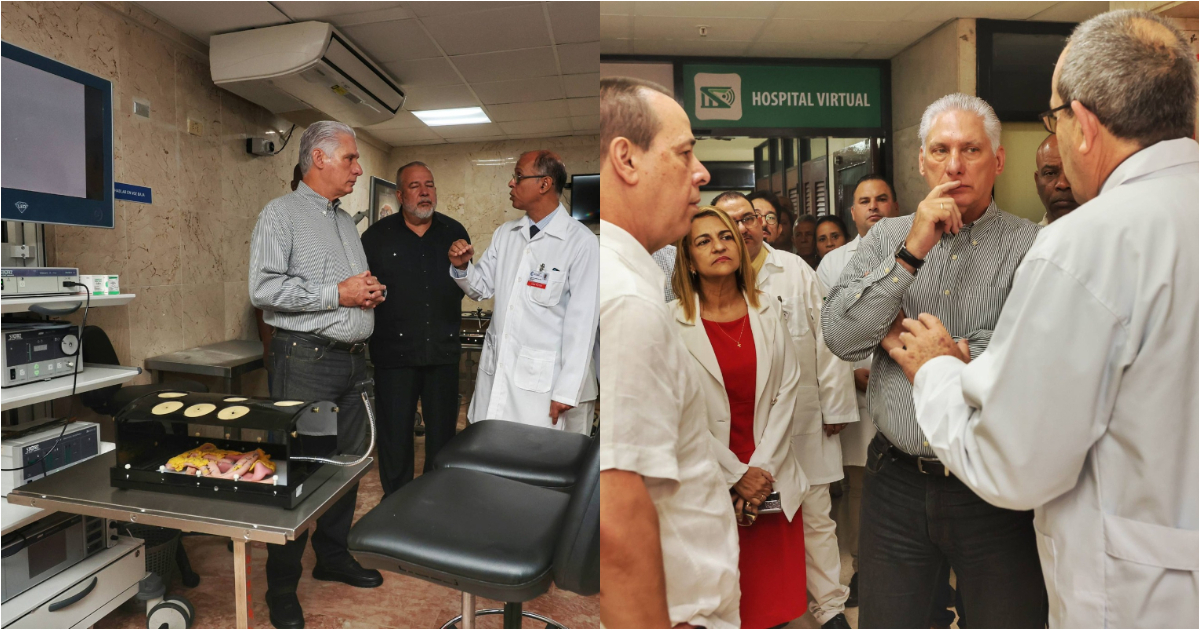
On Friday, Cuban leader Miguel Díaz-Canel toured the National Center for Minimally Invasive Surgery in Havana's Diez de Octubre municipality and the Hermanos Ameijeiras Clinical Surgical Hospital in Central Havana, institutions touted by the government as prime examples of the digital transformation of Cuba's healthcare system.
The Presidency reported on its Facebook page that the Minimally Invasive Surgery Center performs over 4,000 surgeries annually, staffed by a team where more than 80% hold doctorates or master's degrees.
During the visit, Armando Rodríguez Batista, the Minister of Science, Technology, and Environment, explained why the institution received a special mention in 2024 for its service quality.
Rafael Torres Peña, the institution's director, remarked that the recognition poses a challenge to evolve the center into a "smart hospital."
Official information highlighted the center's success in fully digitizing patient consultations, interconsultations, and medical records, along with the implementation of quality management practices.
Accompanied by Prime Minister Manuel Marrero Cruz and Public Health Minister José Ángel Portal Miranda, Díaz-Canel observed a live surgery, praising the staff for aligning with the government's digital transformation objectives.
The tour also included the Hermanos Ameijeiras Hospital, where the president attended the launch of the first phase of a virtual digital hospital aimed at managing medical workflows and supporting staff training.
The Presidency highlighted that the institution offers services in over 40 specialties, trains more than 1,000 residents, and employs dozens of doctors and researchers.
In a post on X, Díaz-Canel declared that both institutions are "at the forefront" of the digitalization process, with plans to extend these advancements throughout the healthcare system.
However, the announcement sparked significant criticism on social media.
Numerous users questioned the focus on elite hospitals, noting that most Cubans lack access to such facilities.
Comments pointed out the deterioration of provincial clinics and hospitals, shortages of essential medicines, supplies, hygiene products, and antibiotics, as well as the degrading treatment of patients.
Some accused the government of staging "shows" for official visits, while the everyday reality of the healthcare system is plagued by shortages and collapse.
Personal accounts surfaced, describing experiences of surgeries without medication, hospital-acquired infections, and the necessity to purchase supplies on the black market.
Criticisms also highlighted the restricted nature of centers like those visited by the president, described as reserved for the privileged or tourists, disconnected from the care received by ordinary Cubans.
These critiques emphasized that one or two reference facilities do not reflect the true state of Cuba's healthcare system, urging authorities to visit ordinary hospitals and clinics, where the country's healthcare crisis is most acutely felt.
Understanding Cuba's Healthcare System
What is the focus of Díaz-Canel's recent hospital visits?
Díaz-Canel's visits aimed to showcase the digital transformation and modernization efforts at select Cuban hospitals, highlighting advancements in service quality and technology.
Why did the announcement of hospital improvements receive backlash?
The backlash arose because many Cubans feel that the showcased hospitals cater to the elite and tourists, while the broader healthcare system suffers from severe shortages and inadequate conditions.
How are hospitals like Hermanos Ameijeiras positioned in Cuba's healthcare system?
Hospitals like Hermanos Ameijeiras are often seen as flagship institutions, meant to represent the best of Cuba's healthcare capabilities, yet they are criticized for not being accessible to the general public.