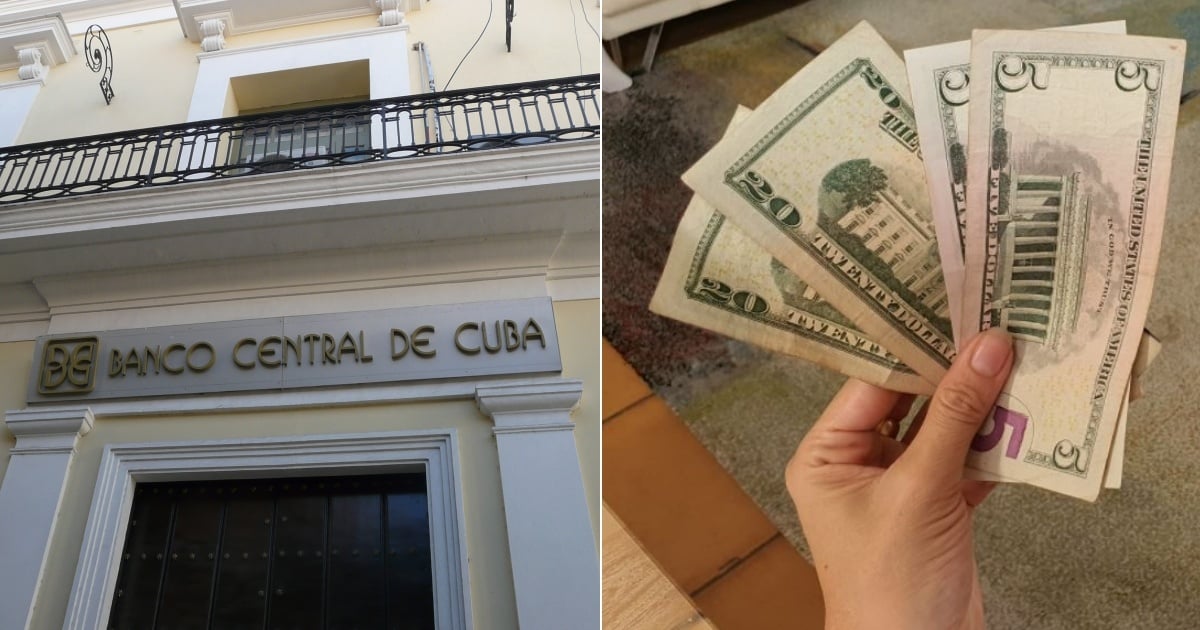
Just a few days after its introduction, Cuba's so-called "floating" exchange rate system has already undergone its first adjustments.
On Saturday, the Central Bank of Cuba (BCC) announced a slight decrease in the official rates for the dollar and the euro.
The dollar's rate decreased from 410 to 408 Cuban pesos, while the euro went from 481.42 to 477.85 CUP.
This represents a two-peso drop for the American currency and nearly four pesos for the European one.
In contrast, the informal market, which serves as the actual benchmark for millions of Cubans, remains unchanged. The dollar still holds at 440 CUP and the euro at 480 CUP, according to daily tracking by elTOQUE.
The so-called official "floating" rate struggles to find its place in a market where transactions at those prices are nonexistent.
The Illusion of a Market
Launched on December 18 as part of the Macroeconomic Stabilization Program pushed by the regime, the new system includes three exchange segments:
Segment I: A fixed rate of 1x24 CUP for essential state operations.
Segment II: An intermediate rate of 1x120 CUP for businesses with foreign income.
Segment III: A daily floating rate, supposedly based on supply and demand, intended for individuals and micro, small, and medium enterprises (MSMEs).
According to the BCC, the goal is to progress towards a future unified exchange rate without causing monetary collapse.
Juana Lilia Delgado, the bank's president, claimed that the scheme would reflect "the real conditions of the Cuban economy." However, the reality on the ground tells a different story.
The availability of foreign currency remains minimal, limited to remittances and legally channeled exports.
Through CADECA, citizens can only access up to 100 USD per digital turn, provided there is availability, which is rarely the case. The promised "floating" rate resembles more of a mirage than an actual market dynamic.
No Trust, No Liquidity, No Impact
The government's announcement was portrayed as a step towards transparency and reducing the black market.
However, since its implementation, it's become clear that the mechanism operates without genuine free supply or demand, and most importantly, without public trust.
Some economists have dubbed the experiment "floating without water."
On platforms like Cubadebate, netizens have reacted with sarcasm and disbelief.
"Criticizing elTOQUE so much only to end up the same," wrote one commenter, summarizing a general sentiment that points to the regime's reliance on the same type of rate it criticized for years.
This Saturday's minor retreat in official rates only underscores the decorative nature of the new system: without a real foreign exchange market or genuine adjustment mechanisms, any variation lacks substance.
It's a "floating" rate that floats, but in the air.
The Informal Market: Immune to Official Rates
Meanwhile, the informal currency market continues to dictate the country's economic tempo.
On December 20, both the dollar and the euro remained unchanged compared to previous days, while the Moneda Libremente Convertible (MLC) — the regime's digital instrument — fell from 315 to 310 CUP.
It's a slight decline that some link to expectations generated by the implementation of the new official rate, though without significant structural impact.
For the third consecutive day, the two main indicators — the dollar and the euro — remain stable in the informal circuit, completely ignoring the BCC's movements.
This reaffirms what many analysts have warned: the street remains the real thermometer of the Cuban economy, not State resolutions.
A Validation of the Black Market
The creation of a floating exchange rate for individuals and MSMEs is, at its core, an implicit admission of defeat: the state model has failed to establish an economy with clear rules, transparency, or trust.
The new system allows self-employed workers and small business owners to access foreign currency from fiscal accounts, up to 50% of their quarterly gross income.
In theory, this aims to reduce their reliance on the black market. However, in practice, most continue to turn to it due to the scarce official availability of foreign currency.
In this context, the floating rate seems less like a genuine reform and more like a policy masked as monetary strategy. An attempt to disguise an informal economy that is already structural and, at times, more efficient than the formal one.
A Country Adrift
The adoption of a daily floating rate by the Central Bank doesn't address the underlying issues: inflation, currency duality, fiscal deficit, declining production, product shortages, and, above all, widespread distrust of the state financial system.
With an average state salary equivalent to just $16 a month at the official rate, most Cubans rely on the informal market not only for foreign currency but also for food, medicine, and basic goods.
The floating of the Cuban peso — at least on paper — has yet to anchor the country in any safe harbor. Rather, it reinforces the feeling of drift, of an exhausted model, and public policies that merely simulate control without changing anything fundamentally.
As one critical economist based in Havana put it, "without liquidity or real currency supply, this floating rate is a raft in a dry pond."
Understanding Cuba's Floating Exchange Rate System
What is the purpose of Cuba's floating exchange rate system?
The floating exchange rate system in Cuba aims to progress towards a unified exchange rate without causing monetary collapse, reflecting the real conditions of the Cuban economy.
How does the informal market impact the official exchange rates in Cuba?
The informal market in Cuba acts as the real benchmark for currency rates, often ignoring the official rates set by the Central Bank. It reflects the actual economic conditions and supply-demand dynamics, rather than the regulated rates.
Why do most Cubans rely on the informal market?
Most Cubans depend on the informal market due to the limited availability of foreign currency through official channels and the need to purchase essential goods, which the state-regulated market cannot adequately supply.