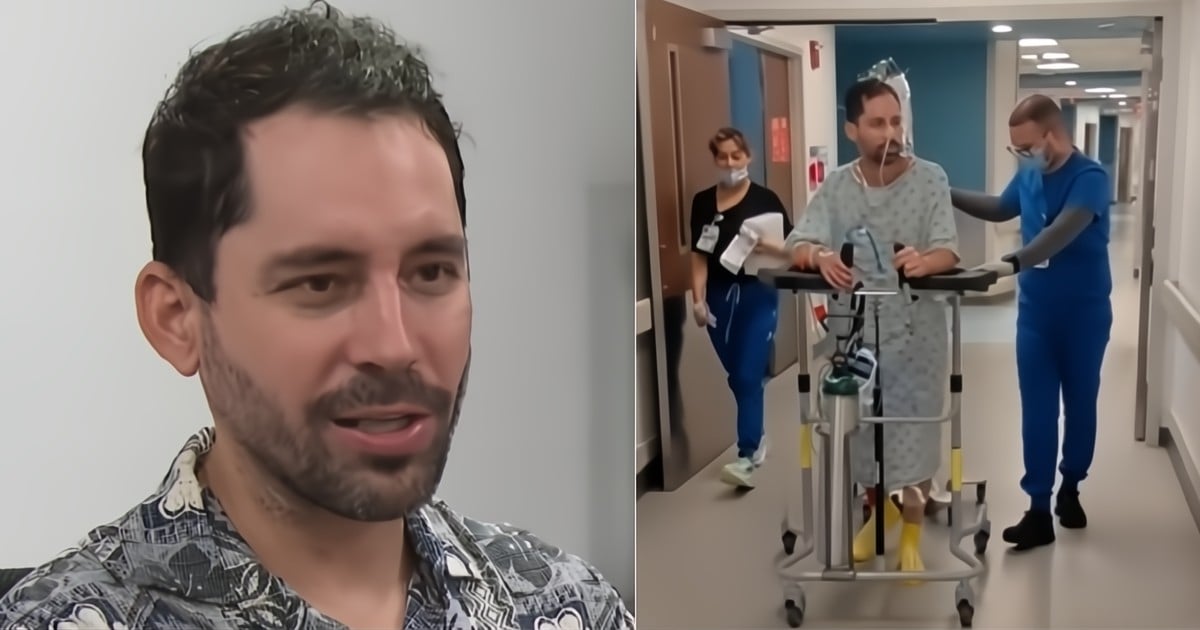
Alejandro Cuevas, a 36-year-old Cuban, carries with him a remarkable story of survival. Just four months ago, he underwent a complex multivisceral transplant in Miami, a procedure involving five organs that is only performed at a handful of U.S. hospitals. Now, as he continues to adapt to the transplanted organs, he faces a looming fear unrelated to his medical condition: the potential deportation of his wife, who is his sole caregiver.
Their plight was highlighted by Univision, documenting the struggles of this Cuban couple who fled to the United States in 2022, seeking the medical treatment unavailable in their homeland.
Diagnosed with a genetic mutation that caused three large tumors in his abdomen, Alejandro's condition worsened to the brink of death. In Cuba, his colon had already been removed, yet his health continued to deteriorate, leaving him with constant bleeding and a grim prognosis, as he shared with Univision.
"They told me I had a ticking time bomb in my abdomen, that at any moment I could lose my life," Alejandro recounted to the U.S. media outlet.
The surgery at Jackson Memorial Hospital in Miami-Dade was a pivotal moment. "It's a miracle, first God and then the doctors who care for me," he declared.
However, his fight for survival extends beyond the operating room. While Alejandro was granted humanitarian parole due to his critical health, his wife Yaisely, a behavioral therapist with a work permit, remains under the I-220A immigration status, leaving her vulnerable to detention or deportation. She is also responsible for securing their health insurance.
"All I ask for is a chance to contribute to society and, at this moment, to care for my husband, who needs me so much," Yaisely expressed. Alejandro was more forthright: "We have no intention of returning to that dictatorship."
Their daily life is overshadowed by immigration uncertainty. Simple tasks like driving, attending medical appointments, or appearing in immigration court are fraught with anxiety. "Sometimes you have that fear that you could encounter the police or immigration officials at any moment," Yaisely admitted.
Last Friday, a federal court hearing offered a glimmer of hope not just for them, but for thousands of Cubans with I-220A status. A positive ruling could set a historic precedent, though attorneys advise caution.
"I don't want anyone rushing to apply for anything because there is still no decision," immigration attorney José Guerrero cautioned to Univision.
As the judges deliberate, the advice remains unchanged: stay informed, avoid legal troubles, and wait patiently.
For Alejandro, every day is precious. His recovery hinges on continuous care and the presence of the woman who has stood by him since leaving Cuba in search of a second chance at life.
Immigration Concerns for Cuban Patients in the U.S.
What is the significance of the I-220A status for Yaisely?
The I-220A status places Yaisely at risk of detention or deportation, despite her role as the primary caregiver and breadwinner for her family, which underscores the urgency of her situation.
How does Alejandro's condition affect his and Yaisely's immigration situation?
Alejandro's critical health condition and need for continuous care highlight the importance of Yaisely's presence, making her possible deportation a critical issue for both their lives.
What potential impact could a favorable court ruling have?
A favorable court ruling could provide a historic precedent, potentially affecting thousands of Cuban immigrants with similar statuses, offering them stability and security.