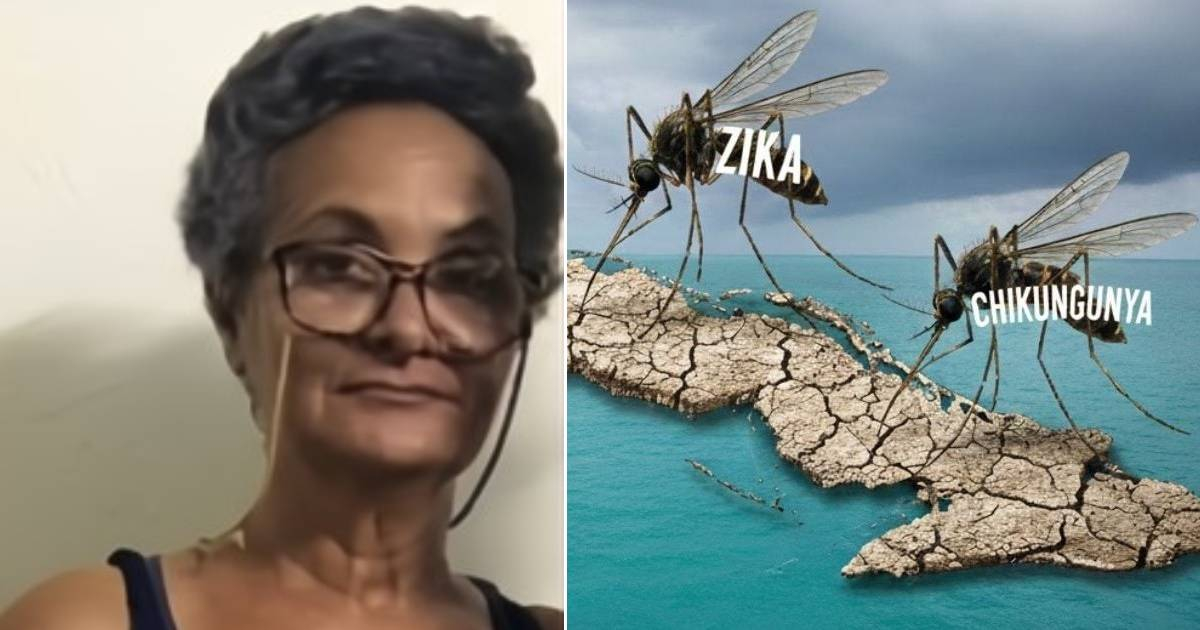
"She was gone in just a few hours." This is how a daughter describes the tragic end of her mother, Bárbara Fleites Valdez, a 59-year-old woman who passed away on December 15 in Caibarién, Villa Clara. Her death occurred in the midst of an arbovirus outbreak that continues to claim lives across Cuba.
The account was shared on social media by Carlos Michael Morales Rodríguez, a former political prisoner and 11J protester, and it quickly spread as a plea for help.
According to the family's account, Bárbara woke up on the morning of December 14 feeling extremely weak, with a yellowish tint to her face and alarming symptoms in her feet. Despite her reluctance to seek medical attention, her children insisted on taking her to the hospital due to her visibly deteriorating condition.
At the medical facility, Bárbara was given intravenous fluids to combat dehydration and then sent home, even though she still felt unwell. As the hours passed, her pain, particularly in her kidneys, became more severe, prompting her family to bring her back to the local hospital.
Once again, she received hydration through an IV, but there were no pain relievers available to ease her suffering. Given the severity of her condition, the attending doctor decided to refer her to the provincial hospital in Santa Clara, though there was no ambulance available for transportation.
The wait continued into the night. When a vehicle with paramedics finally arrived, they prioritized transferring a younger patient who had been in an accident, leaving Bárbara still hospitalized in Caibarién. She suffered a cardiac arrest and passed away around six in the morning.
The family reports that hers is the second confirmed death due to this epidemic in the area. At the end of November, a two-month-old infant died in Remedios after being hospitalized, as shared on social media by the baby's aunt, journalist Belkis Flores. These personal stories starkly contrast with the official narrative that downplays the outbreak's true impact.
This testimony joins other recent accounts that have shocked the public. Recently, there was the story of a mother who gave birth while battling chikungunya. The newborn faced respiratory complications, clotting disorders, and several critical days in intensive care before showing signs of improvement. "They were sleepless nights," the mother admitted, describing the anguish of watching her child struggle between life and death.
While health authorities acknowledge dozens of deaths from chikungunya and dengue and speak of a "slight improvement," the stories emerging from Cuban hospitals and homes paint a different picture. They reveal a reality where the lack of medications, impossible transportation, medical decisions hampered by shortages, and families feeling they arrived too late are all too common.
For many Cubans, both on the island and abroad, the death of Bárbara Fleites is not just another statistic. It is the human face of an epidemic that continues to spread and a healthcare system stretched to its limits, where waiting, scarcity, and official silence weigh as heavily as the virus itself.
Understanding Cuba's Arbovirus Epidemic
What is arbovirus?
Arbovirus refers to a group of viruses transmitted by arthropods, such as mosquitoes and ticks. These include dengue, chikungunya, and Zika viruses, which are prevalent in tropical regions.
How is the arbovirus epidemic affecting Cuba?
The epidemic is severely impacting Cuba, with reports of numerous deaths and a healthcare system struggling to provide adequate medical supplies and transportation for patients.
What challenges is the Cuban healthcare system facing during the epidemic?
The healthcare system is facing challenges such as a lack of medications, insufficient transportation for critical patients, and the need for medical decisions to be made under resource constraints.