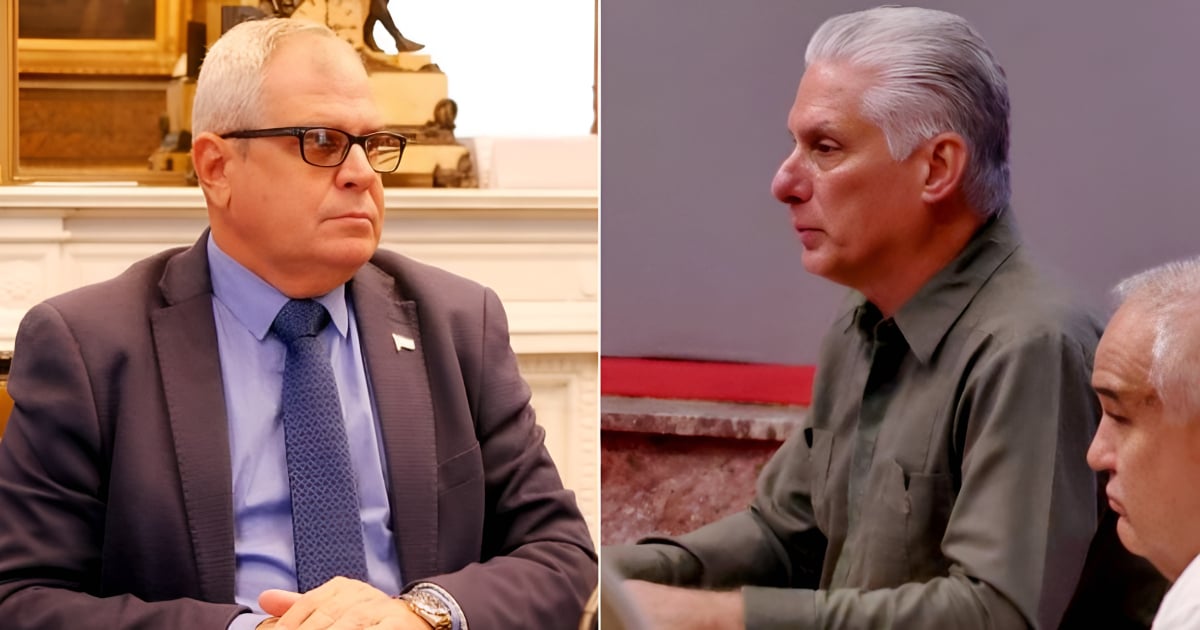
The secretive corridors of Cuban power have revealed an unusual crack this week: Miguel Díaz-Canel has declined to accept the resignation of Homero Acosta Álvarez, one of the regime's most influential yet discreet figures.
This surprising development, announced during a State Council session alongside other accepted resignations, was nearly overlooked by state-run media. Cubadebate merely reported that "the resignations of Ulises Guilarte de Nacimiento and Ricardo Rodríguez González were accepted," subtly bypassing Acosta Álvarez's resignation request.
The absence of Homero Acosta's name from the list of released officials has sparked varied interpretations among analysts and observers: Is this merely an administrative tactic, a sign of internal conflict, or the moral erosion of one of the architects of Castro's legal framework?
According to Esteban Lazo Hernández, the president of the National Assembly of People's Power (ANPP), Acosta Álvarez resigned from his deputy position but not from his state duties. Nonetheless, his resignation seems to have been explicitly rejected for the time being.
Thus, the secretary of the State Council and the ANPP remains in both roles, as well as his status as a deputy, following the leader's decision not to accept his legislative resignation.
A Low-Profile Yet Powerful Figure
At 61, Homero Acosta is one of the most senior and trusted figures in the Cuban regime, yet he remains one of its least visible. A trained lawyer, university professor, and former officer in the Armed Forces, he has held strategic positions at the intersection of the Communist Party, the military, and the parliament for over two decades.
He was once a legal advisor to the Ministry of the Revolutionary Armed Forces and later to the office of the Second Secretary of the Communist Party, held by none other than Raúl Castro. Since then, Acosta Álvarez has solidified his role as a notary of power, translating the top echelon's political decisions into legal language.
His rise culminated with his appointment as Secretary of the State Council in 2009, and later as Secretary of the National Assembly in 2019, roles that made him the chief coordinator of Cuba's parliamentary apparatus. Practically no law or constitutional reform has bypassed his technical review or approval.
The Man Behind the 2019 Constitution
If there's a name synonymous with the legal machinery underpinning the regime, it's Homero Acosta. He was a principal author of the 2019 Constitution, a document that, while appearing to modernize institutions, cemented the Communist Party's absolute power, preserved the state's irrevocable socialist nature, and legally shielded political repression.
During the constitutional process, Acosta Álvarez became the technical and rational face of the project. In state television interviews and international forums, he calmly defended the "superiority of Cuban socialism" and the "need for a strong constitutional order."
However, in recent years, his role has become increasingly linked to managing the system's structural crisis: the de facto dollarization, orchestrated debates in the ANPP on laws and government programs, the legislative power's loss of legitimacy, and the growing inequality between those with access to foreign currency and those living on Cuban pesos.
The Non-Accepted Resignation
The fact that Díaz-Canel accepted the resignations of Guilarte de Nacimiento and Rodríguez González but not that of Acosta Álvarez has been interpreted by some as an attempt to preserve the regime's technical stability. Acosta's importance within the system is undeniable. His figure acts as the legal and administrative glue of the Cuban state, and his thorough knowledge of legislative mechanics makes him a true gray eminence within the regime.
Without his technical oversight and parliamentary coordination, the institutional framework of Castroism would lose cohesion, explaining why his departure is unacceptable to those in power.
Strain and Dilemmas
Rumors of tensions have circulated for months among Communist Party factions, divided between a "pragmatic" line pushing for partial economic dollarization—crucial for maintaining regime revenue—and an orthodox old guard opposing the inequalities this policy has exacerbated. Homero Acosta, shaped by the idealism of the 80s and tied to the old legal structure of classical socialism, may be facing this moral dilemma: witnessing the system he swore to defend transform into a dual economy where military and leaders live in dollars while ordinary citizens survive on pesos.
The political and legal project that Acosta Álvarez helped codify shows signs of exhaustion. He is not a charismatic ideologue but a technician of power, an institutional operator who has upheld the system's legal scaffolding for years. Yet even such a figure can reach a breaking point, especially when the socialist discourse he defended has morphed into a facade concealing corruption, inequality, and privilege.
Some observers argue that Díaz-Canel cannot afford Acosta Álvarez's resignation at this time. The regime is undergoing a transition of key figures, with historical leaders leaving or being repositioned within the political apparatus. Losing Homero Acosta—with his constitutional expertise and connections in the Party and Armed Forces—would be a significant blow to bureaucratic stability.
Thus, the subtle gesture of "non-acceptance" could be seen as a containment maneuver, a way to buy time while negotiating his continued presence or an "orderly" exit that avoids power vacuums.
A Man of the System in Crisis
Homero Acosta has always embodied the profile of a disciplined and loyal bureaucrat, avoiding grand speeches and frequent media appearances. But his influence is undeniable: he was the one who orchestrated the legal transition between Raúl Castro and Díaz-Canel, supervised the design of the new State Council, and maintains technical control over parliamentary decisions.
If his resignation is due to personal exhaustion, it would signal that even the staunchest pillars of Castroism are beginning to show internal cracks. If, instead, it is a controlled political move, it could mark the start of a power reconfiguration where Díaz-Canel—or rather, Raúl Castro and his military circle—seek to replace old operators with more compliant figures.
No matter the reason, the "non-resignation" of Homero Acosta highlights the regime's vulnerability within its own institutional framework. What once seemed like a monolithic apparatus now shows signs of wear, internal tensions, and moral contradictions.
The jurist who drafted the Constitution that legitimized power might be experiencing the same dilemma the communist elite faces today: continue supporting a crumbling structure or attempt, even quietly, to step away from it. In Cuba, where silence speaks louder than words, Homero Acosta's desire to leave—and the power's refusal to let him—says much more than official statements ever will.
Understanding Cuba's Political Landscape
Why didn't Díaz-Canel accept Homero Acosta's resignation?
Díaz-Canel likely rejected the resignation to maintain the regime's technical stability. Homero Acosta plays a crucial role in the legal and administrative framework, making his departure potentially destabilizing.
What role does Homero Acosta play in the Cuban government?
Homero Acosta serves as the Secretary of the State Council and the National Assembly, acting as a key legal and technical coordinator within the Cuban parliamentary system.
What could Acosta's attempted resignation indicate about the Cuban regime?
Acosta's attempted resignation might signal internal tensions, moral dilemmas, and the erosion of the regime's foundational structures as it faces economic and political challenges.