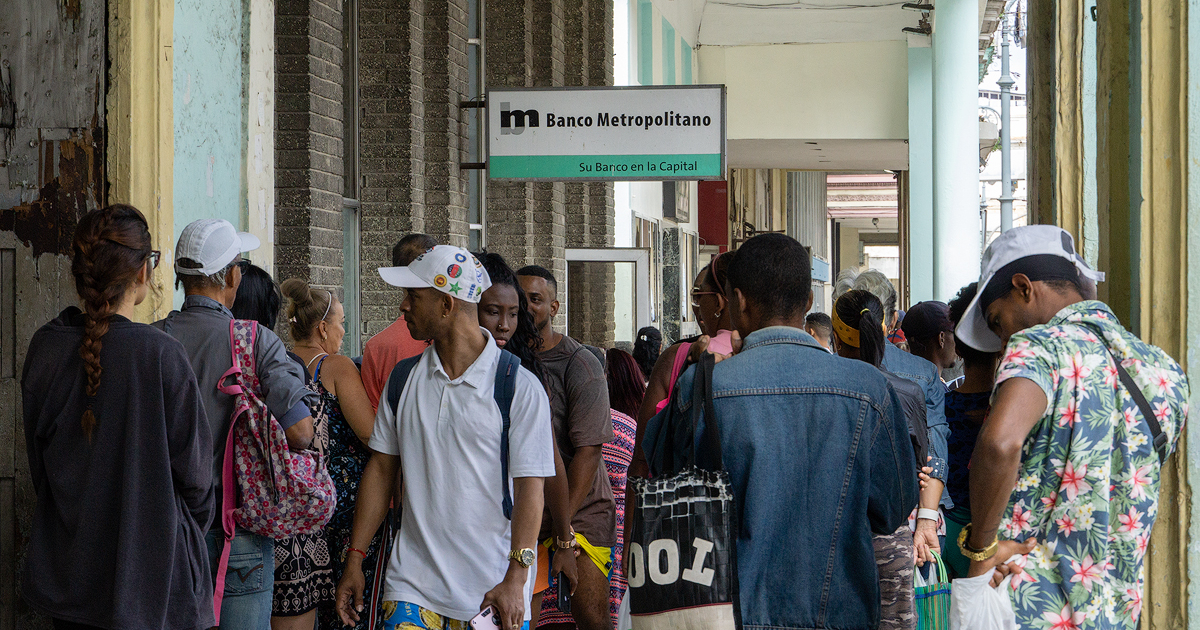
The Central Bank of Cuba (BCC) admitted on Wednesday that the newly established official exchange rate "is not what many anticipated." This pertains to the relaunch of the currency exchange market that took effect on December 18, setting the dollar at 410 Cuban pesos (CUP) and the euro at 481.42 CUP.
Ian Pedro Carbonell, Director of Macroeconomic Policies at the BCC, made this admission in an interview with the official outlet Cubadebate. Carbonell stated that the measure aims to "organize currency flows and establish an official, transparent, and legal market." However, he acknowledged that the new system would not immediately eliminate the informal market.
This overhaul of the exchange system is part of the so-called Macroeconomic Stabilization Program promoted by the regime, introducing three segments with different official rates. Carbonell explained that the new model "reflects the real conditions of the economy," which is grappling with a declining GDP, currency shortages, and a persistent fiscal deficit. Nonetheless, the initiative appears belated and limited in scope, in a country where the population has long valued the Cuban peso based on the informal market.
Rather than correcting distortions, the official exchange rate closely aligns with street prices, effectively validating the value imposed by the parallel market over the years. The independent outlet elTOQUE reports the dollar at 440 CUP and the euro at 480 CUP, figures nearly identical to those published by the Central Bank and CADECA. This unusual convergence highlights the government's failure to impose a realistic exchange rate without relying on the underground economy benchmark. The "new floating exchange market" does not combat informality; it assimilates and formalizes it under state control.
During a televised appearance, Central Bank President Juana Lilia Delgado announced the measure, presenting the new three-segment system and defending the introduction of a floating rate "to restore the purchasing power of the Cuban peso." However, the outcomes reflect a different reality: the official rate is almost at the level of the informal market, implicitly acknowledging the failure of previous currency policies.
With the new rate of 410 pesos per dollar, the national average salary, set at 6,685.3 CUP, equates to merely $16.30 per month, a negligible increase from the previous scenario. The minimum wage, at 2,100 CUP, amounts to $5.12 at the official rate and $4.77 at the informal rate, placing it among the lowest in Latin America. The average Cuban salary increases by just one dollar following the introduction of the new rate, while the prices of food, medicine, and essential goods remain in freely convertible currency (MLC), inaccessible to most Cubans.
Economist Javier Pérez Capdevila recently estimated that living in Cuba costs over 50,000 pesos monthly, about eight times the average salary. "Work in Cuba does not sustain a dignified life," he wrote on social media, noting that the minimum wage "does not cover even a tenth of a family's basic needs."
The Central Bank has insisted that the floating rate will be adjusted periodically and even daily, according to market conditions, but it has not explained how it will ensure the necessary currency supply to support the system. For now, the institution itself admits that the new market "will only sell what it buys," meaning it will rely on capturing dollars through exports, remittances, and CADECA sales.
The result is a scheme that neither restores confidence in the Cuban peso nor changes the reality of an economy still dollarized in practice. For most Cubans, the peso continues to lose value daily, and the true exchange rate remains determined on the street.
Understanding Cuba's Exchange Rate Dilemma
Why did the Cuban government introduce a new exchange rate?
The Cuban government introduced a new exchange rate to organize currency flows, establish an official market, and adjust to real economic conditions. However, the new system acknowledges the persistence of the informal market.
How does the new exchange rate impact the average Cuban salary?
The new exchange rate has a minimal impact on the average Cuban salary, which converts to only $16.30 per month, with the minimum wage being among the lowest in Latin America.
What challenges does the Cuban economy face with the new exchange system?
The Cuban economy faces challenges such as a declining GDP, currency shortages, and a dollarized economy. The new system does not address the reliance on the informal market, which continues to determine the real exchange rate.