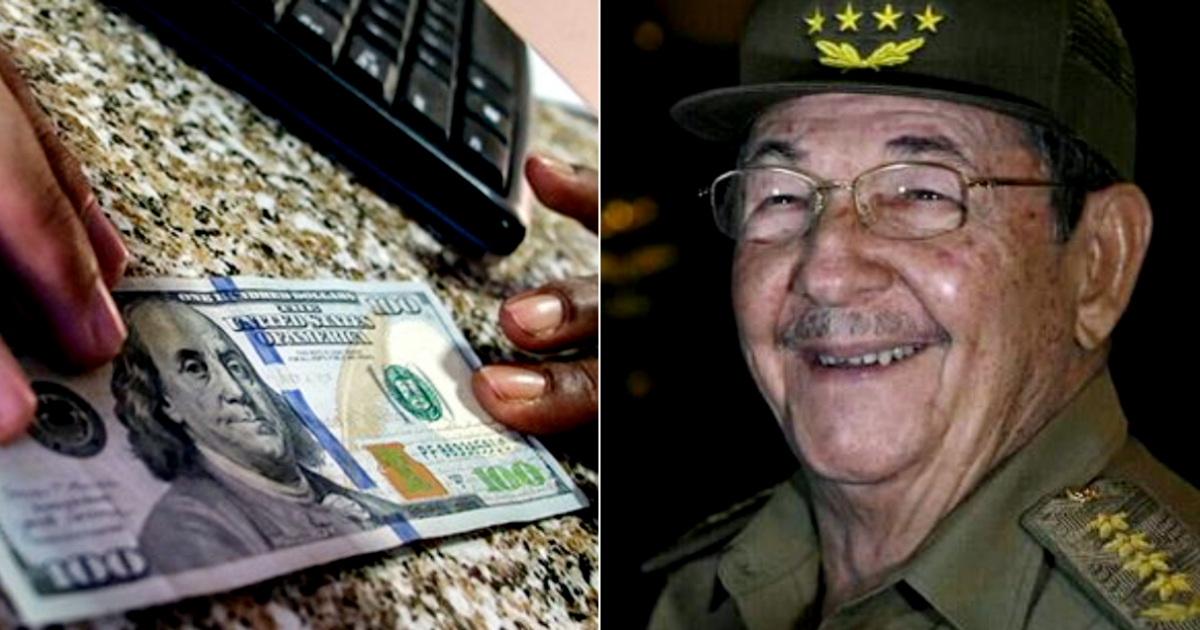
Mauricio de Miranda Parrondo, a renowned Cuban economist, has expressed strong disapproval of the latest exchange rate policy announced by the Central Bank of Cuba (BCC). He argues that the three official rates approved by the Cuban government not only exacerbate existing economic distortions but are also crafted to benefit military-run companies under the conglomerate GAESA.
In a detailed social media post, De Miranda described the government's decision to maintain a system of multiple exchange rates as a "classic economic policy blunder." He explained that such a strategy "segments markets, creates negative incentives, and leads to distortions." According to him, the BCC's decision will keep the population and private entrepreneurs out of a genuine currency market.
A Complex Exchange Rate System
The coexistence of three exchange rates — 1 CUP per 24 USD, 1 CUP per 120 USD, and a fluctuating daily rate — exemplifies what De Miranda calls "a new economic absurdity" and is a tacit acknowledgment of the regime's failed monetary policies.
The official announcement by BCC President Juana Lilia Delgado Portal introduced a third "floating" exchange rate segment, with its value published daily. The other segments retain rates of 1 CUP per 24 USD for basic state operations, and 1 CUP per 120 USD for export-capable entities. The government claims this new scheme aims to "organize currency flows" and "prevent abrupt devaluations." However, De Miranda argues it is a political and financial control mechanism rather than an economic opening.
The Beneficiaries: GAESA
De Miranda explicitly highlighted that companies controlled by GAESA (Grupo de Administración Empresarial S.A.) — a military conglomerate dominating tourism, finance, foreign trade, and foreign investment in Cuba — will be the primary beneficiaries of this setup.
"What do they want? To give special conditions to certain segments (GAESA among them) to operate imports at a 1x24 rate that is unsustainable for the country?" he questioned, warning that this exchange rate design perpetuates military privileges while penalizing the rest of the economy.
His analysis suggests that maintaining a 1x24 rate for "strategic" state operations effectively subsidizes these enterprises' imports, allowing them access to foreign currency at rates far below their actual value. In contrast, other actors, particularly private ones, must operate at significantly higher rates or resort to the informal market.
Economic Illusions
De Miranda questioned the macroeconomic logic behind the new policy. He believes it doesn't address any causes of the currency crisis but instead deepens the regime's self-deception by pretending that "because the government decides the dollar is worth 24 pesos, the market will accept it."
"That's not how economics works, Madam Minister-President of the BCC. You should know this, and so should the Council of Ministers," he remarked, directly criticizing the current economic leaders' lack of realism and technical knowledge.
His argument aligns with the international academic consensus: multiple exchange rate systems create parallel markets, fuel speculation, and erode national currency credibility. Studies from the International Monetary Fund and economist Sebastián Edwards demonstrate that such systems cause inefficiencies, corruption, and loss of international reserves, while maintaining state control over currency flow.
The People Left Out
Another critical point in his argument was the official hypocrisy in claiming these measures "protect the population." De Miranda openly challenged the BCC minister's assertion about preventing abrupt devaluations to protect the people. "Is the population going to operate at rates of 1x24 or 1x120? I don't think so," he noted.
In reality, ordinary Cubans will only have access to the third segment, the so-called "floating" rate, which will depend on the flow of currency entering the official system — predictably limited — while large state operators continue benefiting from unrealistically fixed rates.
The foreseeable consequence, he warns, will be the persistence of the informal market as the true reference point for the dollar's value. Even the Central Bank has admitted that this market "will not disappear immediately," confirming that the new system won't resolve the currency shortage or the lack of trust in the Cuban peso.
Partial Dollarization and Growing Inequality
De Miranda also warned about the social impacts of this model: "Partial dollarization of the economy will not improve the people's living conditions. It will deepen social disparities, hit the poorest hardest, and undermine the Cuban peso's sovereignty."
His warning resonates with other Cuban economists and contemporary economic literature. Research by Levy-Yeyati and Sturzenegger highlights that partial dollarization processes increase inequality, as currencies become concentrated in sectors with privileged market access, leaving the majority trapped in a weak, powerless currency.
A Unified Exchange Rate: The Only Path Forward
As a solution, De Miranda reiterated that the only sensible way forward is to unify the exchange rate, alongside real monetary reform to establish a stable, transparent regime: "The exchange rate must be one, that is, unified," he emphasized.
The economist proposed classic stabilization options such as a currency board (like Argentina's in the 1990s), a crawling peg, or a link to a basket of currencies, provided they are backed by reserves and fiscal discipline. However, he warned that as long as the current centralized model persists, without Central Bank independence or private sector openness, any reform will merely be "crisis window dressing."
In conclusion, the new exchange rate system, far from being an economic opening, represents — according to De Miranda — a maneuver to financially sustain GAESA's military-business apparatus, consolidating inequality and political control over the economy.
His analysis, backed by decades of economic theory, dismantles the official rhetoric: there is no reform, only imitation; no stability, only manipulation; and no market, only control.
Implications of Cuba's New Exchange Rate Policy
What are the three exchange rates introduced by Cuba's Central Bank?
The Central Bank of Cuba introduced three exchange rates: 1 CUP per 24 USD for basic state operations, 1 CUP per 120 USD for export-capable entities, and a floating rate that is published daily.
Why does Mauricio de Miranda criticize the new policy?
Mauricio de Miranda criticizes the new policy for exacerbating economic distortions and being designed to benefit military-run enterprises, particularly those under GAESA, while excluding the general population and private entrepreneurs from a real currency market.
How does the new exchange rate system affect ordinary Cubans?
Ordinary Cubans are likely to be limited to the floating exchange rate, while state-operated enterprises benefit from fixed, unrealistic rates. This situation leaves the informal market as the true reference for the dollar's value, which does not resolve the currency shortage or build trust in the Cuban peso.