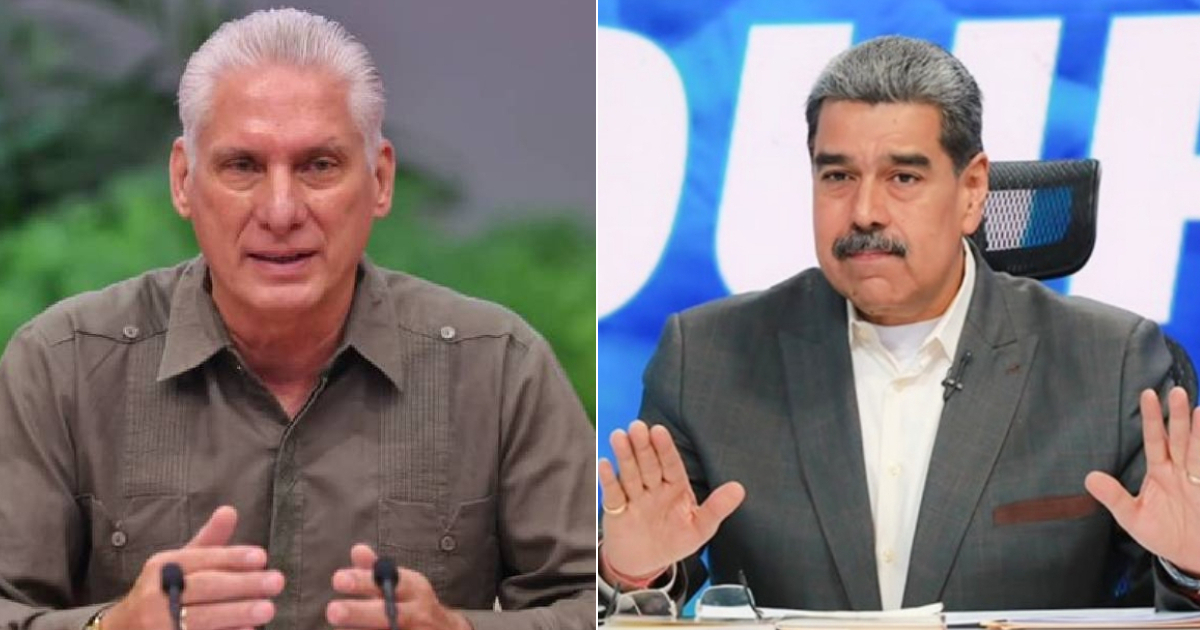
Cuba's leader, Miguel Díaz-Canel Bermúdez, has voiced strong support for Venezuelan President Nicolás Maduro, following President Donald Trump's announcement of an all-encompassing oil blockade against the South American nation.
Through a social media post, Díaz-Canel expressed: “We vehemently oppose the U.S. government's naval blockade of Venezuela. We stand firmly with President Nicolás Maduro, the Bolivarian and Chavista Revolution, and their People's-Military Union. We fully endorse the statement released by the Venezuelan government.” The post also included the official statement issued by the Venezuelan government.
The declaration from the Bolivarian Republic of Venezuela, dated in Caracas, denounces what it terms as a “grotesque threat by Mr. Trump,” asserting that the U.S. announcement violates international law, free trade, and freedom of navigation. The document claims that the U.S. President seeks to irrationally impose a supposed military naval blockade on Venezuela with the intent of seizing the nation’s wealth.
The statement further mentions that Venezuela will bring the issue to the United Nations and urges “the people of the U.S. and the peoples of the world to reject this threat.” It also references a statement attributed to Trump, where he allegedly stated: “until all the oil, land, and other assets that were previously stolen from us are returned to the U.S.”
Cuban Foreign Minister Bruno Rodríguez Parrilla also took to the same platform to declare: “We reject the naval blockade against Venezuela announced by the #U.S., as it constitutes a grave violation of International Law and intensifies the aggression against the Bolivarian government. Our unwavering support goes to the constitutional President Nicolás Maduro, the Bolivarian and Chavista Revolution, and their People's-Military Union.”
President Donald Trump announced a comprehensive oil embargo on Venezuela, alongside stricter deportation measures, accusing Nicolás Maduro's administration of using energy resources to “fund criminal activities” such as “narco-terrorism, human trafficking, murder, and kidnapping.”
Trump stated that Venezuela is “completely surrounded” by U.S. military forces and warned that these actions will persist “until the country returns all the oil, lands, and other assets” that were “previously stolen.”
In his address, Trump labeled the Venezuelan government as an “illegitimate regime” and designated it a “foreign terrorist organization.” The announcement also included tightened immigration policies, emphasizing the expedited deportation of Venezuelan immigrants.
Days before the U.S. announcement, the Cuban government admitted that the oil carried by a seized ship in the Caribbean was destined for Cuba, following complaints that the operation obstructed “the supply of hydrocarbons to the Island.” This admission was made in statements by Foreign Minister Bruno Rodríguez and in a note from the Ministry of Foreign Affairs (MINREX), which described the action as an “act of piracy and maritime terrorism.”
According to reports on the seizure, U.S. authorities confirmed the vessel was transporting sanctioned oil from Venezuela and Iran, intended for Cuba's energy system, which is experiencing a severe supply crisis.
The Cuban government blamed Washington for exacerbating this situation and implementing a policy of pressure against the shipments of Venezuelan crude oil to the Island.
Understanding the U.S. Oil Blockade on Venezuela
What is the U.S. oil blockade on Venezuela?
The U.S. oil blockade on Venezuela is a comprehensive embargo announced by President Donald Trump, aiming to cut off Venezuela's oil exports, which are a major source of revenue for the country.
How has Cuba responded to the U.S. embargo on Venezuela?
Cuba has condemned the U.S. embargo, expressing strong support for Venezuelan President Nicolás Maduro and rejecting what it sees as a violation of international law.
Why did the U.S. impose stricter deportation measures?
The U.S. implemented stricter deportation measures as part of its efforts to pressure the Venezuelan government, which it accuses of using oil revenues to fund illegal activities.