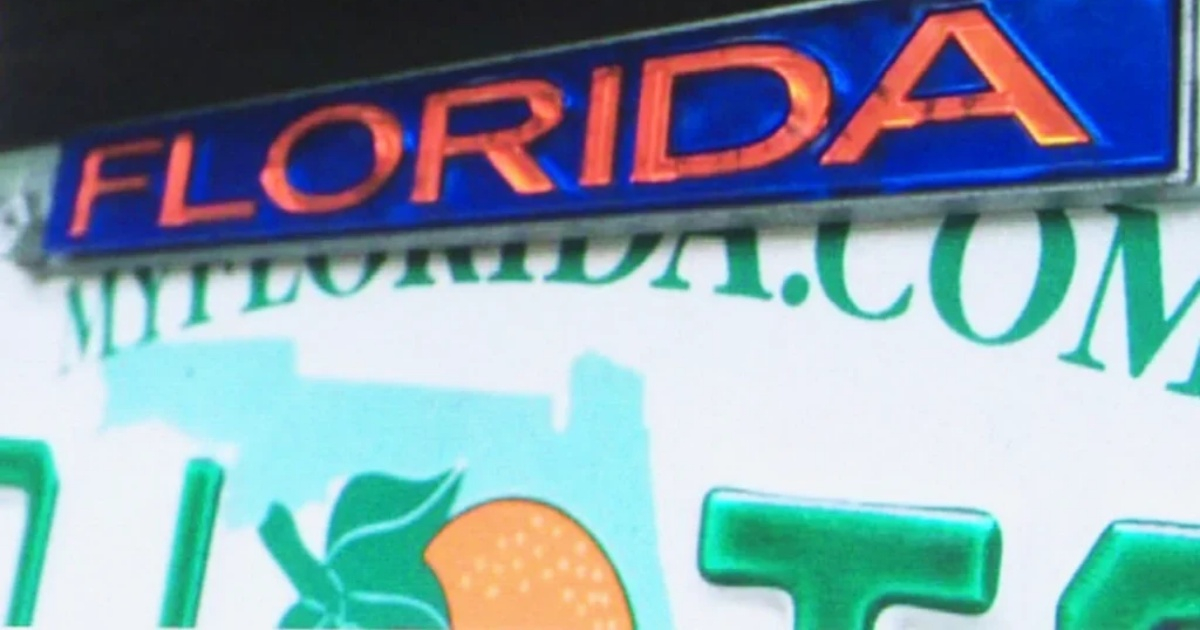
The debate surrounding Florida's recent license plate frame law hit a boiling point following the arrest of Demarquize Dawson, a Broward County resident. His story, which quickly went viral on social media, forced the local police to admit their mistake.
Dawson was stopped by officers from the Davie Police Department because the decorative frame on his rental car's license plate partially covered the "S" in the phrase "Sunshine State."
"He said, 'I'm arresting you because the 'S' on your license plate is hidden: the 'S' from Sunshine,'" Dawson recounted to Telemundo 51, still in disbelief over the incident.
Maintaining that he did not break any laws, Dawson announced his intention to file a formal complaint against the police department.
Error Recognition from Police
Emotionally shaken by the experience, Dawson was taken to a hospital after suffering a panic attack, but was later released on his own recognizance. Following a media uproar, the Davie Police Department publicly acknowledged that the arrest was "invalid" and issued an apology.
In a statement, the police department admitted that the new law's language was "vague, unclear, and open to misinterpretation" when it was first implemented.
"Since the Florida Police Chiefs Association issued a clarifying memo, our officers have received training on how to apply this law correctly. Unfortunately, this arrest was not valid, and we apologize to Mr. Dawson," the statement read.
Julia Ross, the department spokesperson, clarified that frames do not need to be discarded as long as the license plate remains legible and the registration sticker is visible.
Widespread Confusion: A Systemic Issue
This incident is not isolated. In Davie, José Cuellar, a Salvadoran gardener, faced a similar situation when he was stopped by the Highway Patrol for issues related to his license plate.
Unlike Dawson, Cuellar remains detained, highlighting criticism over the lack of clarity and inconsistent enforcement of the law by some agencies. This has sparked concerns about increasingly harsh penalties for minor infractions.
What was once considered a minor traffic violation could now result in a second-degree misdemeanor, carrying penalties of up to 60 days in jail and fines reaching $500.
Understanding the Law
The state law, effective October 1, aims to prevent the use of devices that obscure or alter license plates, such as tinted covers or rotating mechanisms often used to evade tolls or conceal crimes like auto theft.
The initial wording created such ambiguity that even law enforcement agencies misinterpreted the regulations.
The Florida Department of Highway Safety and Motor Vehicles (FLHSMV) had to issue an official clarification: license plate frames are permitted as long as they do not obstruct essential details, namely:
- The alphanumeric identifier (unique numbers and letters).
- The registration sticker in the upper right corner.
"As long as officers can read your numbers and see your registration sticker, you can have a frame," explained Officer Ross.
Public Response and Informative Measures
In response to the confusion, Miami-Dade Tax Collector Dariel Fernández distributed images and pamphlets to visually demonstrate which types of frames are permissible.
"It's important to explain to the community that if you have one of these frames that do not block any information on your plate... for now... there’s no problem," he stated.
Both the police and the Department of Safety recommended a preventive approach: if there is any doubt about the legality of the frame, it is best to remove it.
Doral Police Chief Edwin López was blunt: "Frankly, it's that simple. It's a recommendation I've given to my parents."
Balancing Aesthetics and Legality: A Controversial Law
The new law does not categorically ban personalized frames but enforces strict legal boundaries. Prohibited items include:
- Frames covering key identifiers.
- Sprays or films altering the color or brightness of the plate.
- LED lights or reflective coatings.
- Rotating mechanisms or anything altering plate visibility.
Although authorities emphasize that the aim is not to penalize regular drivers but to curb criminal practices, incidents like Dawson’s have raised alarms about police overreach, legal ambiguities, and excessive penalties.
Conclusion: A Law Misunderstood
Demarquize Dawson's arrest not only highlighted a specific police misinterpretation but also underscored the risks of enforcing unclear laws with criminal consequences.
The initial lack of clarity and the pressure to enforce new regulations have led to situations that, as the affected individual noted, demand urgent review:
"There was a lot of controversy in court about what’s right and wrong with this new statute... Something needs to be done because this isn't right."
A partially covered "S" ended up revealing a much deeper issue: the necessity for laws to be clear, proportional, and applied with common sense.
FAQs on Florida's License Plate Frame Law
What does the new Florida license plate law prohibit?
The law prohibits devices that obscure or alter license plates, such as tinted covers, rotating mechanisms, and frames that cover essential details like the alphanumeric identifier and registration sticker.
Are license plate frames completely banned in Florida?
No, license plate frames are not completely banned. They are allowed as long as they do not obstruct the license plate's essential information, including the alphanumeric identifier and the registration sticker.
What are the penalties for violating the new law?
Violating the new law could result in a second-degree misdemeanor, with penalties including up to 60 days in jail and fines up to $500.