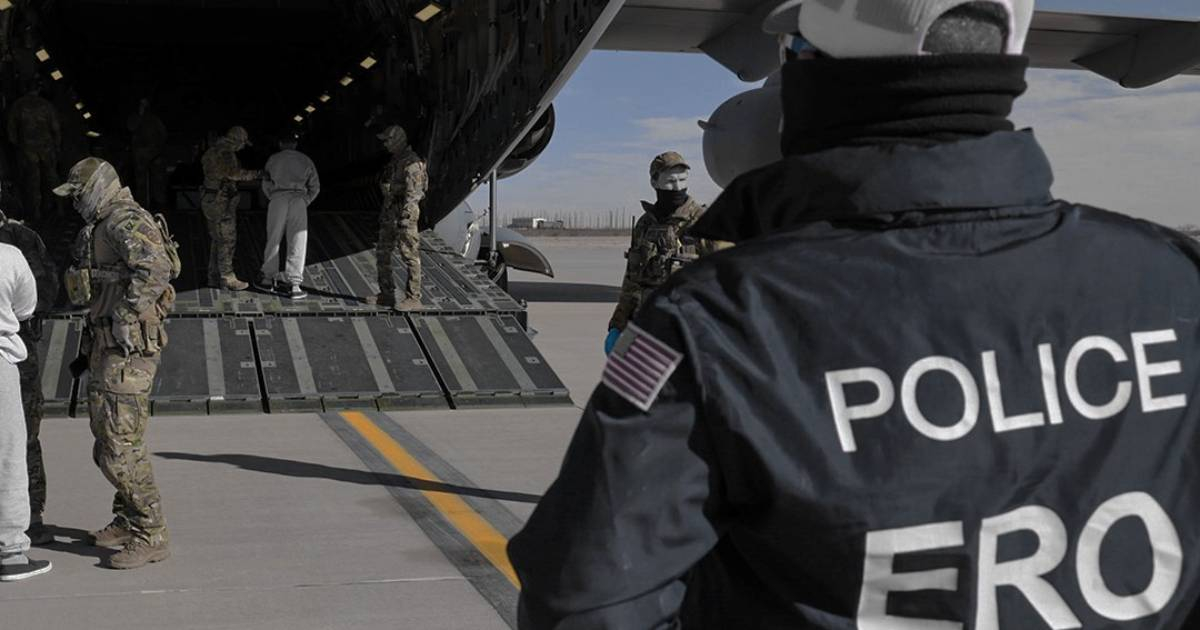
The United States has resumed the transfer of Cuban migrants to the Guantanamo Bay naval base, reigniting a practice fraught with symbolism and controversy that had been paused for several months.
This latest relocation of 22 Cuban men from U.S. soil marks the first such transfer to the facility since January, reviving fears, memories, and legal questions.
According to The New York Times, these Cubans arrived this week at the base in eastern Cuba via a charter flight operated by the Immigration and Customs Enforcement (ICE) from Louisiana.
With their arrival, Guantanamo once again serves as a migrant detention center, despite facing legal setbacks, high costs, and severe criticism throughout the year.
The American newspaper reports that at least five of the newly arrived individuals have been deemed "high-risk illegal aliens" and are being held in a prison that once housed alleged Al Qaeda members. The rest are accommodated in dormitory-style facilities traditionally used for Caribbean migrants seeking asylum.
The Department of Homeland Security has refrained from specifying the ultimate fate of these Cubans, leaving uncertainty about whether they may be returned to Havana's regime.
Political and Legal Tensions
The return of Cubans to Guantanamo follows a period of back-and-forth. In March, U.S. officials defended their authority in court to detain migrants at the base, while organizations like the American Civil Liberties Union (ACLU) criticized "inhumane" conditions, limited legal access, and detainees' descriptions of the site as a "living hell," according to reports from the Associated Press.
Shortly afterward, the Trump administration moved the last remaining migrants to U.S. detention centers, leaving the base empty for the second time in a matter of weeks.
In April, the issue resurfaced in Washington when it was revealed that the administration had spent nearly $40 million in just one month to house around 400 immigrants at Guantanamo.
Financial and Human Costs
Democratic senators labeled the operation as an unnecessary expenditure and harshly criticized the use of military resources for immigration purposes, as reported by The New York Times.
Additional criticisms include inadequate facilities lacking air conditioning and proper electricity, along with incendiary remarks from figures like Secretary of State Marco Rubio, who allegedly stated, according to EFE, that some migrants were "worse than Al Qaeda members."
The legal backdrop is also significant. This recent transfer of Cubans is the first since a federal judge in Washington ruled that the Trump administration overstepped its authority by detaining migrants at the naval base.
In December, another judge blocked the administration's attempt to dismiss a lawsuit against this policy, preliminarily siding with the ACLU's argument that sending migrants to a military base on foreign soil is illegal and merely a "political spectacle."
Historical and Emotional Context
For Cubans, Guantanamo carries deep historical resonance. During the 1990s, tens of thousands were held there after being intercepted at sea, an experience marked by uncertainty and displacement.
Today, decades later, the return of Cuban nationals to this base stirs old ghosts amid an unprecedented migration crisis, where fears of deportation, family separation, and legal limbo are daily realities.
As Washington continues to defend the use of Guantanamo as an immigration tool, the resumption of these transfers places Cubans once again at the heart of a costly and controversial policy, whose human impact remains, for many, the most painful part of the story.
Key Questions about Cuban Migrants at Guantanamo Bay
Why has the U.S. resumed sending Cuban migrants to Guantanamo?
The U.S. has resumed this practice as a part of its immigration policies, despite legal challenges and criticisms regarding the conditions and costs associated with detaining migrants at the base.
What are the legal implications of detaining migrants at Guantanamo?
Legal challenges have been raised, arguing that detaining migrants at a military base on foreign soil exceeds the administration's authority and serves as a political spectacle, according to the ACLU.
How are the detained Cuban migrants being housed at Guantanamo?
Some are classified as high-risk and held in a prison facility, while others are housed in dormitory-style accommodations traditionally used for asylum seekers.