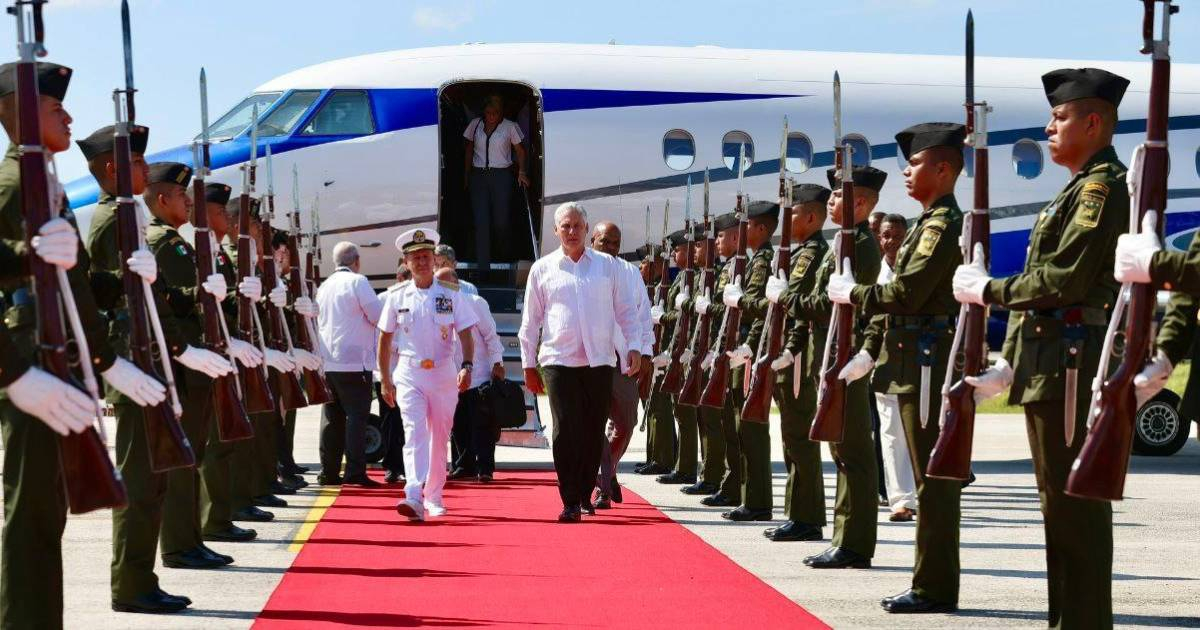
A prolonged stay of an executive jet associated with Cuba’s ruling elite has sparked concerns among Mexican media, reigniting longstanding questions about the privileges, secrecy, and international movements of the Island’s governing class.
The initial report came from Latinus, which disclosed that a Dassault Falcon 900EX, bearing the registration T7-77PR, had been parked for several days at the Aeropuerto del Norte in Apodaca, Nuevo León.
Latinus offered an in-depth account of the aircraft, highlighting routes, dates, registration, and usage history based on air traffic monitoring data and transparency organization reports.
According to Latinus, on December 9, the jet executed an unusual series of flights in a single day, covering the Cayman Islands, Panama, Colombia, Cuba, and Mexico, before settling in Mexican territory.
This aircraft has reportedly carried key figures of Cuban power, including Miguel Díaz-Canel and Raúl Guillermo Rodríguez Castro, Raúl Castro's grandson, known as "El Cangrejo."
The issue was picked up by El Norte, which described a "controversy" among Aeropuerto del Norte users due to the atypical, non-touristic routes of the jet and the notable individuals alleged to have used it, including leaders from Cuba and Venezuela. The publication emphasized the unusual nature of these operations at an airport that typically doesn’t host such flights.
Additionally, El Buen Tono, an independent outlet based in Veracruz, confirmed the jet had been parked in Apodaca for at least five days and noted that the Falcon 900EX is registered in San Marino. This registration practice is common among aircraft utilized by the Cuba-Venezuela axis, aiming to ease maintenance and complicate international tracking.
The report also highlighted that the airport housing the jet is managed by Grupo Mundo Maya, a company under Mexican military control.
This incident is not isolated. For years, journalistic investigations have revealed how Cuban leadership uses luxury private jets, often inherited from close ties with Chavez’s regime, for regional and international travel.
These flights starkly contrast with the dire situation on the Island, characterized by power outages, shortages, a collapsed transportation system, and unprecedented mass migration.
Once again, Mexico emerges as a pivotal point in this web of discreet travel and safeguarded privileges. While millions of Cubans struggle to leave the country or endure extreme conditions, a jet linked to the ruling elite remains on Mexican soil, shrouded in official silence and unanswered questions.
The widespread coverage of this issue by Mexican media highlights a persistent aspect of power in Cuba: unlimited mobility for a select few, complete opacity, and a widening gap between those in power and those suffering the crisis.
Key Questions about Cuban Jet's Presence in Mexico
Why is the presence of the Cuban jet in Mexico causing concern?
The Cuban jet's presence is raising alarms due to its association with Cuba's elite, its unusual travel routes, and the lack of transparency about its purpose and passengers.
What routes did the Cuban jet take before arriving in Mexico?
Before arriving in Mexico, the jet traveled through the Cayman Islands, Panama, Colombia, and Cuba, all in a single day, which is considered highly unusual.
Who are some of the notable figures reported to have used this jet?
Key figures reportedly using the jet include Miguel Díaz-Canel and Raúl Guillermo Rodríguez Castro, highlighting its connection to Cuba's political elite.
What implications does the jet's presence have for Cuban citizens?
The jet's presence underscores a stark contrast between the privileges of Cuba's elite and the hardships faced by ordinary Cubans, who endure shortages and seek to emigrate in large numbers.