During his address at the 11th Plenary Session of the Communist Party (PCC), Miguel Díaz-Canel once again turned to one of his most oft-repeated phrases: "Our greatest strength is unity, rooted in debate, criticism, and conscious discipline. The heroic people remain our greatest inspiration."
At first glance, it sounds like a worn-out declaration of ideals; in practice, however, it underscores the growing disconnect between the authorities who speak of the people and the real populace struggling outside official discourse.
In the regime’s narrative, the Cuban people are an abstraction—a heroic, grateful, and disciplined group always ready to endure hardships, forever convinced of the righteousness of the socialist agenda.
This is the populace found in slogans, murals, news broadcasts, and Party meetings. They are the people carried along by Fidel Castro's nationalistic populism, covered in the dust and rhetoric of deprivation and propaganda. Yet, this imaginary populace exists only in the language of those in power.
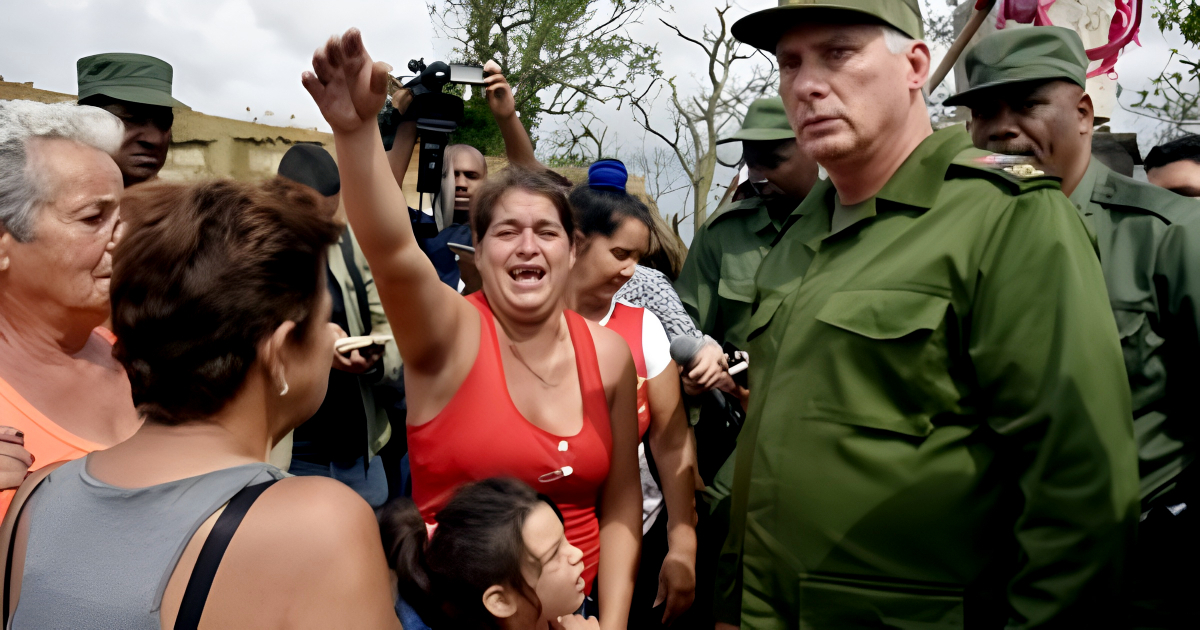
The true Cuban populace—comprised of generations of silenced and fearful families, waiting endlessly in lines and paying exorbitant prices, living amidst blackouts and searching for food in the black market—does not find representation in such rhetoric.
The term "people" has ceased to be a political category and has become a pretext for the system.
When Díaz-Canel claims that "the people's trust in their institutions is built through actions," he glosses over the fact that the country's institutions remain unaccountable and shielded from public scrutiny. There are no mechanisms for citizen oversight or genuine participation. What is touted as dialogue is, in reality, a monologue.
For decades, the official discourse has attempted to replace social complexity with moral unanimity. Being part of the people equates to being within the so-called "revolution"; dissenting means being outside of it. Thus, when the president speaks of the "heroic people," he is actually describing a filtered and tamed version of the citizenry, one that applauds, nods, and remains silent.
The Cuban population is currently enduring one of the most challenging periods in its recent history: declining purchasing power, mass migration, inadequate basic services, and a growing distrust of institutions. Yet, the official rhetoric persists in portraying them as a unified, content, and heroically resigned entity.
The gap between this idealized image and daily reality has become unsustainable.
While the regime speaks of "resistance," millions of Cubans leave the country. As the PCC praises "popular creativity," citizens are forced to improvise to survive without resources. While Díaz-Canel calls for "trust," people respond with silence or sarcasm.
This disconnect is not merely communicative; it is political. A regime that fails to fully acknowledge the political implications of social discontent becomes incapable of governing with legitimacy.
The rhetoric of heroism, once a tool for cohesion, now acts as a mechanism of denial. By insisting on the image of the heroic people, the regime denies the real people—those who question, tire, and leave.
In his speech, the president called for "strengthening the relationship with the people, being more transparent, and more demanding with the cadres." However, without freedom of the press, citizen participation, or free and plural elections, such statements are empty promises. Transparency is not decreed; it is practiced.
In Cuba, the term "people" has been used so often that it has lost its meaning. It has served to justify censorship, impose ideology, legitimize repression, endorse failed policies, and silence those who do not fit the narrative.
Today, when the regime utters it, the majority of Cubans no longer identify with it. The real people are not measured by applause at a plenary session but by their ability to express themselves without fear in an open, free, and plural society.
This is the populace that remains absent from speeches and news broadcasts, yet it is the one that speaks most clearly: through its frustration, migration, protests, satire, and even silence.
While Díaz-Canel asserts that the people remain steadfast, what the people truly say, in hushed tones, is that they no longer believe in the indoctrination and slogans of the dictatorship.
Understanding Cuba's Political and Social Climate
Why is the term "people" considered a pretext in Cuba's political discourse?
The term "people" has been used to justify censorship, impose ideology, and legitimize repressive actions, losing its original political significance and becoming a tool for the regime to maintain control.
How does the official rhetoric in Cuba differ from the reality experienced by its citizens?
The official rhetoric portrays the Cuban people as unified and content, while in reality, they face economic hardships, declining services, and widespread distrust of institutions, leading to mass migration and social discontent.
What challenges is the Cuban population currently facing?
Cubans are experiencing a decline in purchasing power, mass migration, inadequate basic services, and increasing distrust towards the government and its institutions.