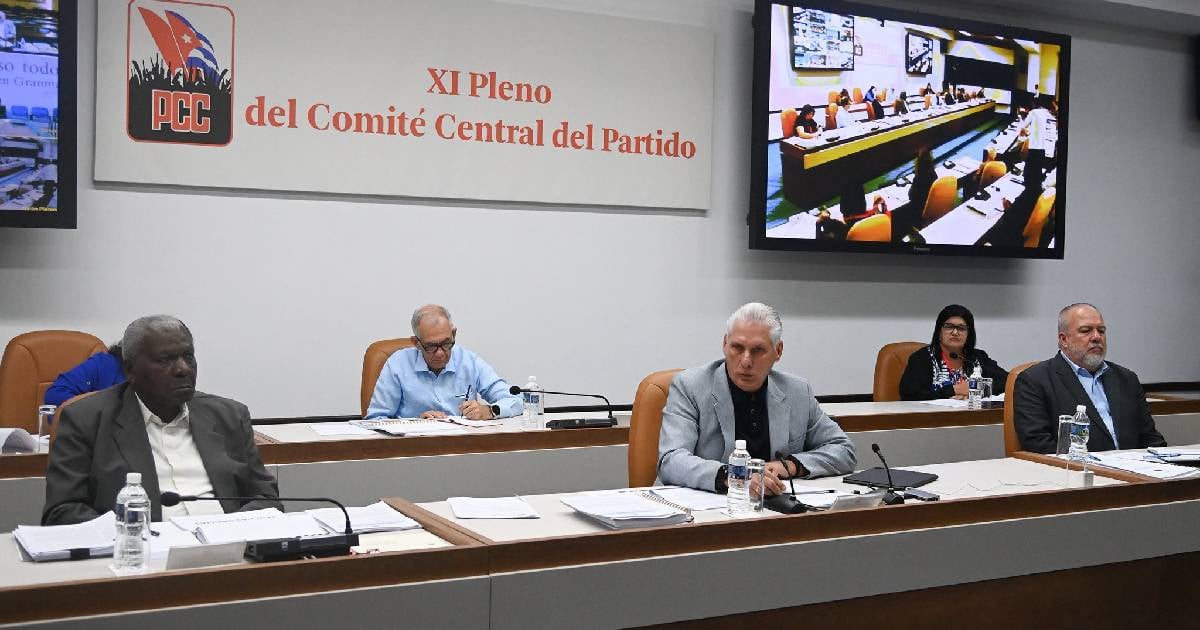
Miguel Díaz-Canel, the First Secretary of the Central Committee of the Communist Party of Cuba (PCC), recently claimed that "each day of the Revolution is a victory" as Cuba faces "the most powerful enemy" with "immense dignity."
This statement was shared via X by the Presidency, extracted from Díaz-Canel's remarks during the XI Plenary Session of the PCC Central Committee, held in Havana this Saturday via videoconference.
However, his assertion prompted a swift backlash from numerous users who challenged the official narrative, questioning the concept of dignity in a nation plagued by extended power outages, food shortages, health crises, and deteriorating living conditions.
Many pointed out that this so-called dignity does not equate to food, electricity, water, or medicines for the majority of Cubans.
Some users dismissed the "external enemy" thesis, arguing that the United States is not directly responsible for the crisis, highlighting imports of food, medical supplies, and other goods from the U.S.
Others demanded free and plural elections, labeling Cuba's political system a dictatorship that does not allow opposition.
The criticism also focused on the privileges enjoyed by the ruling elite, contrasting the rhetoric of sacrifice with images of well-fed, overweight leaders who have stable access to basic services and comforts denied to most people.
"Dignity doesn't feed you or light up your home," wrote one user, while another described the official message as "a victory of hunger."
Many comments echoed the sentiment that the Revolution "is no longer for everyone," but rather for a minority, and that the true adversary facing the nation is poverty, destitution, and lack of freedoms.
Others described the speech as a long-standing lie, disconnected from the daily reality of Cubans, repeated for over six decades.
The publication highlighted the gap between the optimistic narrative of those in power and the dissatisfaction openly expressed on social networks, where the government's notion of dignity is increasingly questioned by a populace whose everyday life is filled with shortages, repression, and no political alternatives.
During the session, Díaz-Canel also urged political transformation within the organization, stating that bureaucracy and inertia should no longer "be obstacles" to the country's development.
Yet, his words contrasted sharply with a wave of public criticism regarding repeated promises of change since 1959 without visible results, the lack of austerity and altruism among leaders, and the disconnect between power and the actual living conditions of the populace.
The XI Plenary of the PCC's Central Committee convened solely this Saturday via videoconference, a decision made by the Political Bureau due to the severe health crisis and fuel shortages plaguing the nation.
During the meeting, the party leadership promoted General of the Army Corps Roberto Legrá Sotolongo, first deputy minister and chief of the General Staff of the Revolutionary Armed Forces (FAR) since 2021, to a member of the PCC's Political Bureau.
Key Questions on Cuba's Current Situation
What are the main criticisms of Díaz-Canel's statement?
Critics argue that Díaz-Canel's statement about daily victories does not align with the harsh realities of food shortages, power outages, and lack of basic necessities faced by ordinary Cubans.
How do some Cubans view the role of the United States in their crisis?
Some Cubans reject the notion that the United States is the direct cause of their current crisis, pointing out that there are imports from the U.S., including food and medical supplies.
What changes do critics demand in Cuba's political system?
Critics are calling for free and plural elections, as they consider the current political system a dictatorship that suppresses opposition.