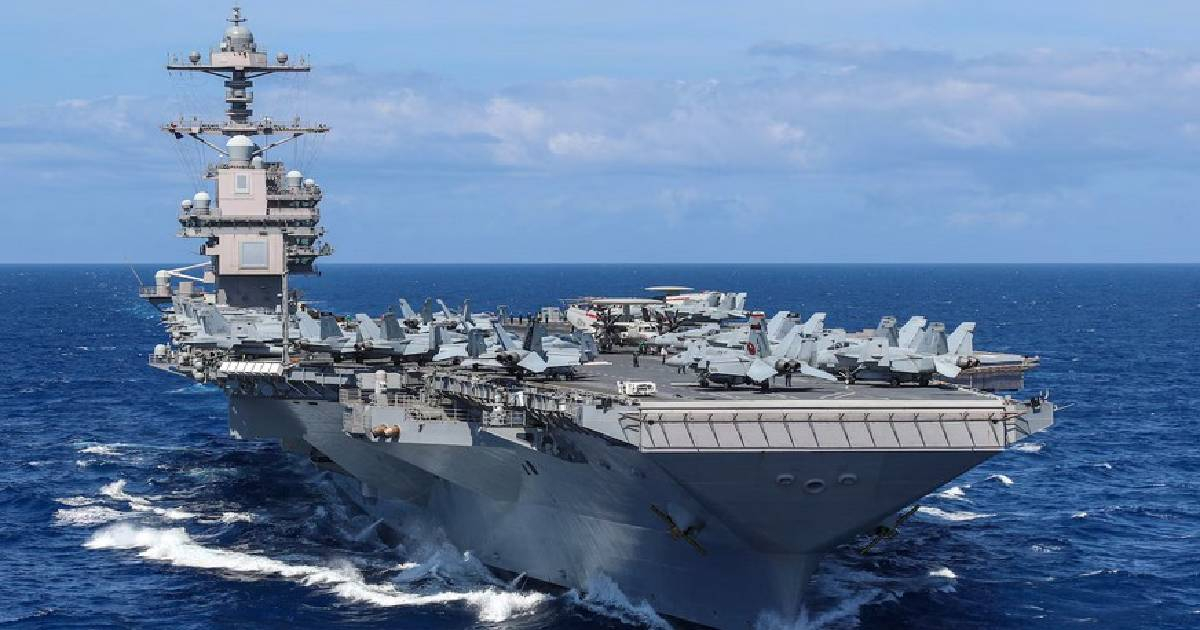
An image from the Sentinel 2 satellite has confirmed that the USS Gerald R. Ford, a nuclear-powered aircraft carrier, has shifted its operations area, moving deeper into the central Caribbean. This new position brings it significantly closer to Venezuela than it was in previous days.
On Friday, December 12th, satellite records showed the largest U.S. nuclear carrier approximately 380 miles (around 611 kilometers) south-southwest of Ponce, Puerto Rico. This marks its furthest southern movement since entering the Caribbean theater, as reported by the digital news outlet La Patilla.
The discovery was highlighted by open-source intelligence analyst @MT_Anderson, noting it as the most southern position detected for the USS Gerald R. Ford in the Caribbean basin to date.
The satellite image also revealed at least one Arleigh Burke-class destroyer navigating alongside the CVN-78. However, heavy cloud cover obscured the complete composition of the escort group accompanying the aircraft carrier.
This repositioning places the U.S. strike group firmly in the central Caribbean, significantly reducing flight times to the northern coast of South America and expanding its operational range.
Military Movements and Regional Tensions
The shift coincided with reports of F/A-18E Super Hornet jets operating north of the ABC islands, enhancing the carrier's air projection capabilities from its new location, closer to Venezuela's maritime boundaries.
Amid escalating tensions between Caracas and Washington, Venezuelan Defense Minister Vladimir Padrino López issued a stern warning to the United States following the flyover of American military aircraft near the state of Zulia. "Do not be mistaken; we know how to defend Venezuelan airspace," he declared, asserting that the Bolivarian Armed Forces are prepared to respond to what he described as "Pentagon provocations" during a military event broadcast by state television.
Economic Pressure and Diplomatic Strain
On the same day, it emerged that the U.S. offensive against Venezuela's oil industry had entered a more aggressive phase, with plans to seize additional vessels as part of a campaign to financially destabilize the Maduro government. According to The Wall Street Journal, cited by Infobae, this strike is more damaging to the Chavismo regime than actions against drug-trafficking-related ships, as it threatens the oil flow crucial for the government's survival.
The seizure of a massive oil tanker loaded with Venezuelan crude off the nation's coast has become the most symbolic episode in the ongoing standoff between Washington, Caracas, and Havana. President Donald Trump portrayed the operation as capturing "the largest tanker ever seized" by the United States, sending a combined military, economic, and direct warning to the network of ships maintaining sanctioned oil flows to Cuba and other destinations.
Operation Southern Spear
Since September 2, 2025, the United States has intensified a military offensive in the Caribbean and eastern Pacific under the guise of combating drug trafficking and "narco-terrorism." The so-called "Operation Southern Spear" has ramped up pressure on Caracas with a naval blockade and daily aerial operations to intercept vessels allegedly linked to drugs.
However, the Maduro government, with some officials accused by Washington of alleged drug trafficking ties, sees this deployment as an attempt to instigate regime change in Venezuela. These operations have led to the destruction of 23 boats and the deaths of 87 individuals, drawing criticism for the lack of verifiable public evidence and the use of military force without a formal declaration of war.
The United Nations High Commissioner for Human Rights has labeled these actions as "violations of international law," demanding an end to extrajudicial executions at sea. Additionally, U.S. lawmakers and human rights organizations have questioned the legality of these operations, conducted without judicial oversight and outside U.S. territory.
Key Questions on the USS Gerald R. Ford's Movements and U.S.-Venezuela Tensions
What is the significance of the USS Gerald R. Ford's new position in the Caribbean?
The USS Gerald R. Ford's repositioning into the central Caribbean shortens flight times to South America's northern coast and enhances its operational range, increasing U.S. military presence near Venezuela.
How has Venezuela responded to the U.S. military presence?
Venezuelan Defense Minister Vladimir Padrino López issued a warning to the U.S., asserting Venezuela's readiness to defend its airspace against perceived provocations from the Pentagon.
What is Operation Southern Spear?
Operation Southern Spear is a U.S. military initiative aimed at combating drug trafficking and "narco-terrorism" in the Caribbean and eastern Pacific, involving a naval blockade and aerial operations near Venezuela.