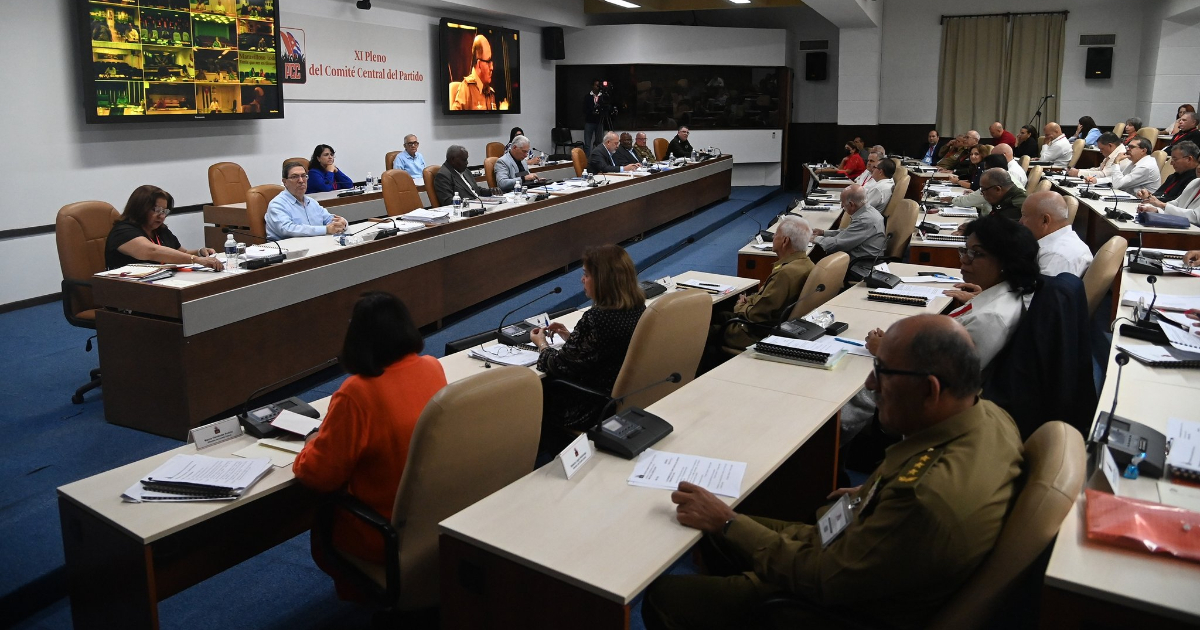
The 11th Plenary Session of the Central Committee of the Communist Party of Cuba (PCC) convenes this Saturday amid an unprecedented economic crisis, escalating social discontent, and a political landscape characterized by secrecy, simulation, and propaganda.
Rather than serving as a genuine forum for discussion or self-criticism, this plenary—reduced to a single-day videoconference—has become a political and communicational maneuver. Its aim is to maintain the facade of unity around the regime while, in reality, deep structural changes are being consolidated that favor the ruling elites, exacerbating inequality and social injustice.
A Brief Plenary in a Nation on the Brink
The reduction of the plenary to a single virtual session is a symbol of the crisis itself. Although the Political Bureau justified this move by citing “cost reduction” and “maintaining officials in their territories,” it truly reflects the state's material and political incapacity to uphold even its own power rituals.
The Party's highest body—which should be a space for strategic direction and analysis—has been reduced to a controlled digital connection, devoid of real debate or public presence. This trend is also evident in the National Assembly of People's Power, which will similarly convene for just one day via videoconference this month, mirroring the pattern of institutional reduction and democratic formality loss, even within the dictatorship itself.
The Context: Legalized Dollarization and Institutionalized Inequality
The meeting takes place just a week after the implementation of Decree-Law 113/2025, which legalizes the partial dollarization of the economy and establishes a state-controlled multi-currency system. Economy Minister Joaquín Alonso Vázquez presented the decree as a "technical update," but its content demonstrates a direct continuation of Alejandro Gil Fernández's model, the former minister disgraced by corruption and espionage charges.
The decree establishes a "foreign exchange management and allocation system," where the Ministry of Economy and Planning (MEP) and the Central Bank (BCC) determine who can operate in dollars, under what conditions, and with what limits. In practice, it institutionalizes the economic segmentation: one for authorized actors (state companies, investors, SMEs with power ties) and another, impoverished and devalued, for the rest of the population surviving on Cuban pesos.
What the regime sells as "rational ordering" is, in reality, a covert neoliberal reform that shifts the crisis's burdens onto ordinary citizens while concentrating currency control in the hands of the State and the military conglomerate GAESA.
A Shrinking State for the People, Fortified for the Elites
The 11th Plenary occurs as the state's structure diminishes—not in its repressive or propagandistic apparatus, but in its public function. The elimination of in-person spaces, the virtualization of political bodies, and the lack of transparent information on budgets, exchange rates, or inflation figures highlight a process of authoritarian recentralization, where decisions are made in the shadows, without accountability or citizen participation.
The austerity discourse is, in truth, cover for the retreat of power into the tightest circles of the Party and the military-economic apparatus. Institutions that once served to legitimize internal consensus now simulate activity while real command is concentrated outside them. The result is a state that does not govern but administers social control.
Propaganda, Unanimity, and the Fabrication of Consensus
The official journalist Angélica Paredes' article titled “Cuba’s Agenda at the 11th Plenary of the Central Committee” repeats the same hollow phrases heard for more than half a century: “unity of the people,” “sacred principles of the Revolution,” “resistance against the blockade.” There are no figures, no data, nor mention of the real issues: rampant inflation, the peso's devaluation, the migratory exodus, or productive paralysis. The narrative's goal is not to inform but to reaffirm the fiction of national unanimity.
The Party presents itself as “the moral compass of the nation,” although it has become a propaganda tool to cloak a depleted totalitarian system in solemnity. Today's plenary will not discuss solutions; it will reproduce the obedience show.
The regime's media strategy is clear: while the country sinks into economic chaos, Granma and Cubadebate launch campaigns about “Cuba's dignity” and “socialist human rights,” turned into viral memes by citizens who mock the stark contrast between discourse and reality.
Official propaganda attempts to rekindle the emotional bond with the Revolution's myth, but it only highlights the gap between power and the streets.
A Strategic Mutation for Survival
Behind this institutional facade lies a deeper operation: the regime is mutating to survive. The legalization of dollarization, the control of currency access, the virtualization of political power, and the intensive use of propaganda configure a technocratic authoritarianism model seeking economic stability without political openness.
It marks a shift from ideological dictatorship to management dictatorship, where socialism is used as a moral brand, but economic practice adheres to corporate control logic and structural inequality.
While the people bear inflation, blackouts, and scarcity, the Party elites and the GAESA military complex capture the country's only profitable circuits: tourism, remittances, currency, and foreign trade. The revolutionary language serves as a curtain for a power reordering in an oligarchic key, where the state ceases to be a redistributor and becomes a collector.
A Plenary Without the People
The 11th Plenary of the PCC's Central Committee is not a debate but a facade of legitimacy. While propaganda invokes “unity” and “principles,” Cubans live on insufficient wages, in an increasingly unequal country without a horizon.
The purported “moral compass” of the Party no longer points to the future but to the power's survival. Today, December 13, 2025, Cuba witnesses a virtual meeting of emptiness, where words are spoken in the people's name but without them.
A plenary that does not correct distortions but turns them into state policy. A plenary that does not reinvigorate the economy but reinforces the lie. And a Party that, unable to transform reality, limits itself to administering the faith of those who still believe in a myth that no longer exists.
Understanding the Implications of Cuba's Political Shift
What is the significance of the 11th Plenary of the Communist Party of Cuba?
The 11th Plenary of the Communist Party of Cuba serves as a facade for political control, masking deep structural changes that benefit the ruling elites while exacerbating inequality and social injustice.
How does Decree-Law 113/2025 impact the Cuban economy?
Decree-Law 113/2025 legalizes the partial dollarization of the economy, creating a system that favors state-controlled entities while leaving the general population to manage with the devalued Cuban peso.
What role does propaganda play in the current Cuban regime?
Propaganda is used to fabricate a sense of national unanimity and distract from the economic crisis, reinforcing the regime's control while failing to address real issues faced by the populace.