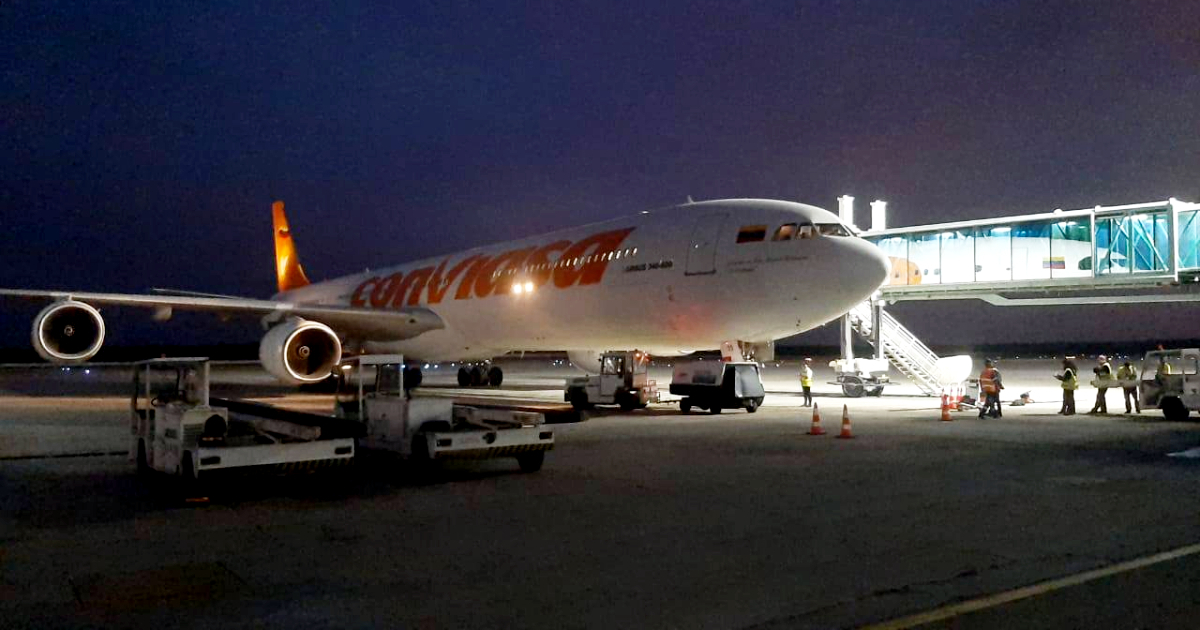
This past Friday, a Conviasa airline flight from Venezuela touched down at Varadero's Juan Gualberto Gómez International Airport, carrying 220 Cuban healthcare professionals returning from their assignments.
State-run media outlets hailed this arrival as part of the regular cycle of professionals completing their missions or going on vacation, yet provided scant information about the specific circumstances surrounding their return.
The airport itself confirmed the flight's arrival through a social media post: “At this moment, a Conviasa airline flight has landed at our airport, bringing back home a team of 220 medical collaborators. Welcome back to Cuba!”
Additionally, the Cuban Medical Brigade in Venezuela shared on their official X account (formerly Twitter) that an “emotional ceremony” was held, led by Dr. Duniel López Góngora, to honor those departing on vacation and those concluding their missions in Venezuela.
During this event, as detailed in the communiqué, outstanding workers were acknowledged “for their dedication and humanitarian spirit,” using the traditional slogan “Mission accomplished!”
However, none of the official announcements address the challenging political and military environment currently affecting the region.
In recent weeks, tension has been rising in the Caribbean following the deployment of U.S. warships off the Venezuelan coast and threats of military intervention against Nicolás Maduro's regime.
In this context, the Cuban government has maintained complete silence regarding the fate of the thousands of collaborators who remain in Venezuela.
According to diplomatic sources and independent organizations, between 10,000 and 20,000 Cubans are currently engaged in medical, educational, and technical missions in Venezuela. Some sources suggest the number could be as high as 25,000, including those involved in intelligence, logistics, and military advisory roles.
The Cuban regime, however, does not release official figures or details about the agreements underpinning these missions, which are based on bilateral accords initiated in 2000 under the Chávez government.
Officially, the return of the 220 collaborators is portrayed as a routine rotation within the personnel program, but the lack of additional information raises questions.
No Cuban authority—neither the Ministry of Public Health (MINSAP) nor the Ministry of Foreign Affairs—has clarified whether this flight is part of a larger repatriation plan or precautionary measures amid potential escalations in Venezuela.
Meanwhile, regime-aligned social media has focused on the symbolic aspect of the return, with triumphalist messages and references to the “legacy of internationalist solidarity.”
For some analysts, this controlled communication mirrors the regime's typical response to external risks, avoiding any acknowledgment of situations that might be perceived as a withdrawal or a crisis of confidence with political allies.
Others interpret these flights as part of a gradual retraction strategy, aimed at reducing the exposure of civilian personnel amid the uncertainty surrounding the future of the chavista regime.
In reality, in stark contrast to the official discretion, the return of these 220 Cuban doctors occurs at a particularly sensitive time, as concerns grow about the safety and future of thousands of compatriots still present in Venezuela.
Neither MINSAP nor the Havana government has issued public statements regarding the number of active collaborators, the conditions of their stay, or emergency protocols. In the absence of transparent information, the regime's response remains one of silence to a situation that intertwines opacity, dependency, and risk.
Frequently Asked Questions About Cuban Medical Collaborators in Venezuela
Why did the 220 Cuban doctors return from Venezuela?
The return is officially presented as part of a regular rotation of personnel who either completed their missions or are taking vacations, although specific details about the circumstances remain undisclosed.
What is the current situation for Cuban collaborators in Venezuela?
The Cuban government has not provided any updates on the conditions or security of the thousands of Cuban collaborators still in Venezuela, amid rising regional tensions and potential military threats.
How many Cubans are currently working in Venezuela?
Estimates suggest that between 10,000 and 25,000 Cubans are working in Venezuela, involved in medical, educational, technical, and other roles including intelligence and military advisory.