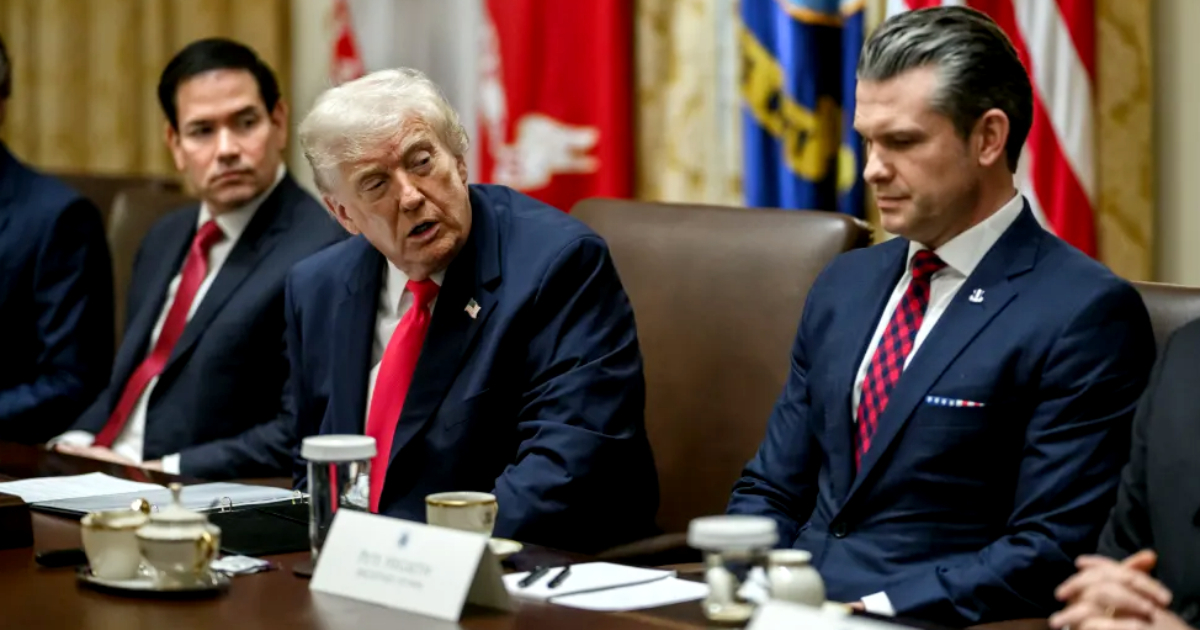
On Friday, President Donald Trump of the United States confirmed the imminent commencement of ground assaults in Venezuela, signaling a new phase of Operation Southern Spear. This military and intelligence campaign, according to Washington, aims to dismantle drug trafficking networks throughout the Caribbean and South America.
"We're now starting on the ground, and on the ground is much easier. That's going to start happening. We will not allow these people to destroy our youth, to destroy our families," Trump stated from the White House, as reported by CNN.
While the President did not provide detailed specifics on the scope or targets of the incursions, sources from the Pentagon indicated that U.S. forces are already positioned for rapid operations both within and around Venezuelan territory.
This announcement comes just two days after Trump accused the regime of Nicolás Maduro of "allowing thousands of criminals to leave Venezuela for the United States" and of "exporting murderers."
According to figures cited by Trump, "11,888 murderers" have reportedly entered U.S. territory from Venezuela as part of the irregular migration flow.
"Maritime drug trafficking has decreased by 92%, and we will achieve the same on land," Trump asserted, referring to the success of naval operations that have destroyed 23 suspect vessels and resulted in the deaths of at least 87 alleged drug traffickers since September.
Heightened Tensions with Colombia
During the Friday press conference, Trump extended his message to include a direct warning to Colombia, traditionally a close U.S. ally in security matters.
"Colombia is producing a lot of drugs. They have cocaine factories... so they better wake up, or they'll be next. I hope they're listening," the President stated, visibly upset, in a message implicitly directed at Colombian President Gustavo Petro.
These remarks were interpreted as a public warning of potential operations within Colombian territory, heightening tensions throughout the region.
Analysts suggest that Trump's message redefines the geopolitical reach of the offensive, transforming what was initially a campaign against Venezuela into a hemispheric strategy of selective intervention under the banner of the "war on drugs."
Venezuela's Response to Threats
The Venezuelan government labeled Trump's statements as an "imperialist threat." Defense Minister Vladimir Padrino López commanded the Armed Forces to "maintain maximum combat alert" and assured that "any aggression against Venezuelan territory will receive a forceful response."
Simultaneously, Venezuela's Foreign Ministry lodged a complaint with the United Nations, accusing Washington of "using anti-drug rhetoric as a pretext for military intervention" and called for an urgent Security Council meeting.
The U.S. Secretary of State, Marco Rubio, asserted, "Maduro is not a president but a criminal indicted by a grand jury in New York," referencing the 2020 narcoterrorism charges filed in the Southern District of Manhattan. "It's not an opinion; it's an undisputed indictment," Rubio emphasized.
Implications of Military Escalation
The White House insists that the offensive is aimed at neutralizing criminal individuals and networks, not targeting sovereign states.
Nevertheless, the military deployments and presidential rhetoric indicate a regionalization of the conflict, with Cuba and Nicaragua expressing support for Maduro's government and warning that "any aggression against Venezuela will be an aggression against all of Latin America."
With U.S. troops stationed less than 200 miles from Venezuela's shores, the Caribbean is witnessing its most significant military tension since the 1989 invasion of Panama.
Trump, however, remains defiant: "We know where the bad guys live. We found them at sea, and soon we'll find them on land."
FAQs on U.S. Military Actions in Venezuela
What is Operation Southern Spear?
Operation Southern Spear is a U.S. military and intelligence campaign aimed at dismantling drug trafficking networks in the Caribbean and South America.
Why is the U.S. targeting Venezuela?
The U.S. is targeting Venezuela as part of its strategy to combat drug trafficking, accusing the Maduro regime of facilitating criminal activities that affect U.S. national security.
What could be the impact of these military actions on the region?
The military actions could heighten regional tensions and lead to a broader conflict involving several Latin American countries.