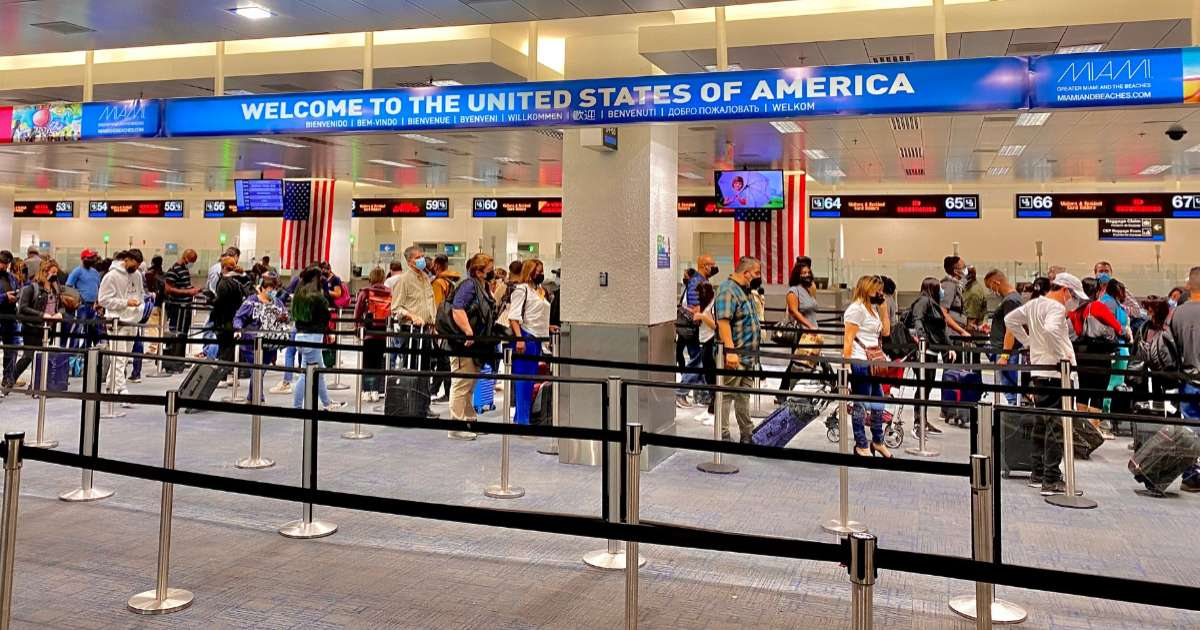
The Trump administration has intensified its immigration enforcement strategies by sharing the names of all air travelers in the United States with Immigration and Customs Enforcement (ICE). This initiative aims to identify and apprehend deportable individuals directly at airports.
As reported by The New York Times, the Transportation Security Administration (TSA) has been supplying ICE with passenger lists multiple times a week since March. This collaboration enables ICE to cross-reference data and deploy agents at airports to carry out arrests.
The process involves comparing passenger names against databases of individuals with outstanding deportation orders. While the exact number of arrests facilitated by this method remains unspecified, a former ICE official noted that in his region, 75% of those flagged by the program were indeed apprehended, according to the report.
A notable instance involves Any Lucía López Belloza, a 19-year-old college student, who was detained on November 20 at Boston's Logan Airport while attempting to board a flight to surprise her family in Texas. She was deported to Honduras two days later.
This disclosure aligns with the Department of Homeland Security's (DHS) official narrative. DHS Secretary Kristi Noem has hailed "historic advances" in immigration control. She cited that since January 20, 2025, over 2.5 million irregular migrants have left the U.S., including 605,000 deported and 1.9 million who departed voluntarily.
Noem attributed these achievements to a significant policy shift from the previous administration, asserting that President Trump has refocused DHS on its "core missions," ensuring what she described as "the most secure border in history."
The extensive use of passenger data is part of broader measures tightening immigration control and expanding state surveillance. These policies have faced increasing criticism for their impact on civil rights, privacy, and due process, especially when arrests occur unexpectedly in public spaces like airports or during domestic travel.
ICE has invested over $1.4 billion in contracts with technology companies to enhance its surveillance capabilities, including facial recognition systems, social media monitoring, and mobile phone hacking software.
Additionally, ICE will implement an artificial intelligence system developed by Signal Labs to track and analyze users' activities on social media. This system will identify immigrants through posts, images, locations, and personal traits visible in photos or videos. The software is also capable of detecting trends, recognizing physical features, and generating automatic alerts for ICE.
This AI system could streamline the process of locating and detaining immigrants, even those without criminal records or prior government system entries. It may lead to quicker arrests and deportations, intensifying the pressure on immigrant communities already living under a climate of surveillance and fear.
Understanding the Impact of Data Sharing on Immigration
How does sharing passenger data with ICE affect immigration enforcement?
Sharing passenger data with ICE allows the agency to cross-reference traveler information with deportation orders, leading to targeted arrests at airports, thus enhancing immigration enforcement efforts.
What technologies are being used by ICE to improve surveillance?
ICE is utilizing technologies like facial recognition, social media monitoring, and mobile phone hacking software. It is also deploying an AI system from Signal Labs for tracking and analyzing social media activities.
What are the potential implications of these immigration policies?
The policies can lead to increased arrests and deportations, potentially infringing on civil rights and privacy, and fostering a climate of fear among immigrant communities.