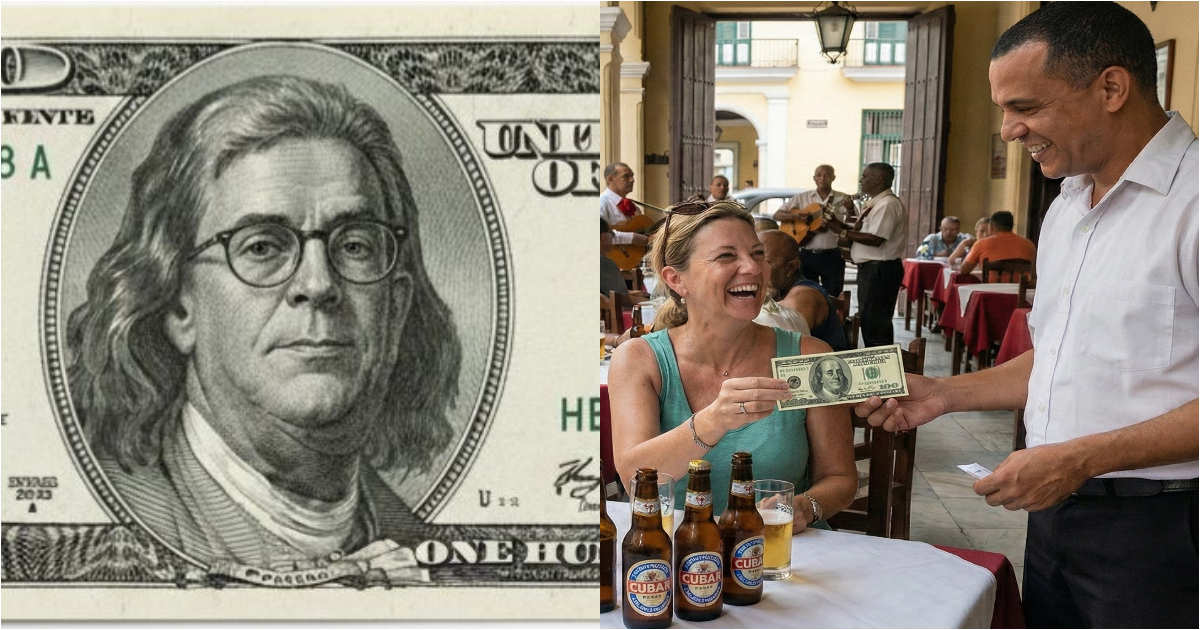
Comedian Ulises Toirac has once again stirred up social media by humorously suggesting the creation of the "pesolar," a fictional currency that satirizes the monetary confusion in Cuba following recent governmental statements about pricing and dollar transactions.
In a post on his Facebook profile, Toirac reacted to the discussions sparked by the Mesa Redonda program aired this Thursday. During the broadcast, the Minister of Economy and Planning, Joaquín Alonso Vázquez, addressed the "unbelievable price of beer" and the "discovery" that tourists could pay in restaurants with dollars.
Against this backdrop, Toirac proposed abolishing the Cuban peso, "a national currency that holds no value in the nation," along with the dollar, which he quipped is not national "even if they want to forcibly nationalize it."
"Let me introduce the pesolar," Toirac wrote, pairing his words with a caricatured image of a $100 bill where his face humorously replaces that of Benjamin Franklin, one of the Founding Fathers of the United States, enhancing the satirical tone of his critique.
Public Reaction and Satirical Comments
The post ignited a stream of similarly ironic comments. Some users proposed alternative names for the currency, others jested about its supposed artistic and heritage value, while many took the opportunity to mock what they see as a shallow economic analysis by the authorities.
Some even imagined that with the "pesolar," it might finally be possible to buy solar panels, portable batteries, or vacation in luxury hotels—a hyperbole that underscores the gulf between official rhetoric and everyday reality.
Context of Monetary Policy in Cuba
Toirac's post comes amid recent explanations from government officials regarding the new foreign exchange management system, which has been defended on state television as a way to channel dollars into the state budget without "dollarizing" the economy.
However, for many Cubans, this narrative merely confirms an existing reality characterized by the chaotic coexistence of currencies, unrealistic exchange rates, and an ever-depreciating Cuban peso.
With humor and sarcasm, Toirac has once again highlighted the issues, turning into a joke what is a daily experience of economic hardship and contradiction for the population.
Legal Framework and Economic Implications
Recently, the Cuban regime introduced further measures for the legalization of internal transactions in dollars and other foreign currencies through the enactment of Decree-Law 113/2025 and a series of supplementary resolutions from the Ministry of Economy and Planning (MEP) and the Central Bank of Cuba (BCC).
According to the government, the new system aims to organize and regulate foreign currency operations, improve control, and define legitimate ways to access foreign currency within the country.
The objective is also to increase foreign currency revenues through exports and foreign investment and to make the management of these currencies more efficient in the national economy. Legalization allows non-state actors to open foreign currency bank accounts, facilitating imports, service payments, and transactions. This includes micro, small, and medium enterprises (MSMEs), cooperatives, self-employed workers, artists, creators, agricultural producers, and individuals with magnetic cards and access to foreign funds.
Nonetheless, the content of Decree-Law 113 reveals a nearly identical continuity with the policies of former Minister Alejandro Gil Fernández, who was recently tried for corruption and espionage.
Both models share the same ideological rhetoric, centralized approach, and effects of inequality and state control over foreign currencies.
Understanding Cuba's Pesolar and Monetary Policies
What is the "pesolar" proposed by Ulises Toirac?
The "pesolar" is a satirical fictional currency proposed by comedian Ulises Toirac to mock the monetary confusion in Cuba. It highlights the absurdity of the current economic situation and government policies.
How did the public react to Toirac's post about the pesolar?
The public reaction was filled with irony and humor, with many users suggesting alternative names for the currency and making jokes about its supposed value, highlighting the disconnect between official narratives and daily life.
What does Decree-Law 113/2025 entail for Cuba's economy?
Decree-Law 113/2025 aims to regulate foreign currency transactions within Cuba, facilitating legal access to foreign funds for non-state actors and attempting to boost foreign currency inflows through exports and investment.