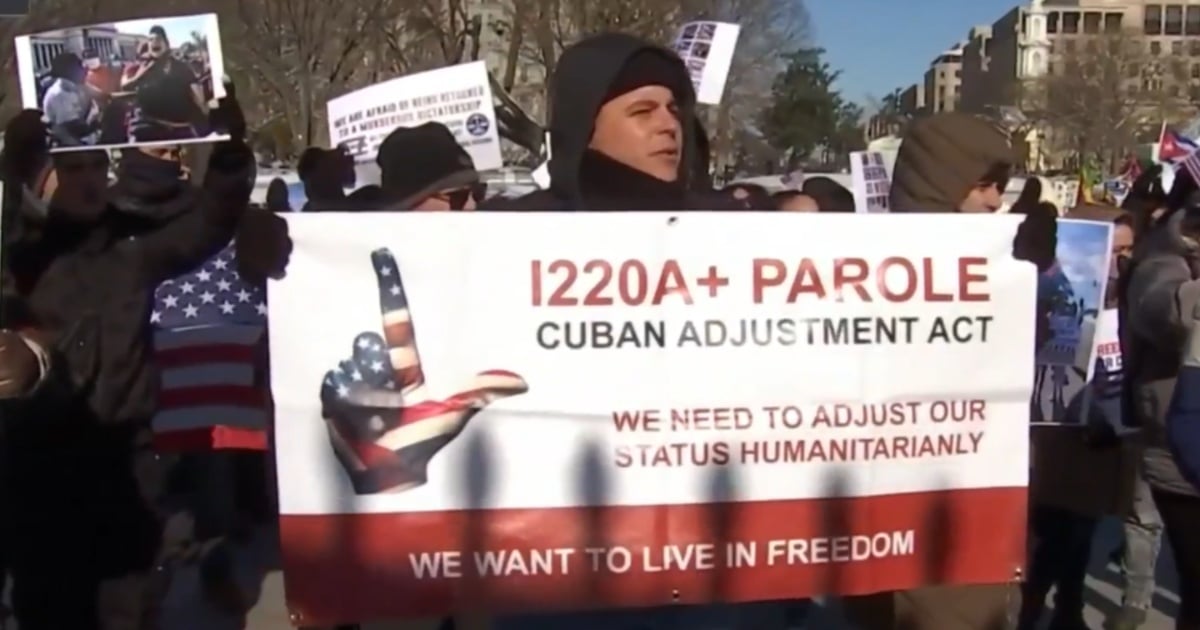
A positive ruling from the 11th Circuit Court of Appeals regarding the consolidated cases discussed this Friday—pertaining to individuals released with I-220A—could pave a legal path to argue these releases were incorrectly processed. The court might interpret that they should have been treated as a parole or its legal equivalent.
This would directly impact the ability to adjust status, particularly for Cubans under the Cuban Adjustment Act, as explained by attorney José Guerrero in an interview with journalist Javier Díaz.
During the hearing, the appellant's lawyer, Mark Prada, argued that these individuals were given "the wrong paperwork." If detained under section 235, the appropriate mechanism for release should have been a parole 212(d)(5), not an I-220A. A judge purportedly stated that the government issued "the incorrect document" to those affected.
Should this perspective prevail, the court could establish that these releases "constituted a parole" or should be treated as such. The challenge would then be how the government adopts and implements this decision.
Potential Beneficiaries
Attorney Ismael Labrador, in a conversation with journalist Mario J. Pentón, detailed that only three states and Cubans residing within the 11th Circuit in Atlanta would benefit directly. "Individuals living in other states can certainly use this as a persuasive argument before immigration judges to attempt case closure. However, the direct beneficiaries remain those in Georgia, Alabama, and Florida," he stated.
For Cubans living in other states, Labrador recommended staying informed. "This decision could assist you, but it won't directly impact your case nor carry full weight," he advised.
Significance for Cubans
José Guerrero noted that a positive outcome might benefit other nationalities released with I-220A. Nonetheless, Cubans would see the most advantage due to the Cuban Adjustment Act, allowing for residence application after one year and one day of physical presence if admission or parole exists.
For I-220A holders, particularly Cubans, this would strengthen the legal argument currently lacking: having a recognized parole to meet the adjustment requirement.
The interview highlighted that no decision has been made yet, and "nothing has changed" at this point: the oral hearing was what took place.
Moreover, Guerrero cautioned that even with a favorable ruling, the government might appeal to the Supreme Court and request a stay to halt the implementation while the appeal is litigated.
Thus, the community's impact may not be immediate, contingent upon (1) the ruling's exact content, (2) any appeal, and (3) whether a "stay" is granted during the proceedings.
Timeline for a Decision
Guerrero mentioned that the court could decide "as soon as Monday" or take three to six months (typically "weeks or months"), without a set deadline, so there's anticipation but no certainty about the date.
The attorney explained that judges challenged the government with logic-based questions, emphasizing the inconsistency of enforcing the "harsh" part of the process (detention under a specific section) and then denying the corresponding legal mechanism for release, illustrated with an example cited in the interview.
He also described Prada's presentation as "masterful," expressing a "glimmer of hope" from the tone of questioning, though cautioning against viewing it as a foregone conclusion.
According to the interview, a favorable ruling could mean: Judicial endorsement of the claim that I-220A was incorrectly processed in these cases. The possibility that the court decides the release amounts to a parole (or should be treated as such), crucial for adjustment. Potential benefits for other nationalities with I-220A but a stronger impact on Cubans due to the Cuban Adjustment Act. A scenario where the government appeals and seeks to temporarily halt the ruling's implementation, extending uncertainty.
Key Questions About the I-220A Court Decision
What is the significance of a parole ruling for I-220A holders?
A parole ruling would mean that individuals released with I-220A would be treated as having been paroled, strengthening their legal argument for status adjustment, especially under the Cuban Adjustment Act.
Who would benefit from a favorable court decision?
Direct beneficiaries would be Cubans and residents in Georgia, Alabama, and Florida, within the 11th Circuit. Others can use it as a persuasive argument in their cases.
How soon could a decision be expected?
The court could issue a decision as early as the following Monday or take several months, as there is no fixed timeline.