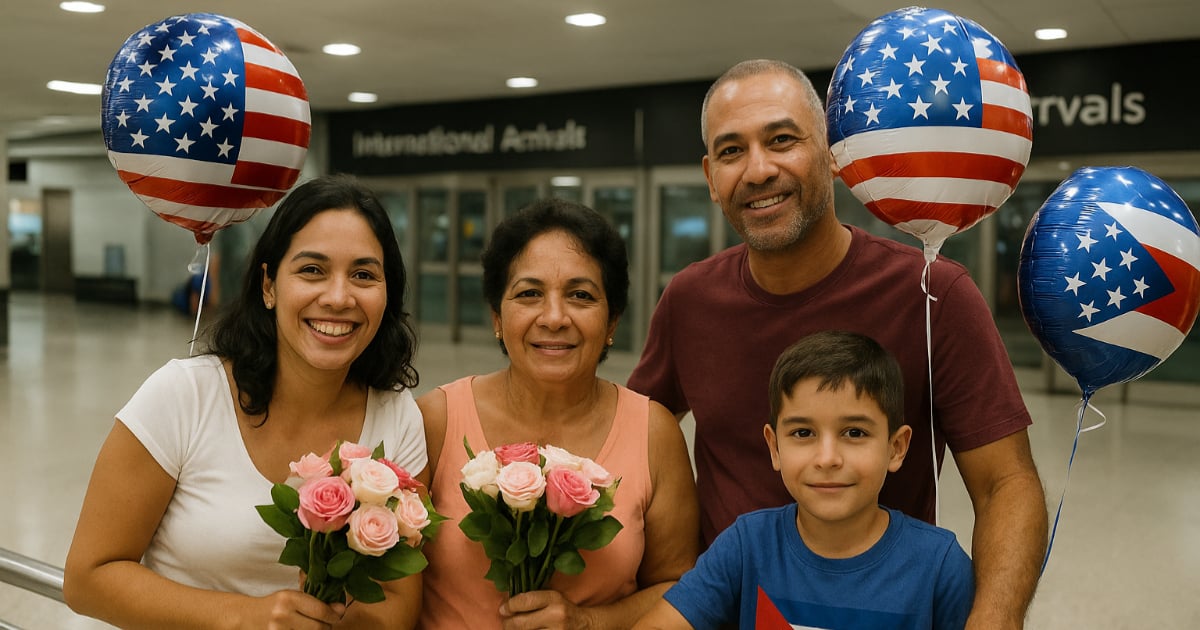
The United States Department of Homeland Security (DHS) announced on Friday the termination of all Family Reunification Parole (FRP) programs that were available to citizens of Cuba, Colombia, Ecuador, El Salvador, Guatemala, Haiti, and Honduras, along with their immediate family members.
This decision marks the end of a system that allowed applicants to temporarily enter the U.S. while processing their immigration applications, under a mechanism known as humanitarian parole.
The official DHS statement emphasized that the measure is aimed at "ending the abuse of the humanitarian parole process" and restoring the original case-by-case review process as envisioned by the U.S. Congress.
The agency highlighted that the FRP programs had enabled the entry of foreigners without thorough security checks or complete background investigations, posing what it considered an unacceptable risk to national security.
"Temporary residence permission was never intended to be used in this way, and DHS is reinstating the case-by-case granting of these permits. The cancellation of the FRP programs is a necessary return to common-sense policies and the 'America First' principle," the statement declared.
DHS defended its decision by pointing out that the programs had security loopholes that could be exploited by "wrongdoers and fraudsters." The department underscored that the government's priority is "the security, protection, and financial and economic well-being of Americans."
Impact and Immediate Consequences for Beneficiaries
According to the notice published in the Federal Register, temporary residence permits granted under the FRP programs will be canceled on January 14, 2026, unless the beneficiary has a pending Adjustment of Status Application (Form I-485) filed on or before December 15, 2025.
If there is a pending application, the permit will remain valid until it expires or until DHS makes a final decision on the case. Should the application be denied, the permit will be revoked, and the individual will be required to leave the United States immediately.
Furthermore, once the permit is canceled, any employment authorization derived from it will also be revoked. DHS stated that it will notify each affected individual personally.
The department advised foreigners without legal grounds to stay in the country to leave the United States before their permit expires. Those who voluntarily depart can report their exit through the CBP Home application, and in certain cases, may be eligible for incentives such as exit bonuses, financial assistance, and help with travel documents.
Understanding Changes to the Family Reunification Programs
Why is the U.S. terminating the Family Reunification Parole programs?
The U.S. Department of Homeland Security is ending these programs to eliminate the abuse of the humanitarian parole process and restore the original intent of case-by-case review, which was designed to ensure national security.
What will happen to those currently holding a permit under the FRP programs?
Permits will be canceled on January 14, 2026, unless there is a pending Adjustment of Status Application. If denied, the permit will be revoked immediately, and the individual must leave the U.S. promptly.
Are there any incentives for those who voluntarily leave the U.S.?
Yes, individuals who voluntarily exit the U.S. may be eligible for incentives such as exit bonuses, financial support, and assistance with travel documentation.