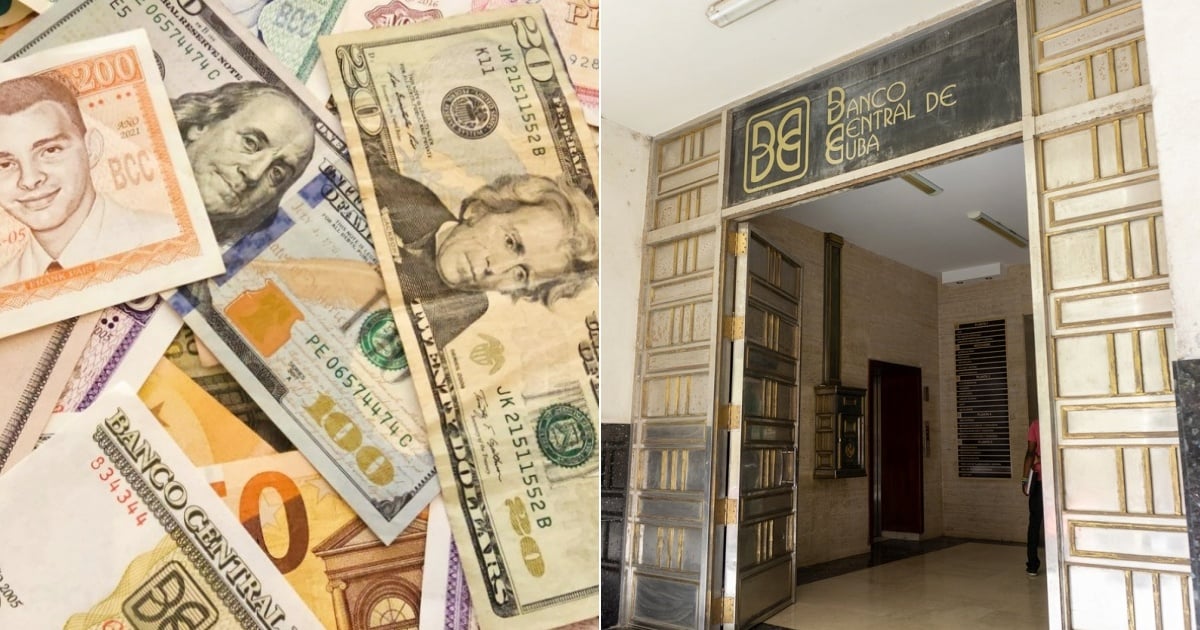
This Thursday, the Cuban regime has taken a significant step towards formalizing internal transactions in dollars and other foreign currencies by enacting Decree-Law 113/2025, alongside a set of supplementary resolutions from the Ministry of Economy and Planning (MEP) and the Central Bank of Cuba (BCC).
Slated to commence on December 17, 2025, the new system establishes a legal framework to manage, control, and allocate foreign currencies within the nation's economy, paving the way for a partially institutionalized dollarization.
While officials claim this is a "temporary" measure, the structural depth and regulatory detail suggest a lasting transformation of Cuba's monetary system, explicitly acknowledging the circulation of foreign currencies—such as the dollar and euro—within its borders.
"This decree-law facilitates currency transactions in our country," stated Minister Joaquín Alonso Vázquez. He further commented, "We are not building capitalism through partial dollarization; we are building a socialism tailored to our nation's characteristics."
A Departure from the "Monetary Reorganization" Model
The new legal framework signifies a break from one of the cornerstones of the 2021 "Monetary Reorganization," which had declared the Cuban peso (CUP) as the sole valid currency for all internal transactions.
Now, the Central Bank itself can authorize the use of other currencies as legal tender, while the MEP will have exclusive authority to determine who can operate using foreign currencies.
This represents an unprecedented relaxation of the national monetary system, transforming access to the dollar from a tolerated anomaly into a regulated privilege administered by state institutions.
Key Aspects of the New System
1. Authorization of Dollars and Other Currencies within Cuba
The Decree-Law empowers the Central Bank to recognize currencies other than the Cuban peso as legal tender, officially breaking with the CUP's exclusive principle.
This move legalizes the internal use of foreign currencies, not just in state retail commerce, but also in economic relations among authorized national actors.
2. Economy Minister to Approve Currency Transactions
The MEP will centralize the authority to approve foreign currency transactions within the nation.
This centralization enables control over who can transact in dollars, under the pretext of "organizing the currency management and allocation system."
In practice, access to foreign currencies becomes an administrative privilege rather than an economic right.
The ACAD: A New Monetary Rationing System
One of the decree's main tools is the creation of the Currency Access Capacity Allocation (ACAD).
This mechanism allows authorized companies and individuals to purchase foreign currencies directly from the state using Cuban pesos, provided there are available funds in the central reserve.
"This economic actor operates in Cuban pesos, so when they receive authorization, they must purchase those currencies," explained Juana Lilia Delgado Portal, president of the BCC.
The ACAD replaces liquidity capacity accounts (CL) and targets entities that do not generate foreign currencies themselves but need them for strategic functions.
Essentially, it's a state-controlled hard currency rationing system, with its usage being non-transferable and temporary.
Legalization of Foreign Currency Accounts for Non-State Actors
Another key novelty is the authorization of foreign currency bank accounts for non-state economic actors, including:
- Micro, small, and medium enterprises (MSMEs).
- Cooperatives.
- Self-employed individuals.
- Artists, creators, and agricultural producers.
- Individuals with magnetic cards and access to foreign funds.
Eligible income sources include exports, e-commerce with foreign payments, sales in MLC, international transfers, and donations.
These accounts can be used for importing, paying for services, making withdrawals or transfers, all under the control of the Central Bank and the MEP.
Mandatory Currency Retention: The State Takes a Cut
The system stipulates that non-state entities can retain a maximum of 80% of foreign currency income, with the remaining 20% to be surrendered to the state, which will convert it to CUP at the official exchange rate (currently 1 USD = 120 CUP).
For certain income types (such as donations or capital contributions), 100% retention is permitted, but this always depends on the source and economic plan authorization.
This measure ensures the state retains a portion of all foreign currency circulating within the economy, reinforcing its control over hard currency flow, even in the private sector.
Internal Payments in Foreign Currencies and Legalized Dual Economy
The Decree-Law also legalizes payments in dollars or euros within the country, provided the actors are authorized.
These payments are allowed:
- In the Mariel Special Development Zone (ZEDM).
- In wholesale and retail commerce operations in foreign currencies.
- In commercial relations between exporters and their national suppliers.
- In other specific cases approved by the MEP.
This formalizes the existence of two economic circuits in Cuba: one rooted in the Cuban peso, and another more profitable and efficient, based on foreign currencies.
The direct consequence is a segmented economy, where only those with access to dollars can operate with flexibility and competitiveness.
Political Justification: Dollar-Controlled Socialism
Despite the apparent opening, the official narrative emphasizes its temporary nature.
According to Delgado Portal:
"A temporary period is set because we have not renounced the goal of restoring a monetary environment where the Cuban peso is the core of the monetary and financial system."
The legal framework appeals to Article 4 of the Constitution to justify this measure as a means to "protect national interests" and maintain state control.
However, the decree does not specify any date or condition for reversing the measure, hinting at a prolonged coexistence of currencies.
Real Impact: Institutionalization of Economic Inequality
The enactment of Decree-Law 113/2025 marks the formal institutionalization of partial dollarization in Cuba, which had already been occurring de facto since the creation of MLC stores.
Now, the model is legal, structured, and centrally managed.
The Cuban peso is relegated to domestic functions without real capacity to compete with the dollar as a unit of value.
Only authorized economic actors can access foreign currency, widening the gap between those who operate in the profitable economy and those left out.
MSMEs or individuals without foreign currency access will be marginalized, along with vulnerable social sectors reliant on the internal CUP market.
Conclusion: Administered Socialism with a Dollar Twist?
The new currency management, control, and allocation system redraws the economic rules in Cuba.
It legalizes and regulates internal dollar circulation, making its access a commodity managed by the state, and establishes a multi-currency framework where the CUP survives subordinate to foreign currencies.
Although presented as a technical tool to stabilize the economy, the decree represents a redefinition of the Cuban economic model: one where socialist planning coexists with regulated dollar use, but without genuine liberalization.
The medium-term challenge will be to balance efficiency and equity in an increasingly segmented and controlled economy, where the dollar is no longer an anomaly... but a state policy.
Understanding Cuba's New Currency System
What is the significance of Decree-Law 113/2025?
Decree-Law 113/2025 marks a pivotal change by allowing the use of foreign currencies within Cuba, signaling a shift towards a partially dollarized economy managed by state institutions.
How does the Currency Access Capacity Allocation (ACAD) work?
The ACAD is a mechanism that allows authorized entities to purchase foreign currencies directly from the state using Cuban pesos, provided funds are available, effectively rationing hard currency access.
What impact does the new system have on non-state actors?
Non-state actors can now open foreign currency accounts, enabling them to engage in international transactions, although they must share a portion of their earnings with the state.
Will the Cuban peso lose its importance in the new system?
While the Cuban peso remains a valid currency, its role is diminished as the system increasingly recognizes foreign currencies, potentially sidelining the CUP in favor of more profitable transactions.