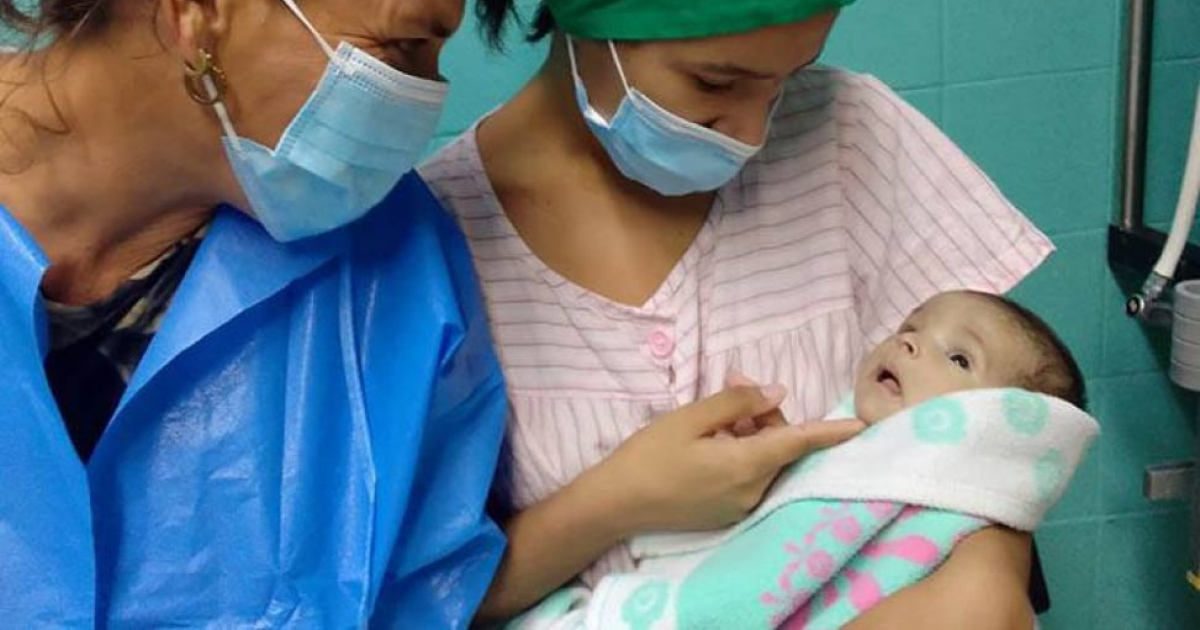
Little Maylom Martínez Abreu was discharged on Tuesday from the José Ramón López Tabrane Gynecology and Obstetrics Hospital in Matanzas. His journey began even before he was born, leading to a 63-day hospital stay and a fierce battle for survival.
During pregnancy, Maylom contracted chikungunya vertically and spent 46 days on a ventilator. His condition was so dire that many doubted he would pull through, according to his doctors.
Amid an out-of-control health crisis in Cuba, Maylom's recovery is nothing short of miraculous.
The Neonatology Service at the Matanzas hospital took charge of his care. The dedicated team of pediatricians, neonatologists, intensivists, physiatrists, nurses, and physiotherapists pushed their limits to keep the newborn alive. He was born under fetal distress, with meconium aspiration, and against a backdrop of confirmed arbovirus.
Maylom's mother, Litzaidis de la Caridad Abreu Piña, arrived at the hospital with a high fever and tested positive for chikungunya at 38.5 weeks of pregnancy, necessitating an emergency C-section.
Weighing in at 3,910 grams (8.62 pounds), Maylom was immediately placed on mechanical ventilation due to his precarious health. On his second day, he experienced disseminated intravascular coagulation, a critical condition for any newborn.
According to Dr. Liliana Amieva Ruiz, head of Neonatology, the situation served as a learning experience for the entire service, as they had never handled a chikungunya-positive case in a neonate before.
Dr. Amieva Ruiz praised the efforts of physiatrist Adisnay González Rodríguez, who, despite having recently battled chikungunya herself, helped address Maylom's joint stiffness caused by the virus, ultimately allowing for his extubation.
A Bright Spot Amidst a Healthcare Collapse
Maylom's discharge comes as Cuba grapples with one of its worst public health crises in recent years. The arbovirus epidemic, primarily chikungunya and dengue, has overwhelmed a deteriorating healthcare system plagued by severe shortages, lack of personnel, and countless patients deprived of adequate care.
On Tuesday, the Ministry of Public Health acknowledged that nine minors remain in critical condition due to arbovirus-related issues. Overall, 71 people are in serious or critical condition. Despite these alarming statistics, the authorities maintain a "positive" outlook on the cases, which starkly contrasts with the reports from families and healthcare workers about medication shortages, hospital overcrowding, and basic service deficiencies.
Official figures fail to inspire confidence. Cuba has reported over 42,000 arbovirus cases since the outbreak began, yet only 1,462 have been PCR-confirmed, highlighting the diagnostic limitations in a system where laboratories operate on a shoestring budget, and many clinics can only assess clinical symptoms.
The death toll also raises concerns: the government has reported 44 official deaths from chikungunya and dengue, including several minors. Authorities have been slow to acknowledge fatalities, fueling suspicions of underreporting, reinforced by family accounts of unreported cases.
While the population endures fever, pain, and mosquitoes without access to fumigation or insecticides, the government has shifted blame onto citizens for not taking personal measures, instead of addressing the collapse of vector control campaigns and resource shortages to tackle the outbreak.
A Glimmer of Hope
In this grim scenario, Maylom's discharge is a beacon of hope—a testament to human determination triumphing over resource scarcity and institutional neglect. The medical team that cared for him didn't have the luxury of abundant resources or ideal conditions. They operated in the same hospitals criticized daily by patients and professionals for lacking basic supplies, antibiotics, diagnostic tools, and even water.
Maylom's recovery is undoubtedly a cause for celebration for his family and the healthcare professionals who tended to him. However, it also serves as a poignant reminder of the vulnerability faced by thousands of children suffering from fever in homes without medication, forcing families to improvise treatments, and a healthcare system that claims "victory" while reality paints a different picture.
Maylom survived. Not everyone is as fortunate.
FAQs about Chikungunya in Newborns in Cuba
What is vertical transmission of chikungunya?
Vertical transmission refers to the passing of the chikungunya virus from mother to child during pregnancy, childbirth, or right after delivery.
How critical is disseminated intravascular coagulation in newborns?
Disseminated intravascular coagulation (DIC) is a severe condition characterized by the widespread activation of clotting mechanisms, leading to clot formation and bleeding. It is particularly critical in newborns and requires immediate medical intervention.
What are the main challenges facing Cuba's healthcare system during the arbovirus outbreak?
Cuba's healthcare system is currently dealing with deteriorating hospital infrastructure, extreme shortages of supplies, a lack of medical personnel, and inadequate patient care amid the arbovirus outbreak.