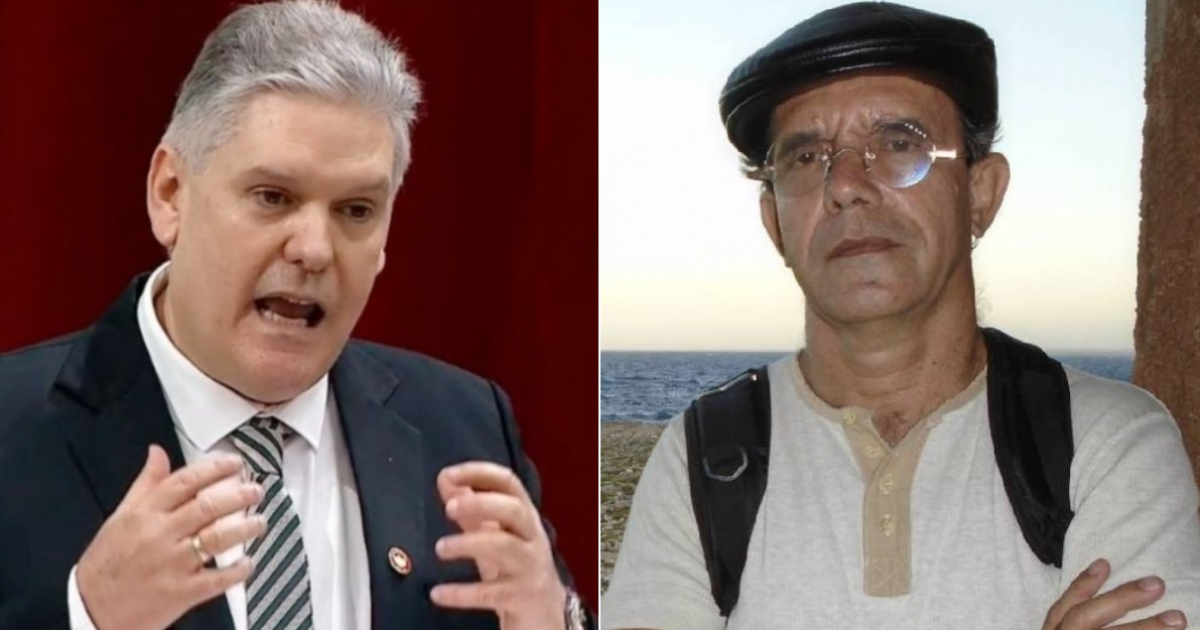
The life sentence handed down to former Cuban Minister of Economy and Planning, Alejandro Gil Fernández, has sparked a wave of public scrutiny. Among the critics is writer and humorist Jorge Fernández Era, who has condemned the political, opaque, and manipulative nature of the judicial process against the ousted official.
Fernández Era recalled warning Gil back in December 2020 about the impending failure of the so-called "Ordenamiento" economic reform, the institutional paralysis, and the inaction of the National Assembly in the face of governmental decisions.
At the time, Fernández Era questioned how a parliament that "claims to represent us" could fail to exert even the slightest pressure or oversight on policies affecting the entire population.
Now, following the sentence, the writer asserts that the ruling has more to do with the government's need to create a "useful scapegoat" to obscure the economic collapse and moral decay of the system than with any genuine pursuit of justice.
"He has been made a scapegoat to provide a veneer of 'legality' over the moral and ethical degradation that the irreversible crisis on the Island has caused," Fernández Era criticized on Facebook.
He also condemned the official silence that surrounded the process for a year and a half, only to later coincide the prosecution's charges with the aftermath of Hurricane Melissa, and then announce the verdict amid an energy crisis.
The life sentence, announced by the Supreme Court, accuses Gil of espionage, corruption, bribery, forgery of public documents, influence peddling, tax evasion, and other crimes tied to the handling of classified information.
Yet, Fernández Era argues that the official discourse is riddled with deliberately crafted gaps to shield the government from accountability. In his post, he questions the charges: What personal gains did Gil receive? What foreign firms were involved? Which public officials were bribed? Why were they not prosecuted as well?
He also highlights the contradiction in portraying the ex-minister as a "lone supervillain" while no auditing body, including the Comptroller's Office, detected any irregularities for years.
The intellectual ridicules the official narrative that Gil "deceived the country's leadership," reminding readers of a public commendation from Miguel Díaz-Canel himself for the minister's supposed dedication.
In his view, such narratives aim to shield the state elite by depicting Gil as an all-powerful infiltrator, while leaving the rest of the political structure unscathed.
"If the trial proved he put classified information 'at the enemy's disposal,' isn't this the chance to expose how the northern neighbor operates? What prevents sharing details with the public, the main victims of the ex-minister's excesses?" Fernández Era questions.
"Ten million Cubans could testify in a truly fair trial where the entire government should be on the dock, but the vast judicial and police apparatus only acts when those at the top command," he added.
Concluding his remarks, the humorist asserts that the Cuban state has been "corrupt by nature" since 1959, due to its lack of accountability to its citizens, and that the "useless" National Assembly "prostitutes itself in a continuous act of subservience."
"We barely survive in a country designed for leaders, in their 'devotion,' to act at will and thrash about to stay on top. So that power perpetuates itself without chains," he stated.
Understanding the Political Climate in Cuba
What are the main accusations against Alejandro Gil?
Alejandro Gil faces accusations of espionage, corruption, bribery, forgery of public documents, influence peddling, tax evasion, and mishandling of classified information.
Why does Jorge Fernández Era criticize the government?
Jorge Fernández Era criticizes the government for using Gil as a scapegoat to divert attention from the country's economic and moral crises, and for the lack of transparency and accountability in the judicial process.