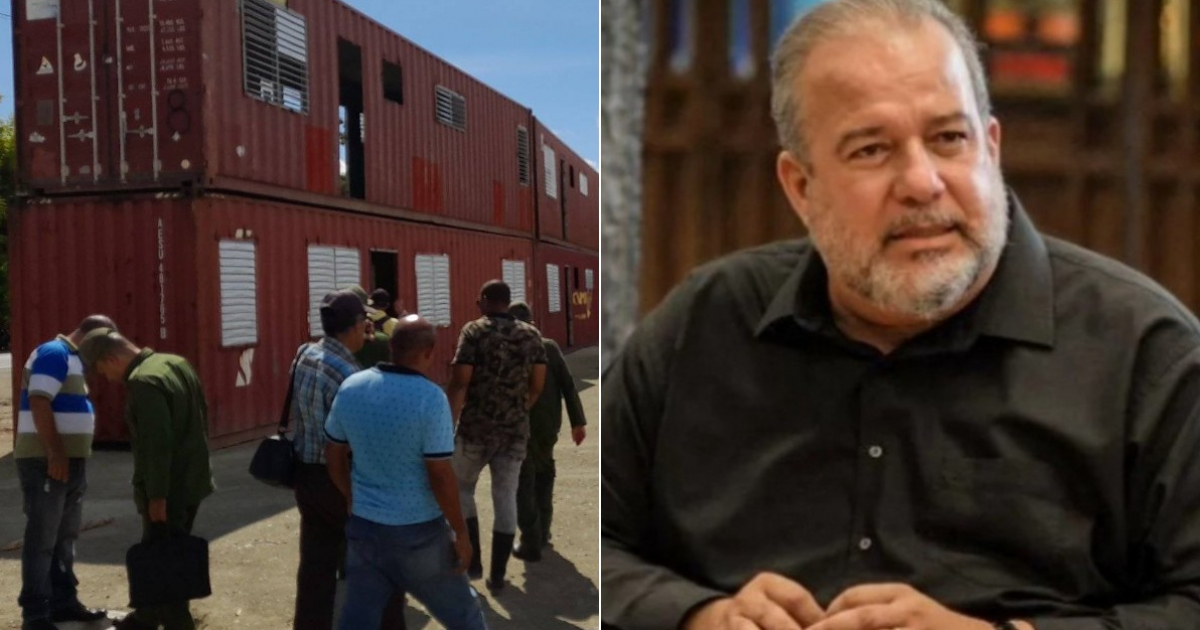
The Cuban administration is once again proposing the transformation of shipping containers into homes as a solution to the country's severe housing shortage.
This initiative comes directly from Prime Minister Manuel Marrero Cruz, who has called for the acceleration of this strategy in the Granma province, as reported by the newspaper Granma.
The announcement coincides with the plight of thousands of families who are living in collapsing buildings, overcrowded conditions, and temporary shelters that have become permanent. Despite these dire circumstances, Cuban authorities continue to push for quick fixes that fail to address the underlying structural issues.
The eastern province has joined the state program to convert shipping containers into residential units, a strategy orchestrated by the Ministry of Construction (Micons) to combat the housing deficit.
In Jiguaní, five residential units are being developed from containers, each equipped with a living room, kitchen-dining area, bathroom, and two bedrooms.
The Granma Construction and Assembly Company has assured that each module will include main and service entrances and will be allocated to families deemed "priority": those affected by hurricanes, mothers with three or more children, and workers in "essential" sectors.
The authorities have promoted this so-called "cargotecture" as a "fast" and "sustainable" option, arguing that these metal structures—designed for extreme conditions—can reduce construction time compared to traditional methods and fit within a circular economy framework.
They also emphasized that technical quality will be crucial to ensure "comfort," though they did not specify standards, control mechanisms, or realistic delivery timelines.
Marrero himself has urged the use of all available containers to expedite the plan, given a context where demand far exceeds the state's capabilities.
However, this announcement comes amidst a nationwide rollout of a policy that has already met with resistance in several provinces.
The government continues to promote containers as an "immediate alternative," despite the fact that, in the Cuban climate, these structures become extremely hot and require a level of thermal insulation that the authorities do not guarantee.
This measure is part of a rushed effort already underway in Santiago de Cuba, where more than 137,000 homes have collapsed—in part due to Hurricane Melissa—forcing an acceleration in the conversion of containers into "emergency housing."
During a government visit led by Miguel Díaz-Canel on December 5, officials acknowledged that demand exceeds any existing capacity and that critical cases are on the rise. Nonetheless, they avoided providing concrete targets or timelines for how many modules will be made available or when they might genuinely alleviate the crisis.
Recent events have shown increasing public discontent.
An article in the newspaper Ahora, in Holguín, which described these structures as "secure, resilient, and dignified homes," sparked a wave of criticism: from mothers who claimed that "this is like cooking a person alive" to engineers who warned that without proper insulation and anchorage, they are "solar ovens" susceptible to hurricanes and flooding.
Readers also pointed out that, although container homes exist in other countries, they adhere to strict insulation and climate control standards, which are not mentioned in Cuba.
Just weeks ago, the government admitted the failure of the national container housing program, despite having released over 1,700 units for this purpose and the fact that progress has been excruciatingly slow.
Despite acknowledging these shortcomings, the government remains committed to expanding the same approach.
Meanwhile, the housing crisis continues to deepen, leaving thousands of families waiting for genuine solutions.
Against this backdrop, the official push to convert containers into permanent homes not only highlights the absence of a structural and sustainable plan but also perpetuates a cycle of improvised responses that fail to address the accumulated deterioration over decades.
Understanding the Housing Crisis in Cuba
Why is the Cuban government turning to shipping containers for housing?
The Cuban government is using shipping containers as a quick and supposedly sustainable solution to address the severe housing shortage caused by years of neglect and recent natural disasters.
What are the challenges of using container homes in Cuba?
Container homes in Cuba face significant challenges, including extreme heat due to insufficient thermal insulation and vulnerability to hurricanes and flooding, issues that the government has not adequately addressed.
How has the public reacted to the container housing policy?
The public has largely reacted negatively, criticizing the lack of proper insulation and climate control, with many viewing these homes as inadequate and unsafe in the Cuban environment.