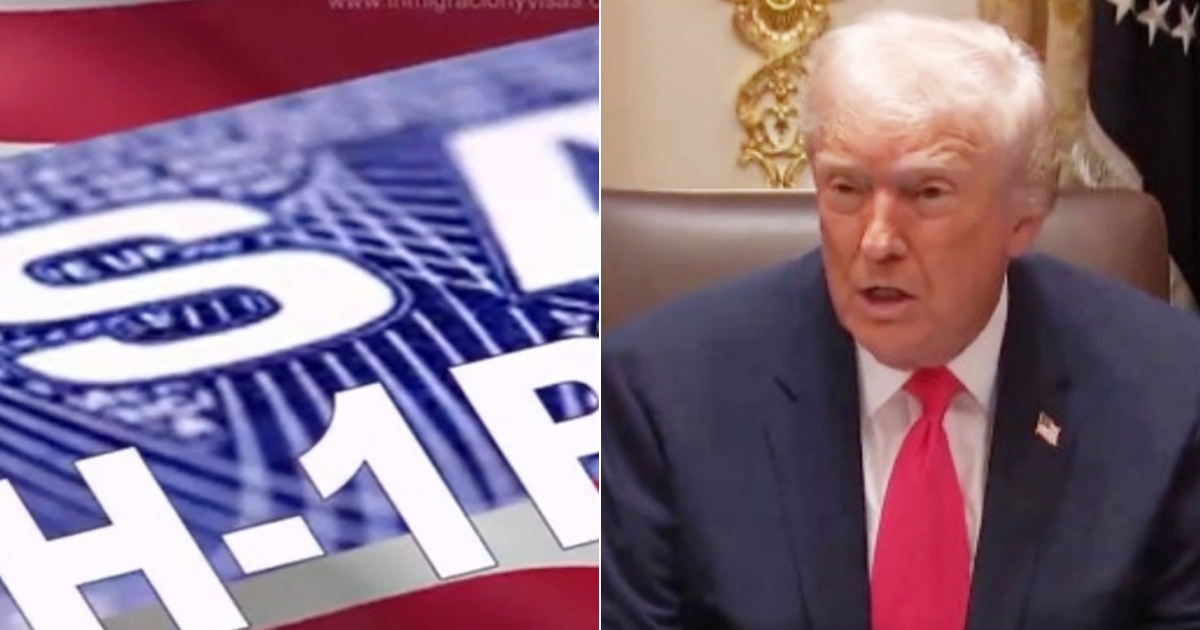
The administration under Donald Trump has unveiled a fresh initiative targeting what it perceives as restrictions on free speech in the United States. This time, the focus is on applicants for H-1B visas, particularly those who have previously engaged in roles involving content moderation, fact-checking, or digital trust and safety functions on tech platforms.
An internal memo from the Department of State, circulated to U.S. diplomatic missions earlier this month and exclusively revealed by Reuters, instructs consular officials to meticulously examine the work histories, resumes, and LinkedIn profiles of applicants and their relatives to identify any potential ties to activities deemed as censorship.
According to the directive, if evidence reveals that an applicant "was responsible for or complicit in the censorship or attempted censorship of protected expression in the United States," a visa ineligibility ruling must be issued under a section of the Immigration and Nationality Act.
Who is Under Scrutiny?
While the cable indicates that all visa applicants are subject to this level of scrutiny, it particularly emphasizes H-1B visas, noting that holders "frequently work in the tech sector, including social media or financial services entities involved in the suppression of protected expression."
The directive specifically calls for thorough investigations into whether applicants have participated in activities such as:
- Fact-checking
- Content moderation
- Preventing disinformation or false narratives
- Enforcing digital community standards
- Working in trust and safety (T&S) departments
The administration's stated goal is to prevent foreign workers from entering the U.S. to "silence Americans."
"We do not support bringing foreigners to the United States to work as censors and silence Americans," a State Department spokesperson stated, refusing to verify the leaked document.
"Previously, the president himself was a victim of such abuse when social media companies blocked his accounts. He doesn't want other Americans to suffer similarly," the spokesperson added.
The Ideological Motivation: A Battle Against "Censorship"
This policy is part of a rhetorical campaign by Trump and his allies against what they perceive as a systematic suppression of conservative voices on tech platforms.
After being banned from Twitter and Facebook for his role in the January 6, 2021, Capitol riot, the former president has consistently argued that major tech companies engage in ideological censorship.
Throughout the presidential campaign and during joint events with Elon Musk, Trump has championed free speech as a key issue.
In May, Secretary of State Marco Rubio warned that the U.S. might restrict visas for "foreign officials and individuals complicit in the censorship of Americans."
Moreover, the new approach extends beyond blocking social media profiles. The State Department has also increased scrutiny of applicants' digital activities, requiring them to make their social media accounts public for consular review.
Legal and Tech Sector Concerns
Experts in free speech and digital rights have expressed alarm over this measure.
Carrie DeCell, senior attorney at the Knight First Amendment Institute, criticized that "those who study misinformation and work on content moderation teams are not engaging in 'censorship'; they are participating in activities the First Amendment was designed to protect."
DeCell described the policy as "incoherent and unconstitutional."
Concerns also arise from the tech industry. Alice Goguen Hunsberger, who has led trust and safety teams at companies like OpenAI and Grindr, stated: "I am alarmed that trust and safety work is being conflated with 'censorship.'
Hunsberger emphasized that these departments focus on protecting minors from child sexual abuse material (CSAM), preventing fraud, scams, and sextortion, and making the internet a safer space.
To achieve this, she noted, it's crucial to have professionals from diverse countries who understand multiple languages and cultural contexts.
A Clash of Freedoms and Borders
The Trump administration's approach presents a paradox: while claiming to defend free speech, it targets those who legally work to curb abuses and illegal content online.
It implements an immigration filter based on ideological and occupational criteria that, according to experts, could lead to discriminatory and potentially unconstitutional outcomes.
This policy may significantly impact the U.S. tech sector, which heavily relies on international talent.
H-1B visas are vital for companies hiring skilled personnel in fields like software engineering, cybersecurity, or artificial intelligence.
Many of these workers have held or aspired to positions in content moderation and digital trust, precisely the roles now stigmatized.
Ironically, Trump has expressed support for the H-1B program in recent interviews.
In a discussion with Laura Ingraham, when she questioned the influx of foreign workers, the former president replied: "We also need to bring in talent."
Days later, he reaffirmed to business leaders that the U.S. needs skilled immigrants to train domestic workers in high-tech factories.
A New Front in the Cultural War?
This measure, beyond its immigration implications, can be seen as a new front in Trump's cultural battle against the tech establishment.
By equating fact-checking with censorship and treating moderators as threats, his administration presents a vision of digital discourse where content control is seen as an ideological attack rather than a necessary regulatory tool.
As his presidential campaign advances, such initiatives send a clear message: those who work to contain misinformation—in the name of safety or ethical journalism—could face penalties.
And for foreigners aspiring to work in these fields in the U.S., the message is clear: watch what you've done before, or you might be barred from entry.
Understanding the H-1B Visa Screening Changes
What is the new policy regarding H-1B visa applicants?
The new policy involves a detailed review of H-1B visa applicants' work history and social media profiles to identify any involvement in activities considered as censorship, which could lead to visa ineligibility.
Who is primarily affected by this new screening process?
The focus is on H-1B visa applicants who have worked in content moderation, fact-checking, or digital trust and safety roles, particularly in the tech sector.
Why is this measure being implemented?
The administration aims to prevent foreign workers from entering the U.S. to engage in activities that could be seen as silencing Americans, under the guise of protecting free speech.
What are the potential impacts on the U.S. tech sector?
This policy could deter international talent crucial for roles in software engineering, cybersecurity, and AI, potentially affecting the tech industry's reliance on skilled foreign workers.