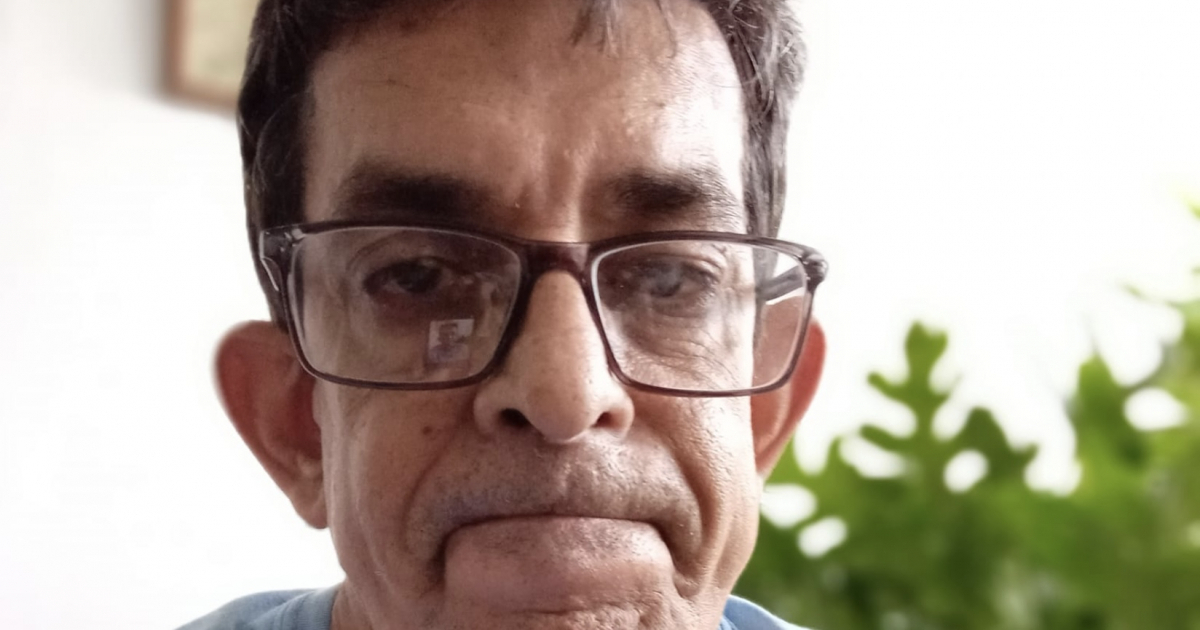
Cuban comedian Ulises Toirac has once again stirred social media with a candid and sharp critique regarding Qatar's donation of $4.5 million aimed at repairing parts of the National Electric System (SEN) in Havana, Artemisa, and Mayabeque.
Through a Facebook post, Toirac dismantles official celebrations and exposes, using a direct metaphor, the crux of the issue: the SEN isn't just slightly damaged; it's in such disarray that it barely holds together with makeshift solutions.
Toirac acknowledges the significance of the aid—"you don't just find $4.5 million lying around"—and expresses gratitude for Qatar's contribution, echoing the sentiments of many Cubans.
However, his analysis quickly turns into a raw depiction of the decades-long neglect, patchwork solutions, and improvisations by the Cuban government that have led to the deterioration of the electrical system.
Using a homely analogy—comparing the SEN to a pair of shoes that are repeatedly patched up until they're beyond repair—Toirac illustrates a cycle of negligence that has pushed the system to the brink of collapse.
"Those shoes are done for, my friend," he declares. "That's what's happening with the SEN. No amount of makeshift solutions can hold it together now."
The actor emphasizes that restoring such a complex system requires substantial funding, a comprehensive plan stretching over more than seven years, and unwavering political will—none of which have been present.
"But focus and get it done, because without electricity, there is no country. It's do or die," he stressed.
Toirac likens the $4.5 million from Qatar to "the cobbler fixing the first hole" when the entire shoe is coming apart, urging the government to temper its excitement: "Celebrate all you want. Be happy... But you still have no shoes, got it?"
The Qatar Donation: Another Lifeline for a Failing System
The Qatari donation, managed by the United Nations Development Program (UNDP), was presented as a humanitarian effort to restore essential services in areas affected by a hurricane in western Cuba. According to the Qatar Fund for Development, the project is set to benefit over 2.2 million people.
Yet, this aid highlights a familiar pattern: the Cuban regime's dependence on international funds to sustain its crumbling state infrastructure without implementing long-term solutions or structural changes.
While resources are managed by multilateral organizations, they ultimately bolster a state apparatus unable to independently maintain the power grid, healthcare services, or production chains. Meanwhile, Cubans continue to endure daily blackouts, ill-equipped hospitals, and an energy system on the verge of failure.
A Cycle of Temporary Solutions
The Qatari donation adds to other recent aid—like food distributions from the World Food Program—disbursed under strict government control with no independent oversight. For many critics, these financial infusions are temporary fixes that allow the state to justify inaction, delay necessary reforms, and manage the crisis as if it were just a fleeting issue.
In this context, Toirac's voice stands out as it challenges the official rhetoric of "gratitude" and points to the issue that those in power refuse to acknowledge: what's missing is not just money, but a genuine plan.
Until such a plan materializes, every foreign donation will merely serve as another patch on a system that can no longer be held together by makeshift solutions.
Understanding the Implications of Qatar's Aid to Cuba
What was the purpose of Qatar's $4.5 million donation to Cuba?
Qatar's donation was intended to help repair parts of Cuba's National Electric System in Havana, Artemisa, and Mayabeque, as part of a humanitarian effort to restore essential services following a hurricane.
How does Ulises Toirac view the donation from Qatar?
Ulises Toirac views the donation as a temporary fix for a deeply flawed system. He criticizes the Cuban government's neglect and lack of a comprehensive plan to address the underlying issues.
What are the broader implications of international aid for Cuba?
While international aid provides temporary relief, it often highlights Cuba's dependence on external funds to maintain its infrastructure. This reliance hinders the implementation of long-term structural changes necessary for sustainable development.