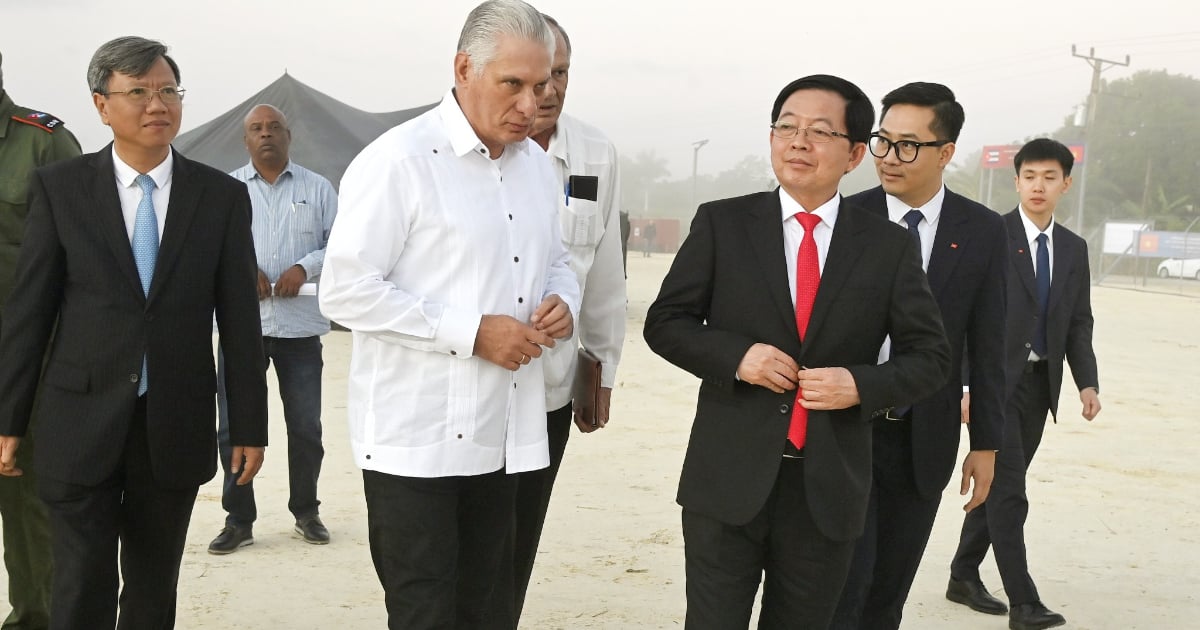
In Cuba, miracles last only as long as it takes for the power to go out again. On December 2nd, as Miguel Díaz-Canel swapped his "emergency" olive green uniform for a crisp white guayabera to inaugurate a solar park in Mayabeque, the national electrical system decided to pay tribute to the leader's casual attire by shutting down once more.
The day before, an article on CiberCuba titled "Why Does Díaz-Canel Wear a Military Uniform in His Latest Public Appearances?" sparked ridicule, criticism, and outrage among readers on the outlet's Facebook page.
Comments flooded in: "The blackouts leave him no time to iron his guayaberas"; "It's the campaign against Aedes aegypti"; "His wife doesn't do his laundry"; "A uniform doesn't make him a commander, just like a guayabera doesn't make him civilized."
Image consultants at the Palace, avid readers of CiberCuba, hastily removed the National Defense Council uniform from the designated leader and presented him the next day in a spotless white guayabera, signaling that the Communist Party's first secretary indeed has someone to iron his attire.
The scene—both symbolic and unfortunate—unfolded during the political-cultural event organized by the Presidency to commemorate the 65th anniversary of diplomatic relations between Cuba and Vietnam.
Amid flags, brotherly speeches, and meticulously lit enthusiasm, a starched Díaz-Canel and Vietnamese Deputy Prime Minister Ho Quoc Dung laid the "first stone" of the "Vista Alegre" photovoltaic park.
Just hours after his dapper appearance, the entire western region of the island went dark.
The Irony of Progress: Solar Park and Power Outages
According to a triumphant post by the official Presidential account on social media, the day was "memorable for the nation's history."
Indeed, it was memorable, but not for technological advancement. Rather, it was the almost poetic coincidence between the debut of a solar park and the collapse of the national power system that stood out.
While the leader spoke of "new energy victories" and expressed gratitude for Vietnamese donations, the Electric Union announced—without the poetry—the disconnection of the island's western half, from Pinar del Río to Cienfuegos. Another "unforeseen interruption" that by now has become a national routine.
The absurd contrast was so stark that Cuban humor needed no effort: the headline was enough to ignite social media. "Díaz-Canel dons a guayabera and the country goes dark," users quipped amidst memes and blackouts.
Theatrical Change: From Military Green to Civilian White
The leader's change of attire also drew attention. After a month of public appearances in military dress—justified by reasons ranging from Hurricane Melissa to supposed "defense tasks"—Díaz-Canel reemerged in a white guayabera, against a backdrop carefully staged with solar panels and friendly flags.
Yet the guayabera, a symbol of tropical elegance and institutional calm, ended up being just another costume in the regime's attempt to project "control" amidst an energy crisis. As the leader spoke of "fraternity, brotherhood, and solidary cooperation," Cubans crossed their fingers, hoping the lights wouldn't go out prematurely.
The Empty Promises of Solar Power
Official discourse claims that the four solar parks donated by Vietnam—each with a capacity of 20 megawatts—"will contribute to improving the country's electricity generation." In reality, this contribution would cover less than 2% of the daily deficit of the system.
But the numbers matter little when the goal isn't electricity generation, but propaganda.
In a country where blackouts are measured in hours, not megawatts, the government continues to rely on ceremonies, anthems, and declarations of "unbreakable brotherhood." Whether there's light or not is secondary; what matters is that cameras are rolling.
A Nation in Permanent Darkness
Meanwhile, millions of Cubans endure a perpetual blackout—not just of electricity, but also of information and politics. The government's inability to resolve the energy crisis reflects the structural collapse of a system more reliant on speeches than kilowatts.
Díaz-Canel may change his uniform or his guayabera, and he may cite Raúl Castro, Ho Chi Minh, or "eternal brotherhood," but neither rhetoric nor donated panels are enough to light a bulb in Pinar del Río.
Ultimately, the only glow remaining is that of popular sarcasm, a sun that, unlike the regime, never dims.
Understanding Cuba's Energy Crisis and Political Symbolism
Why did Díaz-Canel switch from a military uniform to a guayabera?
Díaz-Canel's change in attire from a military uniform to a guayabera was likely an attempt by his image consultants to project a more civilian and relatable image amidst public criticism and ridicule over his previous choice of clothing.
What was the significance of the solar park inauguration?
The inauguration of the solar park was meant to highlight technological progress and international cooperation between Cuba and Vietnam. However, it ironically coincided with a major power outage in western Cuba, undermining the event's intended message.
How did Cuban citizens react to the blackout during the solar park event?
Cuban citizens reacted with humor and sarcasm on social media, mocking the irony of a blackout during the solar park inauguration. The headline alone sparked a wave of memes and jokes, underscoring the public's frustration with ongoing energy issues.