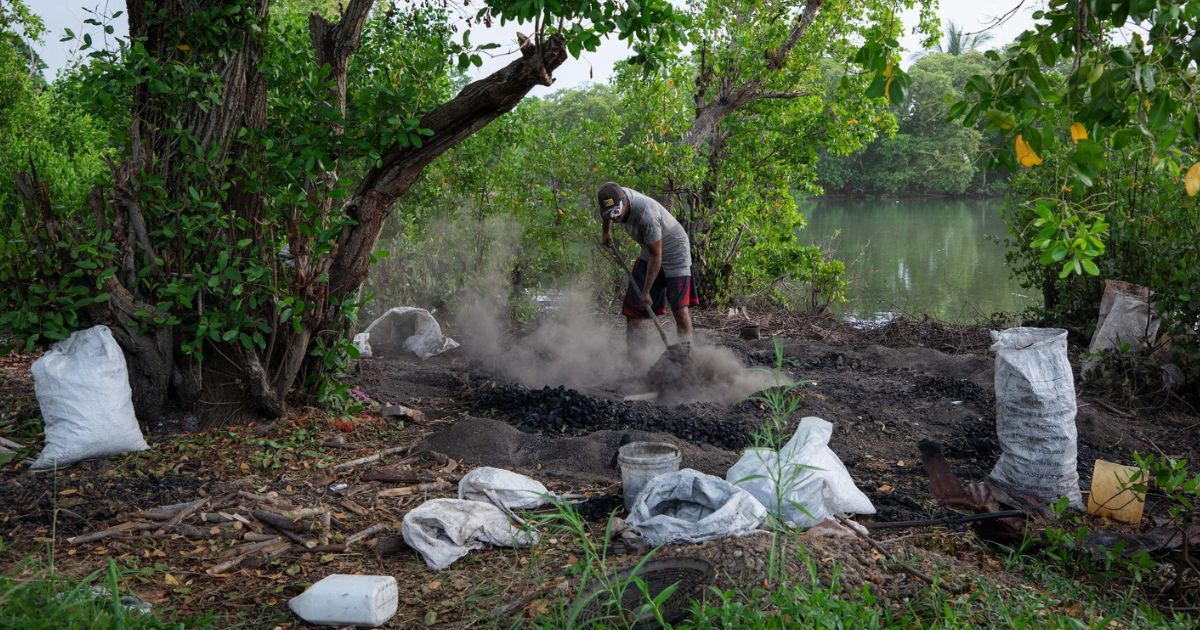
In the Yumurí Valley, smoke has become an integral part of the landscape. Amidst makeshift kilns and the sound of machetes, dozens of men are busy turning wood into charcoal, currently one of the most sought-after commodities in Cuba.
Raúl Navarro González, a journalist and photographer from the state-run newspaper Girón, captured the harsh realities of this trade on Facebook in a piece entitled “Today's Enterprise.”
What he describes is not a cherished tradition or a rural legacy, but rather a desperate solution in a nation crippled by constant blackouts and a lack of formal employment opportunities.
“Agriculture is no longer sustainable, and the nation grinds to a halt with endless power outages. As a result, charcoal has become the only quick-paying job in an economy where virtually nothing else is moving,” wrote the reporter, depicting a scenario where survival has overtaken economic planning.
In rural areas, men work covered in soot, tending to burning kilns through the night and inhaling smoke in exchange for a meager wage.
Meanwhile, in urban settings, families are spending up to 3,000 pesos monthly just to boil milk or brew coffee, as gas is scarce and electricity is available only sporadically.
What was once a rural resource has transformed into a nationwide business: intermediaries speculating, prices soaring, and an informal market supplying urban homes, where no one has the luxury to choose between cooking with electricity or charcoal.
Each bag sold on the street carries a tale of hardship: the farmer cutting down trees because farming is no longer viable, the mother searching for embers to heat food, and the smoke linking rural poverty with urban desperation.
“Charcoal — a regression no one chose — has become the sole means to sustain life amid the darkness,” Navarro concludes, offering an honest portrayal of the energy and economic crisis engulfing the country, beyond official propaganda.
Once a symbol of a rural and modest past, charcoal has become the driving force of Cuba's 2025: an industry born out of darkness, fueled by sweat, smoke, and necessity.
The rise of charcoal production in Cuba is not solely driven by domestic need but also by the regime's commercial interests. Recently, charcoal exports have increased, raising questions among Cubans about how the state can sell abroad a resource that is scarce for its own citizens.
This contradiction between domestic scarcity and international trade has exacerbated public discontent amid power outages and energy shortages.
The market distortion became even more apparent when authorities in Las Tunas offered charcoal and fans as "incentives" to baseball players, an act many saw as a mockery of the current economic collapse.
This incident not only highlights the inadequacy of state reward systems but also illustrates how charcoal has transitioned from a rural symbol to a practical currency valued across all social strata.
Charcoal Production and Economic Implications in Cuba
Why is charcoal production booming in Cuba?
Charcoal production is booming due to constant blackouts and lack of formal employment, making it a quick-paying job in a stagnant economy.
How does the Cuban government benefit from charcoal exports?
The government benefits from charcoal exports by generating revenue, despite the domestic scarcity of charcoal for local citizens.
What impact has the charcoal trade had on Cuban society?
The charcoal trade has deepened economic disparities and public discontent due to its role as a necessity in daily life amid energy shortages and market distortions.