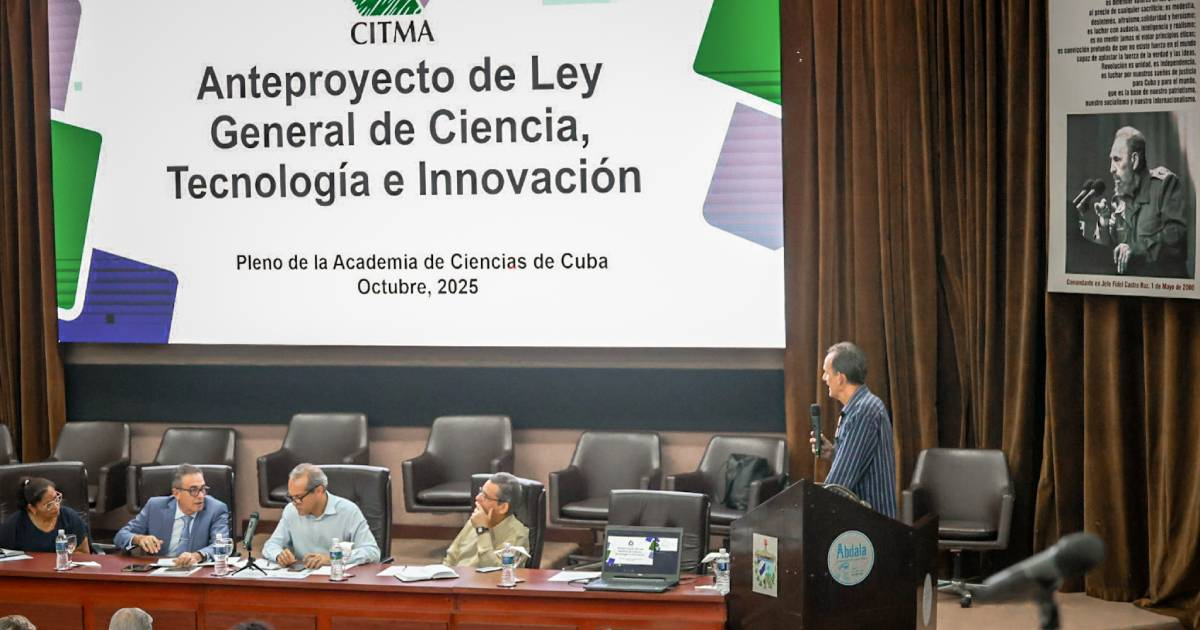
The Cuban government has unveiled a new draft of the General Law on Science, Technology, and Innovation. This legislation is touted as a means to "promote, develop, and regulate" scientific activities within the nation. However, it further entrenches a highly centralized model where the State maintains absolute control over research, knowledge production, and its dissemination.
Released on December 6 by the National Assembly, the draft is accompanied by an email for public input. This is part of the legislative process before the proposal is debated in Parliament next week.
Arriving at a time when the scientific sector is in sharp decline—characterized by low salaries, brain drain, outdated laboratories, and funding shortages—the law shuns greater institutional autonomy or openness. Instead, it reinforces the top-down command structure that governs science in Cuba.
The Ministry of Science, Technology, and Environment (CITMA) is reaffirmed as the governing body at all levels, endowed with the authority to coordinate, oversee, and manage policies, funds, and both national and territorial strategies. Consequently, any research initiative becomes a process subordinate to state planning.
The law defines science as a "public good serving socialism," emphasizing that every entity—from universities to private companies, cooperatives, local projects, and even independent scientists—must operate within a singular, regulated system, monitored and evaluated by the State.
While governance is described as planned and involving multiple actors, it remains under the leadership of CITMA and the Council of Ministers. Even scientific ethics are under state control, with bans on expressions that might "generate alarms or false expectations" and a requirement for discretion in research linked to economic, political, or national security objectives—categories that in Cuba, have a very broad scope.
A key component is the control over scientific information. The draft proposes creating a National Information System to integrate all publications, data, results, and indicators, administrated by CITMA.
Open science is mentioned rhetorically, but the digital infrastructure will be centralized, and all scientific output must pass through official channels, limiting editorial autonomy and independent circulation of knowledge.
The law's publication is accompanied by a call for "citizen participation," yet the process is limited to submitting opinions via email—a common practice in the National Assembly that seldom results in significant changes.
While the government attempts to project transparency, the law consolidates political control over a sector crucial for the country's development. This occurs in a context where many young scientists are leaving Cuba in search of better conditions, research freedoms, and genuine opportunities for innovation.
Parliament is set to review the proposal during its next session beginning on December 18. Should it pass, as is typical in Cuban politics, Cuban science will become even more subordinate to state logic, diminishing the margins for autonomy and deepening the reliance on a centralized model that has shown limited capacity to retain talent and foster sustainable advancements.
Cuban Science and Innovation Law: Key Questions
What is the main objective of Cuba's new science law?
The new law aims to promote, develop, and regulate scientific activities in Cuba under a centralized model where the State retains comprehensive control over research and knowledge dissemination.
How does the new law affect scientific autonomy in Cuba?
The law reduces scientific autonomy by reinforcing a top-down command structure, making all research initiatives subject to state planning and oversight.
Who oversees the implementation of this new law?
The Ministry of Science, Technology, and Environment (CITMA) is tasked with overseeing the implementation of the law, coordinating policies and strategies at all levels.